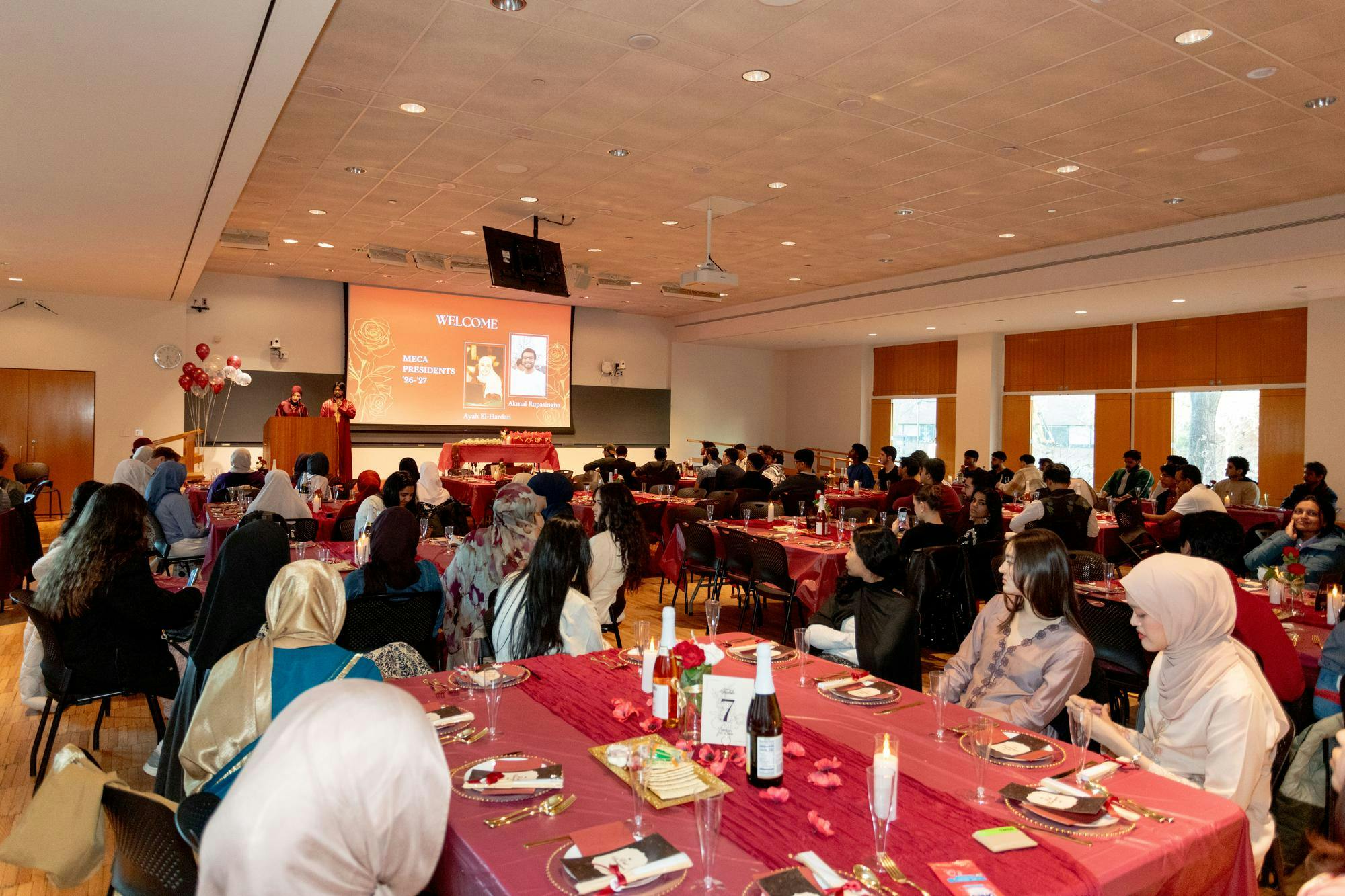
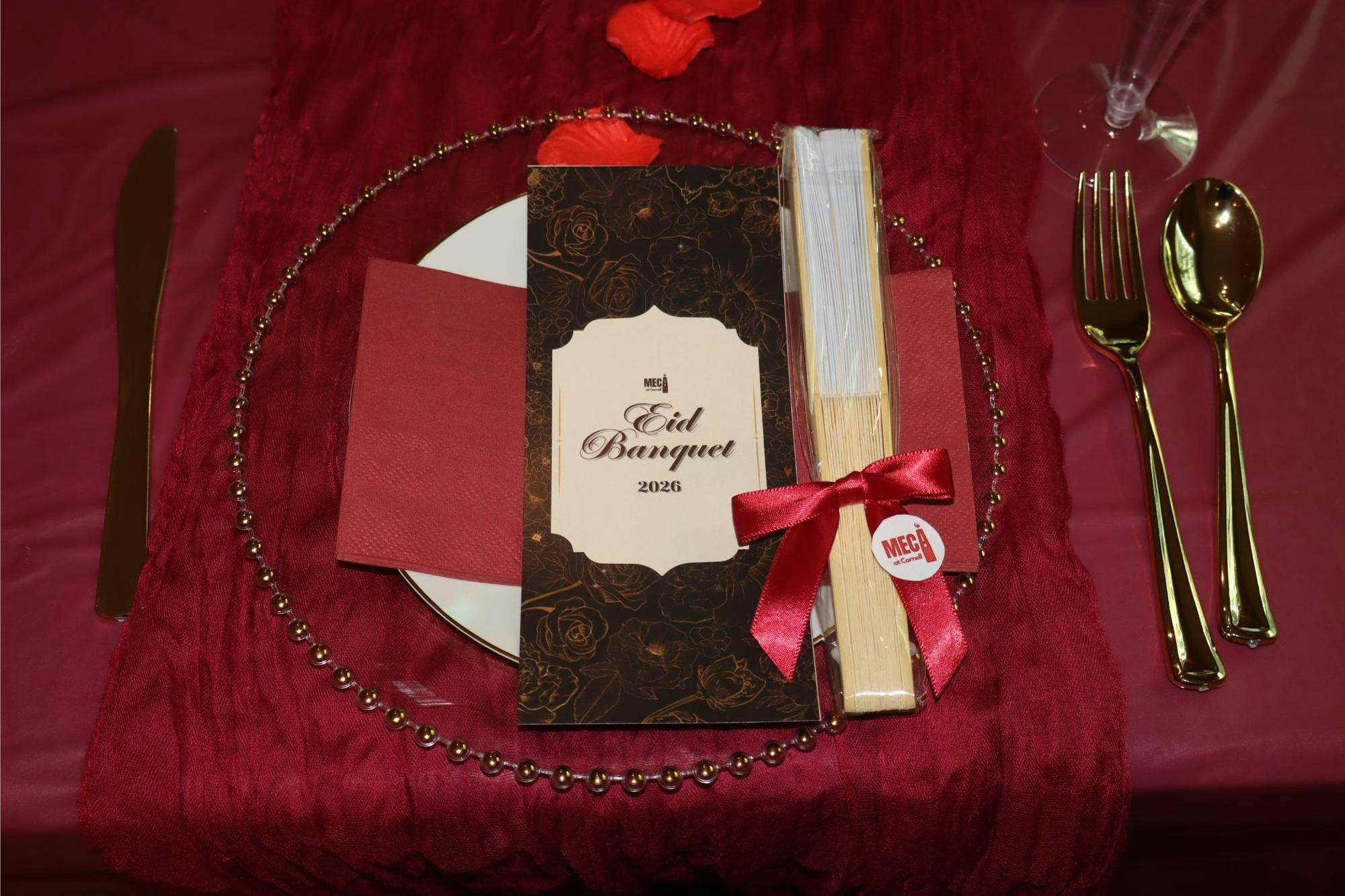
Seated at tables draped in shades of deep red, approximately 150 people attended Cornell’s Muslim Educational and Cultural Association’s annual Eid Banquet on Saturday evening to celebrate the end of Ramadan. The banquet included a formal dinner, keynote address, senior recognition ceremony, photo booth and game of Family Feud.
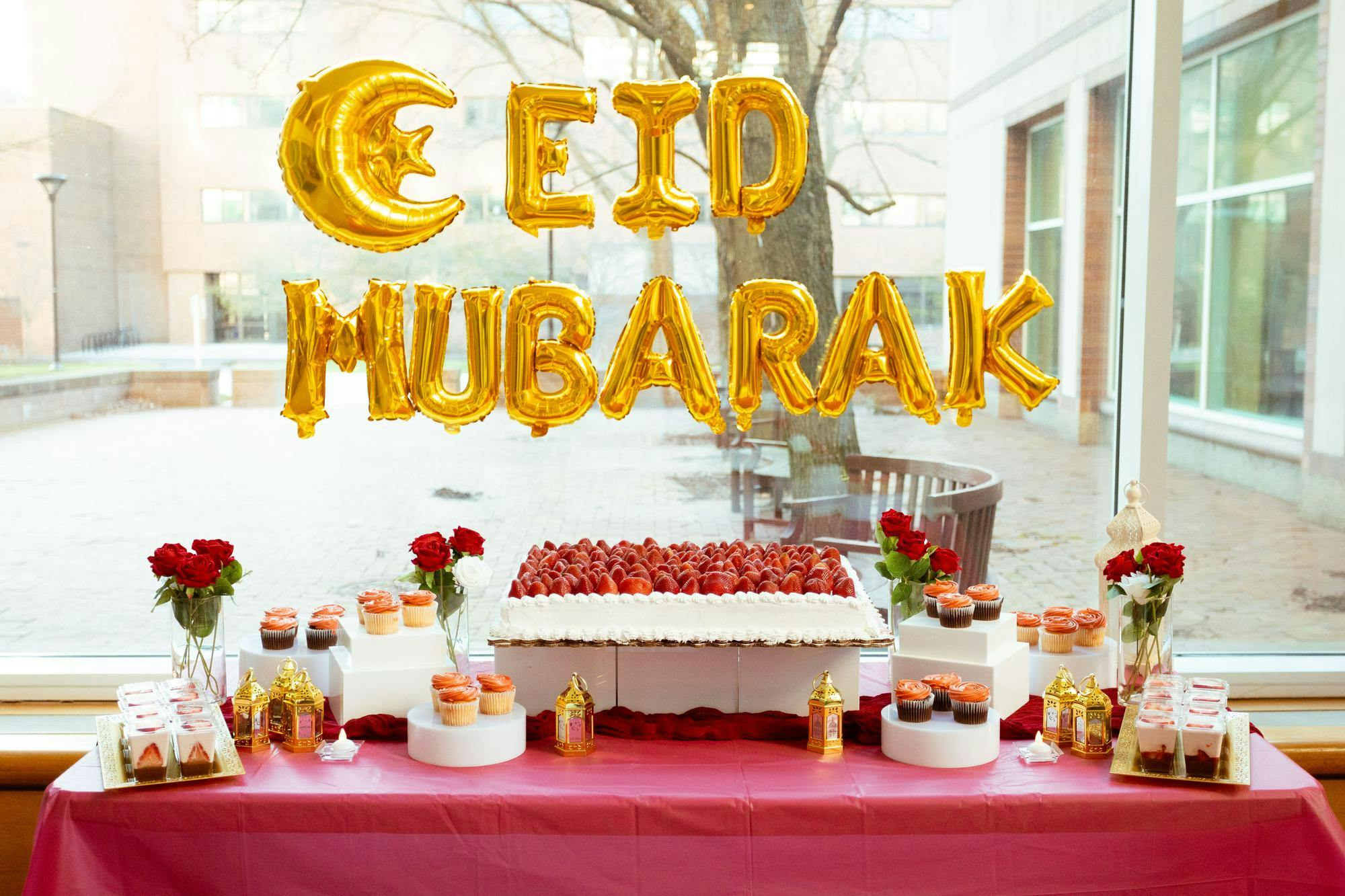
The event began at 6 p.m. in the Biotechnology Building, welcoming many guests dressed in formal and cultural attire to a room set with tables and formal place settings, decorated throughout with a maroon color theme.
Ramadan is the Islamic holy month during which Muslims fast from sunrise to sunset to spiritually reflect and hold solidarity with those less fortunate, and Eid al-Fitr is the celebratory holiday marking its end. This year, Eid fell on March 20, but MECA pushed its celebration back three weeks to accommodate spring break.
MECA Co-President Ayah El-Hardan ’27 said the event took months to organize. She added that MECA began making decisions on the banquet’s date, venue and color theme in the fall, while the “nitty-gritty planning” such as invitations, food orders and marketing began in February.
The event opened with MECA member Amr Elhady ’27 reciting specific verses from the Quran, which he said were selected for their message of hope during hardship. Elhady, who has memorized significant portions of the Quran, performed in the style of tajweed, the discipline governing precise articulation and intonation of Quranic recitation.
“Maybe someone in the crowd will hear this and they’ll think back to what they’re going through and be reminded that there is hope,” he told The Sun.
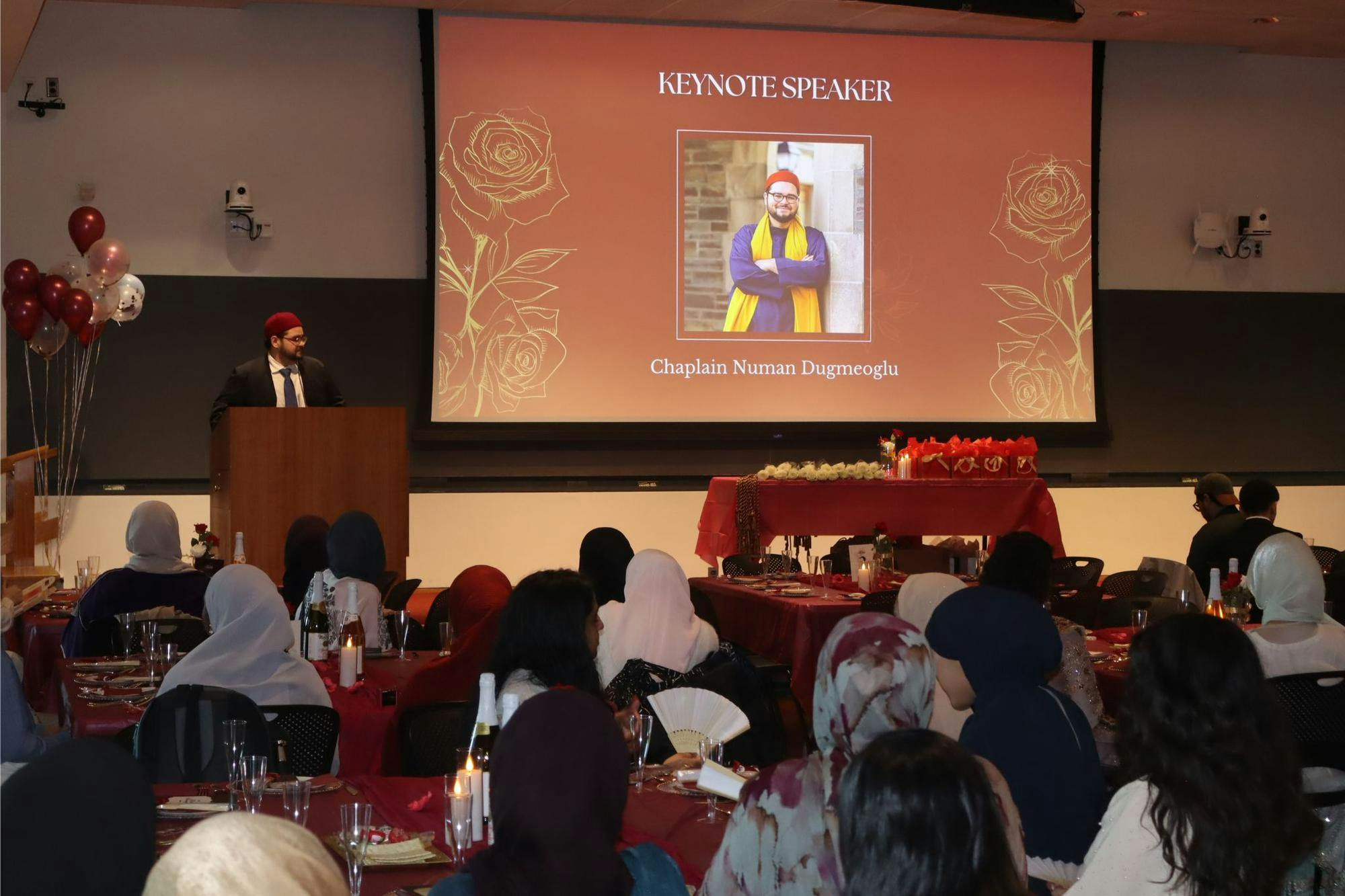
MECA co-presidents El-Hardan and Akmal Rupasingha ’27 delivered the welcome speech for the event, followed by Cornell’s Muslim chaplain, Numan Dugmeoglu, who offered the keynote address.
In the welcome, El-Hardan and Rupasingha reflected on a Ramadan they described as “truly special,” noting that many new faces got involved with the Muslim community and volunteered their time. They urged underclassmen to get involved and show up.
Dugmeoglu’s address centered on the meaning of Eid as a communal celebration rooted in faith.
“The Prophet … informed us that our celebrations are built upon obedience of God, [and] at the end of Ramadan, we celebrate,” he said.
Dugmeoglu closed by urging attendees to reflect on the people around them.
“Don’t underestimate how far you can get in life by loving the right people,” he said.
A senior recognition ceremony followed the addresses, where graduating MECA members were given a gift and acknowledged with their name, major and favorite MECA memory on stage.
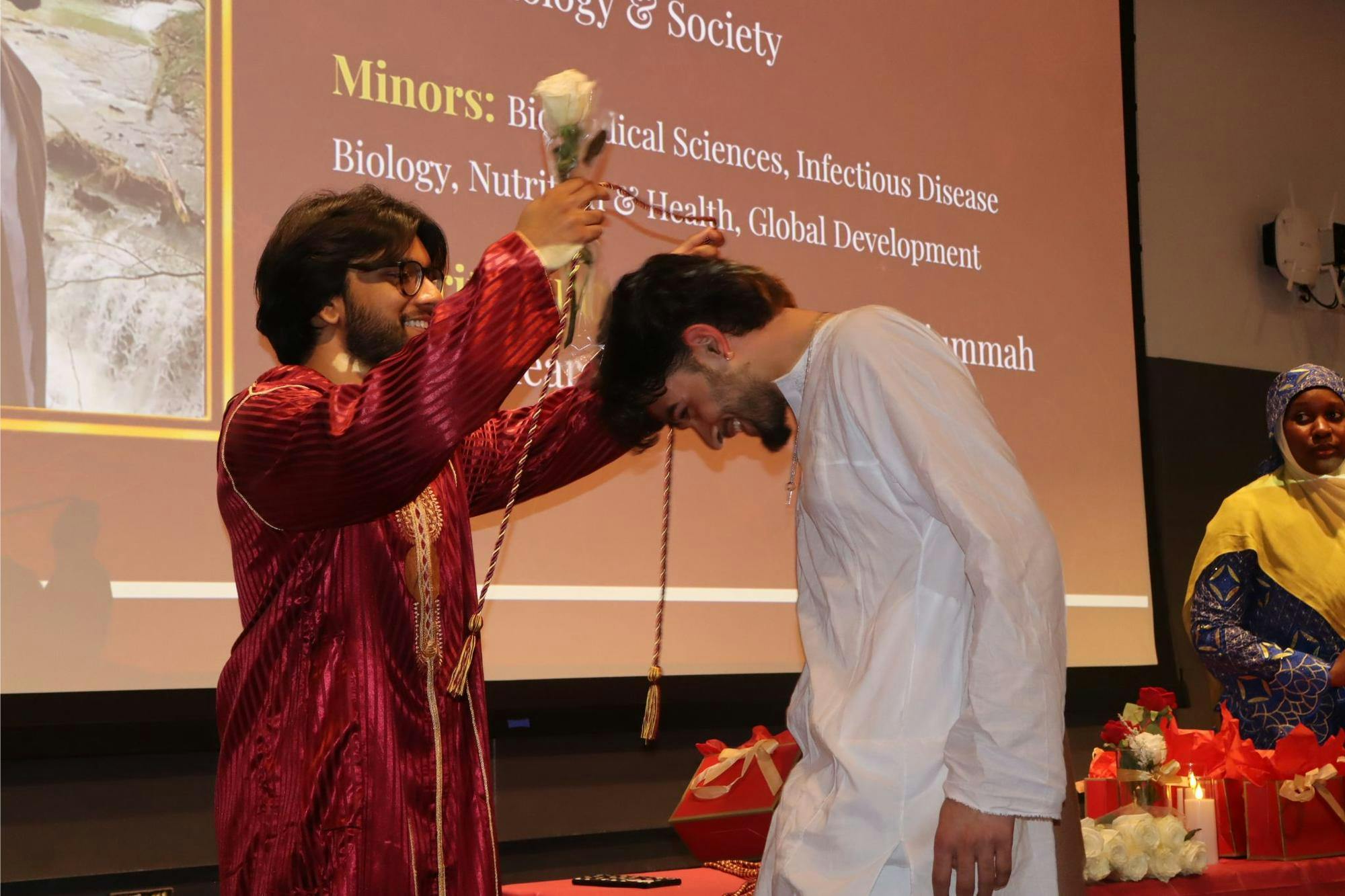
For Mohammad Labadi ’26, a senior attending his fourth consecutive Eid Banquet, the ceremony carried particular meaning. He said that in past years, he had helped more to organize the event, but now as a senior, he was just able to enjoy it as an attendee.
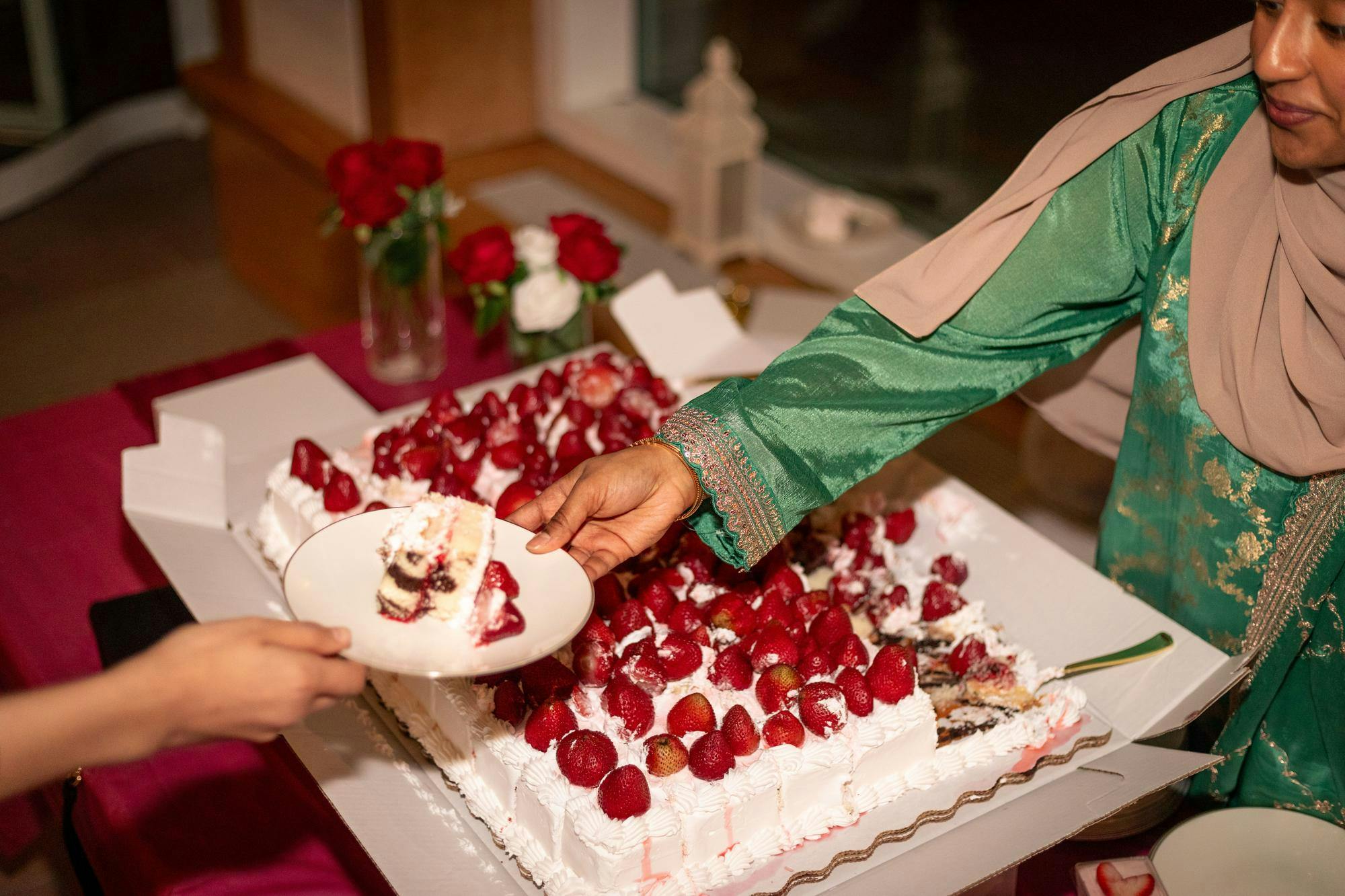
Dinner service featured a lamb and chicken mix with potatoes and rice, Greek salad and peach and rose blush ciders, with strawberry shortcake, strawberry chocolate cups and mixed cupcakes served for dessert.
Later, the night shifted to a round of Ramadan and Eid themed Family Feud before closing remarks at 9 p.m.
For some attendees, the banquet carried weight beyond its programming. Hana Saleh ’27 said the student-centered nature of the event sets it apart from Eid celebrations back home.
“It’s set up by students, for students,” she said, adding that at home, the Eid events center around the general community as a whole.
Saleh said she encourages her non-Muslim friends to attend events like the banquet, since experiencing other cultures in this way “opens your eyes to how other people live” and has helped her friends understand her identity more deeply.
MahNoor Abbas ’25, who grew up in an area with little Muslim representation, said finding MECA changed her Cornell experience entirely.
“Once I came to campus and I found my people through the Muslim life at Cornell, it really made a real difference and made me realize what I was missing all along — the sense of belonging and community,” she said.
Abbas added that the annual banquet has become a meaningful ritual for her.
“For all four years, the Eid banquets have been really amazing experiences and [have shaped] my identity, to some extent,” she said.
That sense of belonging extended to international students as well. Andi Adhnitasari, a master’s student in food science from Indonesia, said the transition to Cornell was isolating at first until she found MECA.
“I’m from a Muslim country … [when I came here,] I felt lonely in the beginning, because I [didn’t] know anyone, but then when I found MECA. It felt like home to me,” she said.
Uzair Hashmi ’29 celebrated Eid away from his family for the first time this year, and said the evening reinforced the community he had found at Cornell over the past year.
“I can look at this room and I already know at least like 50 [to] 60% of the people here,” he said. “[This event is] an excellent testament to how close I’ve gotten to the [Cornell] Muslim community.”
El-Hardan reflected on the event’s growth since she first joined MECA as a freshman. She recalled how the banquet used to be a smaller gathering at first, before she began scaling it up to meet growing engagement from Muslim students on campus.
“I think it’s a very beautiful thing to just gather together, celebrate [and] take some time away from school,” she said.

Rowan Wallin is a member of the Class of 2027 in the Nolan School of Hotel Administration within the SC Johnson College of Business. He is a senior writer for the news department and can be reached at rwallin@cornellsun.com.