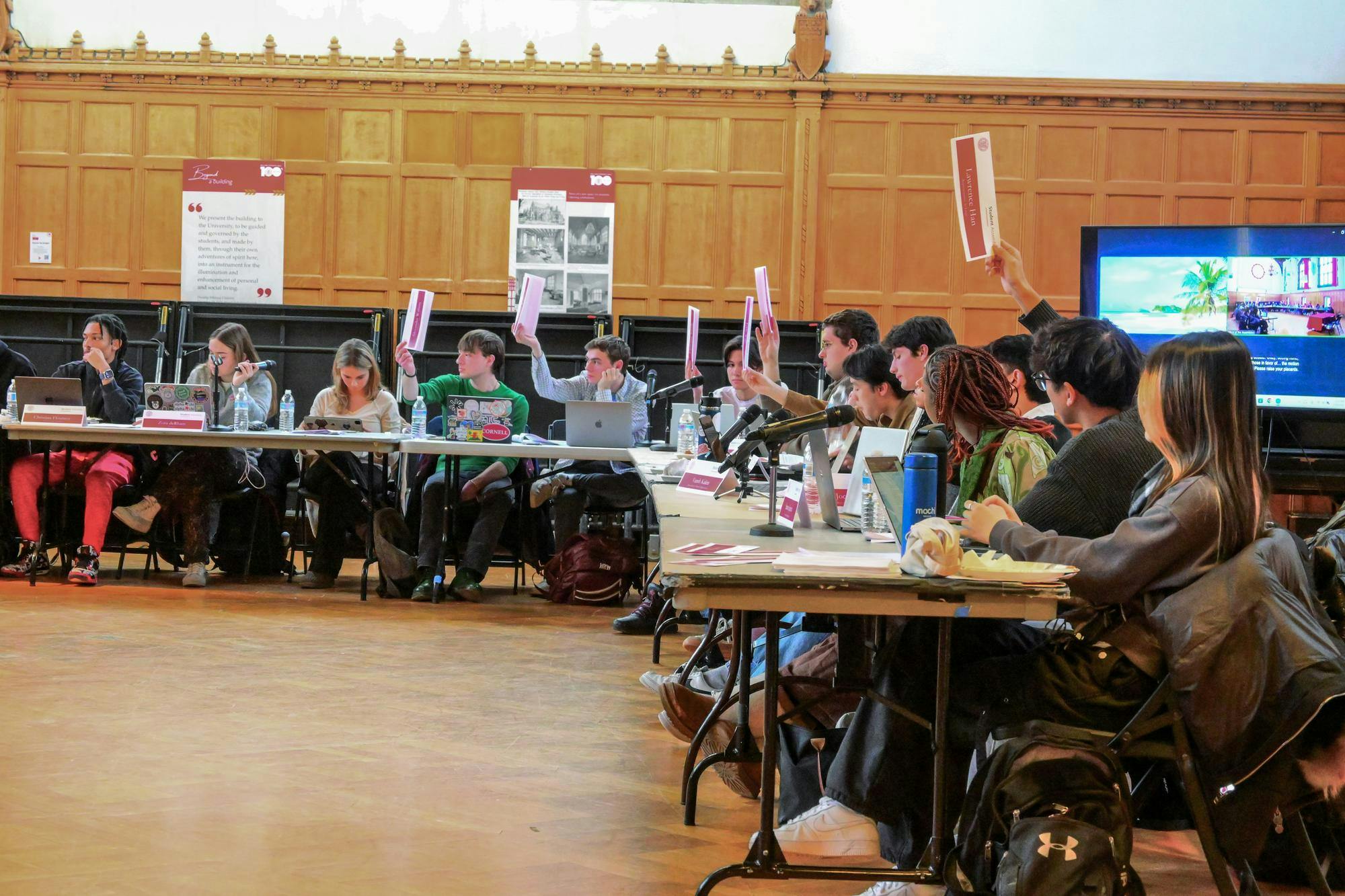
The Student Assembly passed Resolution 70: The Last Straw, a five-year plan to phase out single-use plastics on campus, during its Thursday meeting.
The resolution was presented by Lydia Blum ’27, College of Agriculture and Life Sciences representative, alongside Samantha Johnstone ’26 and Ben Kerstetter ’27 from Plastic Free Cornell. They were accompanied by Emily Pape ’26, founder of Cornell Student Athletes for Sustainability and “Skip the Lid” Ambassador.
The measure would phase out single-use plastics over five years, replacing them with reusable or compostable alternatives while allowing limited exceptions for research, medical use and emergencies. The proposal places Cornell among a growing number of universities adopting similar policies and aligns campus operations with institutional sustainability commitments.
“This is something all the SUNY schools have adopted,” Johnstone said during the meeting. “We modeled our policy after [theirs], and a bunch of other schools have adopted similar ones.”
In 2024, the State University of New York published a policy with the goal “to eliminate the use of plastic items generally recognized as being designed for single use.”
“If we’re going to be a leader in sustainability as a university, we should really make sure that we’re walking the walk as well as talking the talk,” Pape said.
Debate centered on whether the University and Tompkins County have the infrastructure to support alternatives like compostable plastics, which can only degrade under specific conditions.
“Compostable plastics are not really compostable,” said President Zora de Rham ’27. “They are only compostable in anaerobic digesters, and I do not know where the nearest one is in Central New York.”
Tompkins County has anaerobic digesters that are used for wastewater treatment, and CALS uses the technology for food and manure decomposition. The nearest anaerobic digester for composting plastics is in Auburn, NY.
de Rham also raised concerns about contamination in recycling systems, noting that improper sorting could “actually be worse” than current plastic use due to contamination of recyclable materials.
Recyclables can be contaminated through wishcycling, where people recycle improper items. Unless a facility uses hand-sorting to differentiate between recyclable materials and nonrecyclables, a piece of trash in a recycling bin renders the whole sample obsolete. This can have adverse effects on the environment as recyclable materials are thrown away en masse due to human error.
In response, Johnstone emphasized that compostable plastics would be a last resort.
“The idea is to replace [plastics] with reusable [items], and if that’s not available, then something like bamboo, and then the last case would be those compostable plastics,” Johnstone said.
Johnstone added that the five-year timeline is intended to address the infrastructure and cost concerns.
Several representatives pointed to student behavior as a key factor in whether the policy would succeed.
“If there’s a system that’s uniform across campus, you should learn what you’re getting and then where you dispose of it,” said Admir Cekic ’26, first-generation college students representative, suggesting sustainability training modules for students.
Resolution 70 came alongside proposed measures addressing course enrollment and residential maintenance issues, which will be voted on during the next meeting.
The Assembly also discussed Resolution 79: Consolidating Student Access to University Resources, a proposal to centralize University resources, particularly with regard to mental health and financial aid.
“We feel that the school has so many [resources], but oftentimes it’s buried under so much information,” said Daniel Addoquaye ’28, vice president for policy, during the presentation.
Resolution 66
The meeting also followed President Kotlikoff’s recent approval of Resolution 66, a revised Student Activity Fee allocation of $424, on April 6. The resolution was sent to him after the March 26 Assembly meeting.
Resolution 66 is the only resolution that has been approved by President Kotlikoff this academic year.
Resolution 66 recommends keeping the mandatory undergraduate Student Activity Fee at $424 — equivalent to the 2025-2026 fee —- and reallocating that total across byline organizations for the next two-year cycle. The revised recommendation followed President Kotlikoff’s rejection of the Assembly’s earlier Student Activity Fee proposal in Resolution 21, which had recommended a $52 increase in order to meet the increased financial needs of byline organizations on campus without stripping other organizations of their funding.
The Student Activity Fee is funded directly by undergraduate students, though for those on financial aid, colleges and schools often absorb some or all of the cost –– a factor cited by Kotlikoff in his rejection of the initial proposal.

Emma Spindler is a member of the Class of 2028 in the College of Arts and Sciences. She is a senior writer for the news department and can be reached at espindler@cornellsun.com.