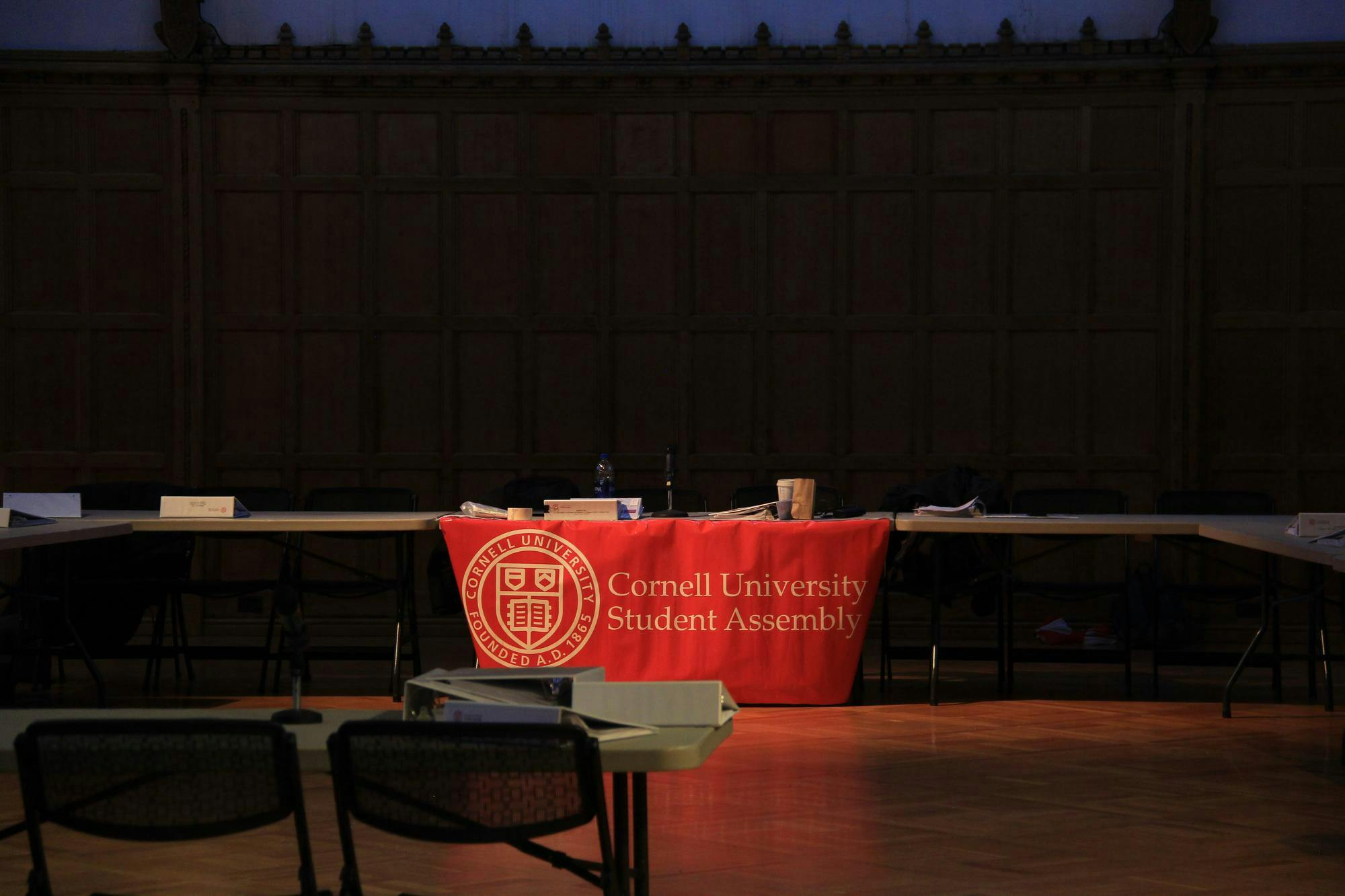
The Sun interviewed the two executive vice president candidates for the Student Assembly to learn about their different visions for the role.
Voting opened at noon on Monday for the Spring 2026 election cycle, and students have until noon on April 27 to cast their online ballot, according to an email sent out by the Student Assembly.
Find interviews with the three presidential candidates here, and a complete list of all of the candidates running for positions here.
Both candidates pointed to challenges within the Assembly’s internal effectiveness and outlined priorities ranging from improving accountability and coordination to increasing member engagement.
Hayden Watkins ’28 Emphasizes Internal Accountability and Operational Reform
By Riya Devroy and Emma Spindler
Hayden Watkins ’28, who currently serves as vice president of finance on the Assembly, said his campaign for executive vice president is focused on improving the Assembly's internal operations and holding members accountable for their work.
He views the executive vice president role as “the backbone of the Student Assembly,” responsible for ensuring that members are actively contributing behind the scenes.
Watkins said consistent organization and participation are critical to the Assembly’s effectiveness, noting that, under his leadership, the Finance Committee met regularly even as engagement varied more broadly across the body.
Watkins pointed to attendance and participation as ongoing challenges. Inconsistency, he said, extends to committee work, with “committees that haven’t met the entire year” despite their role in incorporating student input in resolutions.
Watkins said the executive vice president must step in when participation falters, particularly “when attendance is getting out of control… [and] people aren’t writing resolutions.”
He emphasized the importance of building relationships within the Assembly and among committee members, describing personal efforts to create “more of that buy-in” among members through consistent communication and support.
Watkins outlined three main priorities: “improving function [of the Assembly], quality of life for students and building more widespread resistance [to the Trump administration].”
He described the latter as “tapping into external partners in order to build more pressure against Cornell [administration]” to respond to student concerns.
On the operational side, Watkins pointed to more consistent oversight of committee leadership, including plans to hold one-on-one meetings with chairs to ensure committees are functioning effectively and members are supported in their roles.
Watkins emphasized the potential for smaller, student-facing improvements.
“One of the things I’m definitely most proud of is next year there’s going to be a New York Times Games subscription for students,” he said.
Watkins described adding more ice machines to campus as an example of a potential quality-of-life improvement. He also suggested that the Assembly could explore additional initiatives during high-stress periods, including subsidized food options during finals week.
Ultimately, Watkins said he hopes students would notice a more active and engaged Assembly, describing a body that is “so much more involved in their day-to-day lives.”
Kennedy Young ’28 Focuses on Accountability, Transparency and Student Representation
By Emma Spindler
Kennedy Young, who serves as vice president of diversity, equity and inclusion and as a minority student representative on the Assembly, wrote in an email to The Sun that her campaign for executive vice president centers on strengthening accountability and ensuring that Assembly initiatives lead to measurable outcomes.
Young pointed to her work on a resolution addressing transparency in first-year program house placements as a key example of her approach. The resolution, which passed unanimously, requests that Housing and Residential Life provide aggregated data on applications and placement outcomes, along with a clearer explanation of the selection process.
She described the initiative as an effort to move beyond general concerns about equity and instead push for “specific, data-driven transparency” in how decisions are made.
Addressing questions about the tangible results of resolutions, Young explained that the issue stems in part from the limits of the Assembly’s authority.
“Many resolutions fall outside of the Assembly’s direct authority and ultimately function as recommendations,” she wrote, adding that without consistent follow-up, they can feel disconnected from real outcomes.
To improve follow-through, Young emphasized the importance of engaging administrators earlier in the policymaking process, noting that “meeting with administrators during the drafting process” can help assess feasibility and create a clearer path to implementation.
Young outlined three main priorities: increasing institutional accountability and transparency, strengthening student voice in decision-making spaces and supporting marginalized students.
On transparency, she wrote that she plans to “continue pushing for data requests within the Assembly’s direct purview,” particularly in areas such as housing, Student and Campus Life and student services, while ensuring “consistent follow-up with administration” on required actions.
To strengthen student representation, Young wrote that she would advocate for “students to have voting power, not just advisory roles,” and explore systems such as “a jury-based or representative selection process” for participation in disciplinary and decision-making bodies.
She also emphasized the importance of protecting marginalized communities, calling for “consistent oversight of programs and spaces that serve marginalized communities” and ensuring that policies are evaluated for their impact “before and after implementation.”
Young shared that improving communication is key to rebuilding trust in the Assembly, adding that “students need to see not just what we pass, but what we actually change as a result.”
More broadly, she described the Assembly’s role as ensuring that students have “a meaningful role in campus governance” by representing their interests and advancing policies that improve student life.

Emma Spindler is a member of the Class of 2028 in the College of Arts and Sciences. She is a senior writer for the news department and can be reached at espindler@cornellsun.com.