Prof. Jon W. Parmenter is an associate professor of history in the College of Arts and Sciences, specializing in the history of indigenous peoples in the Northeast, particularly that of the Haudenosaunee (Iroquois). He can be contacted at jwp35@cornell.edu.
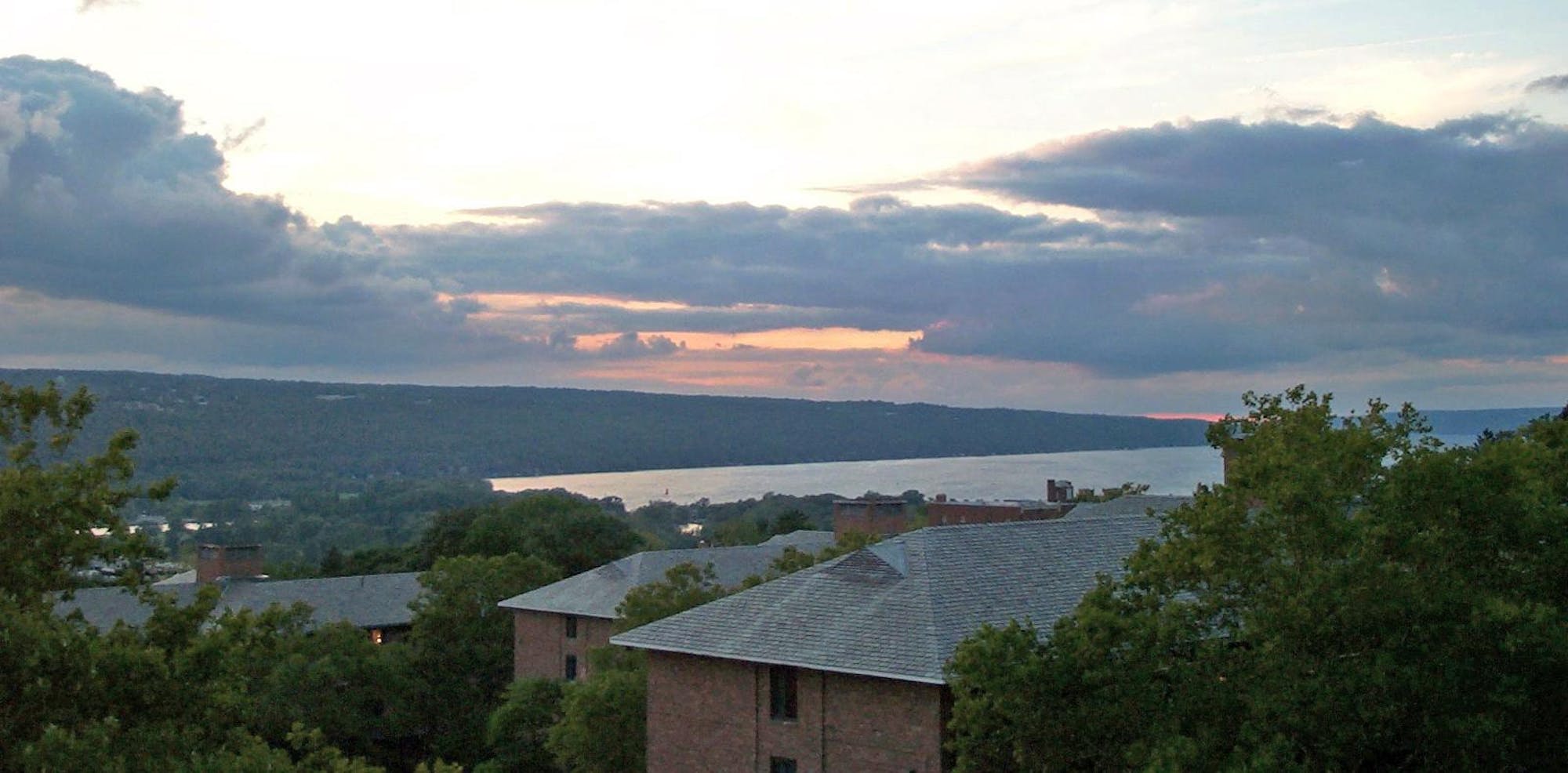
Cornell University adopted its current land acknowledgment in May 2021 after consultation with the traditional leadership of the Gayogo̱hó:nǫˀ (Cayuga) Nation, led by faculty in the American Indian and Indigenous Studies Program. The version of the land acknowledgment most often heard at campus events acknowledges Cornell’s presence on ancestral Gayogo̱hó:nǫˀ territory and the continuing relationship of Gayogo̱hó:nǫˀ people to those lands and the surrounding waters.
Since May 2021, we have learned much more about another category of formerly Indigenous land significant to Cornell University’s history: the real estate in Wisconsin, Minnesota, and Kansas obtained by Ezra Cornell under the auspices of the Morrill Act of 1862 and later sold by the University to build much of the Ithaca campus. AIISP provided an addendum to the land acknowledgment to address the impact of the Morrill Act in February 2022. To date, Cornell’s effort to address the relationship between the Morrill Act and Indigenous dispossession amounts to a textual supplement to the land acknowledgment on its Commitment to Indigenous Communities and Nations in North America page, but I have yet to hear this version spoken aloud by any University representative. More problematically, that written supplement (hidden behind a tab labeled “History”) misrepresents Cornell’s financial benefit from these dispossessions inaccurately as a phenomenon confined to the past when it is in fact ongoing.
Cornell University possesses an existential and enduring relationship to Indigenous dispossession — not only because of its location on ancestral Gayogo̱hó:nǫˀ homelands, but also because of the financial returns it receives from the lands formerly held by the Ojibwe, Dakota, Ho-Chunk, Osage and Kansa nations. The sum of those revenues over time represents the equivalent of at least $685 million (2025 USD) or approximately 5.8% of the current $11.8B endowment. That may seem like a small fraction but consider that one-seventh of that money came to Cornell University in just eight years after 1881 — largely from the sale of white pine timberlands in northern Wisconsin. This represented the sole source of revenue that rescued the University from near-certain bankruptcy and catapulted it into the ranks of the nation’s largest-endowed institutions of higher learning. We can also state with certainty that in 2008 the capital account containing the principal of accrued income from the University’s Morrill Act lands paid out in interest the equivalent of at least $4 million (2025 USD) in unrestricted funds. What that annual payout might be today I cannot say because the University has denied my written requests for this information.
If the land acknowledgment does not provide a comprehensive acknowledgment of Cornell’s history of relations with Indigenous people, how effectively can it speak to the current situation? While we would be remiss not to recognize recent positive developments, such as the efforts of AIISP faculty and the University’s Linguistics Department to help revitalize the endangered Gayogo̱hó:nǫˀ language, it is also important to point out other less encouraging trends. Enrollment of Native American students in the Class of 2028 declined from 1.8% the year prior to a mere 1% and by one metric only four Native American students are reported to be in the Class of 2029. Retention of Indigenous faculty is also proving to be a growing challenge. A thoughtful and innovative January 2024 proposal to establish a Gayogo̱hó:nǫˀ land base at Cornell’s Arnot Teaching and Research Forest has been ignored.
Outside Ithaca, urgent appeals on two occasions in 2024 for the University to transfer its mineral rights on land containing a sacred pipestone quarry in Wisconsin (located on a former Morrill Act parcel) to appropriate Indigenous caretakers similarly garnered no response. An August 2025 article on the University’s mineral interests in the pipestone quarry elicited only a “no comment” from a University official. Two emails written by myself regarding the issue — one to Anne Meinig Smalling ’87, president of the Cornell Board of Trustees on Sept. 10, 2025, and a follow-up to the general intake email account for the board on Dec. 17, 2025 — have gone unanswered.
Given the facts above, it is difficult to escape the conclusion that Cornell’s senior leadership believes that it has done its part by adopting the land acknowledgment — no further discussion of the University’s historic and structural relationship to Indigenous dispossession appears to be forthcoming.
Yet with each passing day, Cornell doesn’t just fall further behind its Ivy League peers grappling with past entanglements with slavery, or its land-grant university peers addressing their institutional relationships with Indigenous dispossession via the Morrill Act. It also falls behind colleges and universities in New York State (including Syracuse University, the University of Buffalo, St. Bonaventure University, Hamilton College and most recently Binghamton University) that have taken significant steps to build productive relations with neighboring Haudenosaunee nations.
Like it or not, Cornell’s past, present and future are all inextricably linked to acts of Indigenous dispossession by the U.S. federal government from which the University continues to benefit while Indigenous communities await a fuller measure of justice.
Cornell’s land acknowledgment represents a critical first step toward reparative action and an implicit invitation for the University to do more, but it is no substitute for the kind of meaningful partnerships that could be formed with Indigenous nations impacted by the University’s role in their ongoing alienation from sacred sites and other ancestral territories. Until University officials decide to prioritize such relationships, we must rely on the land acknowledgment as an entry point for people to learn more about Cornell’s role in the persistent displacement of Indigenous peoples (while simultaneously raking in millions of dollars of unrestricted income annually from those very practices) and to keep thinking about how we might promote greater accountability for the institution’s historical and ongoing extractive relationship to Indigenous lands and resources.
*Historical financial figures cited above are derived from University financial records (1882 to 2008) assessed by the most conservative option (GDP Deflator) of seven different indices provided on the peer-reviewed website MeasuringWorth and include no provision for the accrual of any compound interest over time.
Guest authors are people who submit pieces to The Sun and undergo the same thorough editorial process as any Sun staff writer. The Sun does not endorse the views of any guest author. If you would like to get in contact with the author of a Guest Room article, please use the undersigned author's email provided at the bottom of the article.
The Cornell Daily Sun welcomes any and all submissions of guest columns and letters to the editor for review. Please visit this website for information on how you can submit as a guest author to The Sun: https://www.cornellsun.com/page/join-the-suns-opinion-section. If you have any questions regarding this process, please contact us at associate-editor@cornellsun.com.