Recently returned to in-person instruction, a unique Cornell class introduces students to the language and culture of the Gayogo̱hó:nǫˀ, or Cayuga, people, on whose homelands Cornell stands.
In AIIS/LING 3324: “Cayuga Language and Culture,” students explore the history, culture and continuing presence of the Gayogo̱hó:nǫˀ community while learning the Gayogo̱hó:nǫˀ language, which the United Nations classifies as critically endangered.
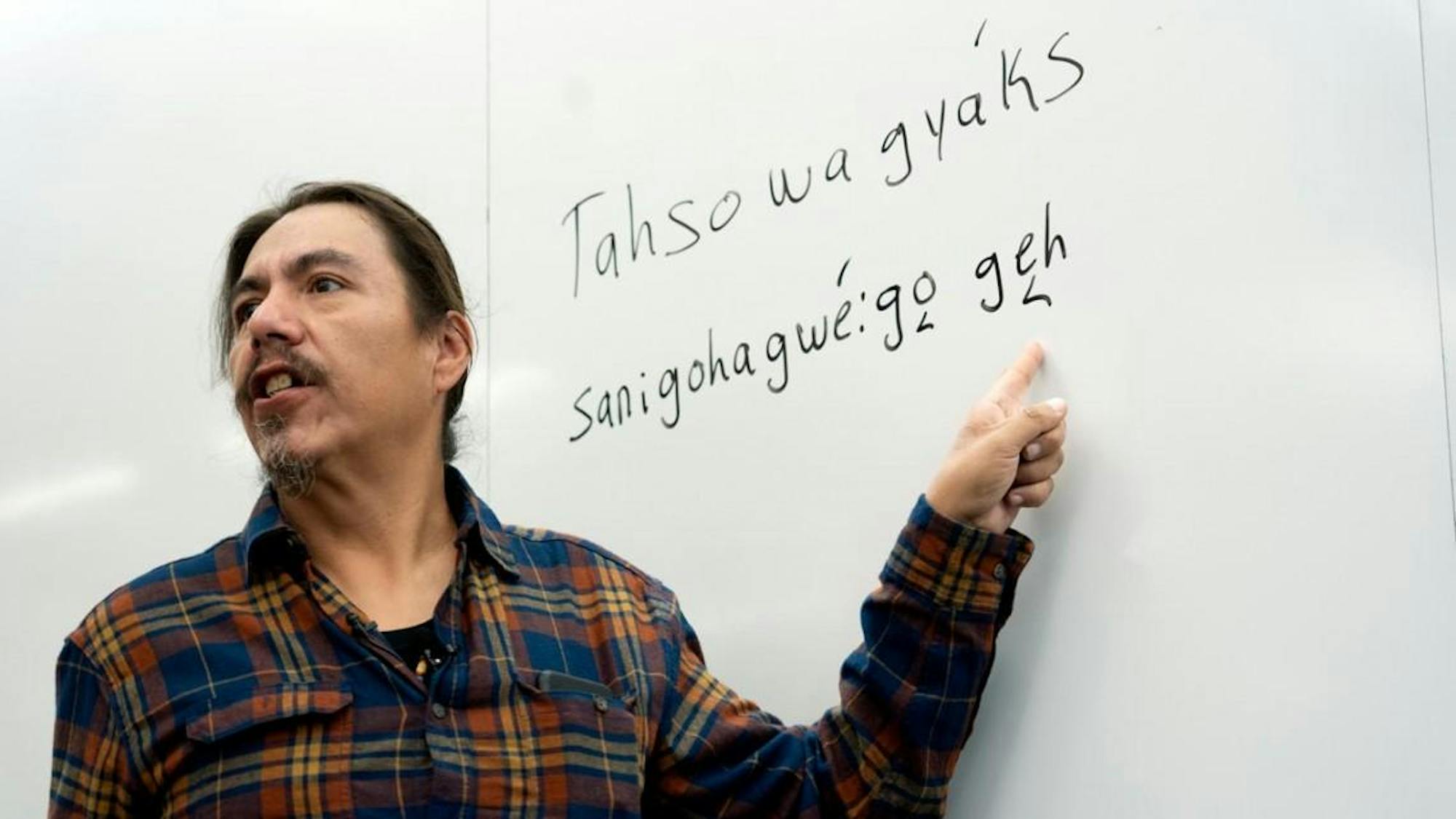
The course is currently taught by Steve Henhawk, a member of the Wolf Clan of the Gayogo̱hó:nǫˀ nation and native speaker of the language, with assistance from Prof. John Whitman, linguistics.
The Gayogo̱hó:nǫˀ nation is one of the six nations of the Haudenosaunee Confederacy, whose ancestral homelands are located in the Finger Lakes Region of New York. Today, most Gayogo̱hó:nǫˀ people, including Henhawk, live in the Six Nations of the Grand River reserve in Canada.
This forced displacement is largely due to the destruction of Gayogo̱hó:nǫˀ crops and villages around Cayuga Lake during the American Revolution, ordered by George Washington as part of the Sullivan-Clinton Campaign, which led many people to flee to Canada.
Since then, assimilatory efforts taken by both the U.S. and Canadian governments, including government-funded residential schools — boarding schools where Indigenous children were taken from their families, forced to assimilate and abused for speaking their native languages, according to the National Centre for Truth and Reconciliation — have led to the decline of the Gayogo̱hó:nǫˀ language.
With fewer than twelve first-language speakers today, Gayogo̱hó:nǫˀ is classified by the U.N. as a “critically endangered” language.
As one of these few remaining speakers, Henhawk serves as a knowledge keeper in the Haudenosaunee community. As a knowledge keeper, Henhawk’s duties include conducting traditional ceremonies in the language and teaching people throughout the Six Nations and Finger Lakes Region.
At Cornell, Henhawk sees the “Cayuga Language and Culture” course as a valuable component of ongoing work toward the revitalization of the Gayogo̱hó:nǫˀ language.
“We can’t go back in time and we can’t change things, but we can look to the future,” he said. “This is where I see [Cornell], where things can happen … to help move forward.”
Creating the Course
“Cayuga Language and Culture” was born in the fall of 2018, when Whitman was approached by a dean in the College of Arts & Sciences who expressed interest in starting a Gayogo̱hó:nǫˀ language class. This was at the request of Prof. Jolene Rickard, art history, who is Tuscarora — part of the Haudenosaunee Confederacy. Rickard had been offered a job at another university and listed the establishment of a Gayogo̱hó:nǫˀ class as a condition for her staying at Cornell.
“She deserves a huge amount of credit for that,” Whitman said.
When Whitman first heard the idea, though, he was hesitant.
“I said, ‘do you have any idea?’” he recalled. “This language is … really critically endangered. So the idea that we could just pluck someone to teach Gayogo̱hó:nǫˀ to Cornell students was just completely unrealistic.”
It was through Rickard that Whitman met Henhawk, who was teaching the language to a community of Gayogo̱hó:nǫˀ people at the north end of Cayuga Lake at the time. The pair met for the first time at a pizza parlor in Seneca Falls, and “Cayuga Language and Culture” was born.
Henhawk started teaching the class in Fall 2019 and continued for the next year. Then, between 2021 and 2024, various teachers from the Gayogo̱hó:nǫˀ community in the Six Nations reserve — including visiting lecturer Jessica Martin and Charlene Hemlock — took up the mantle and remotely taught both installments of the course, Cayuga Language and Culture I and II.
Fall 2025 marked Henhawk’s return to teaching the class, and the first time it has been offered in-person in four years.
“[Gayogo̱hó:nǫˀ] has changed my life. It’s an amazing language,” said Whitman, who has become an expert in Gayogo̱hó:nǫˀ linguistics. “It’s endangered, and that’s the big thing — what can be done to help second language learners now learn it.”
The existence of “Cayuga Language and Culture” at Cornell is unique in itself due to the fact that Gayogo̱hó:nǫˀ has ongoing revitalization efforts, unlike many other Indigenous languages that have no speakers remaining, according to Whitman.
“We actually can work with the language of this region. There's no other Ivy League university that can do that,” Whitman said. “Cornell has … an opportunity that most universities don’t have.”
Culture-Based Learning
A typical session of “Cayuga Language and Culture” focuses on providing students with opportunities to speak the language as well as understand how the Gayogo̱hó:nǫˀ language and culture have progressed to the present day. The course covers topics including basic pronunciation, phrases and writing, as well as Gayogo̱hó:nǫˀ history, traditional stories and ecological knowledge.
Creating an immersive language-learning environment for students was an important goal for Henhawk, who learned Gayogo̱hó:nǫˀ growing up with his grandparents on the Six Nations reservation and is one of the few native speakers of Gayogo̱hó:nǫˀ remaining today.
“At that time, there was [an immersive] environment where it was total Gayogo̱hó:nǫˀ,” Henhawk said. “Now, you have to create an environment where you can even have a full conversation in Gayogo̱hó:nǫˀ … I feel lucky with just that memory [of speaking completely in Gayogo̱hó:nǫˀ].”
For instance, certain phrases and words in Gayogo̱hó:nǫˀ may only be used in this type of conversational environment that no longer exists today. Such phrases might be among the first pieces of the language to be lost, so Henhawk tries to emphasize them in his teaching.
The significance of language strikes home for Zelazzie Zepeda ’26, who took both installments of “Cayuga Language and Culture.” Zepeda majors in linguistics and hopes to pursue a career in language revitalization, particularly with his heritage language of Yoem Noki, which is spoken by the Yoeme people in Sonora, Mexico and Arizona.
“The language really defines the people. What does it mean to say ‘I love you’ in a settler's language?” Zepeda said. “That is really at the root of the importance of language revitalization. … Language is a gift that we use to preserve our way of life.”
New Perspectives on History and Place
The course also focuses on Gayogo̱hó:nǫˀ history, including the efforts to eradicate the language and the experiences of past generations, emphasizing what they endured to hold onto the language and pass it down to speakers like Henhawk.
For many Cornell students, this class is their first introduction to the Gayogo̱hó:nǫˀ people and culture, including the violence and forced displacement the community has faced.
Jaden Cumpston ’26 did not know anything about the Gayogo̱hó:nǫˀ people before taking the course and emphasized the importance of gaining this understanding.
“As a Cornell student, this school exists on Indigenous land, so I think that makes it important that you understand the history behind it,” Cumpston said.
This message resonated with Madison Larter ’26, who developed a deeper appreciation for understanding the history and people of a region after taking the course.
“A big part of coming to Cornell is actually the physical place itself, and I think you don't really have a true understanding of the place unless you understand the history and the people also,” Larter said. “Taking this course has inspired me to try and continue that idea for other places I might live, to take a minute and learn a bit about the place I'm in, and the history of it, and better understand how I fit into that.”
At the same time, Henhawk told The Sun that he hopes students will leave the class with a deeper understanding of where they are and the continued presence of the Gayogo̱hó:nǫˀ community at Cornell, Ithaca and the Finger Lakes.
“Any signage and things that are in the area about our people … it's always in the past tense. It always says ‘was,’ ‘were,’” Henhawk said. “So what I do is … change that aspect, to let [students] know that we're actually still here, we're just displaced.”
“Cayuga Language and Culture” is also unique for the opportunities it offers students to give back to the Gayogo̱hó:nǫˀ community. A past student’s short film about growing crops is now used as a teaching tool within the community, while another student’s research on the tones and stress placements of the Gayogo̱hó:nǫˀ language can be a resource for other second-language learners.
“What this class means to me is that Gayogo̱hó:nǫˀ is recognized at this level of academia,” Henhawk said. “It's brought our language to this level of academia to where it can be researched further and really that we can work together in a way that it really helps our community.”
Looking Forward
Offering “Cayuga Language and Culture” at Cornell is a start, but students and faculty believe that the University can do more to promote Gayogo̱hó:nǫˀ language revitalization.
Zepeda referenced Cornell’s status as a land-grant university, meaning that the University received lands and their profits from the federal government through the Morrill Act of 1862. These lands were taken from Indigenous tribes through violence and unfair treaties.
Cornell received the most land under the Morrill Act than any other U.S. university, amounting to almost 990,000 acres.
“I don't think [Cornell is] doing enough, considering that position that they have as the biggest beneficiary of the land-grant institution,” Zepeda said. He hopes to see more collaboration between Cornell and the Gayogo̱hó:nǫˀ community, such as through making “Cayuga Language and Culture” open to community members
Both Whitman and Henhawk also hope for more stability from the University regarding the course. Although the American Indian and Indigenous Studies Program sponsors the course, Henhawk does not have a stable, guaranteed faculty position, he said, which affects his certainty about whether the course will be offered in coming years.
Even so, Henhawk acknowledged the efforts already taken to get to this point and expressed his hope for continued support and collaboration with Cornell.
“Being able to share about our language that's critically endangered, the work that has been done [and] mentioning the people that have done this work … I think that really helps to give a future to the language and our people here in our homelands,” Henhawk said.
Tania Hao is a member of the Class of 2028. She is a science editor for the 144th Editorial Board and can be reached at thao@cornellsun.com.