Around 60 students and community members gathered in Anabel Taylor Hall Chapel to celebrate Jewish Voices for Peace and Chavurah at Cornell’s third consecutive and fourth ever Freedom Seder on April 9.
The Passover Seder is a ritual meal that traditionally takes place on the first night of Passover, the eight-day-long Jewish holiday. The Seder involves a retelling of the story of the liberation of the Israelites from slavery in Egypt, or “mitzrayim,” from the Book of Exodus in the Torah. Customs also include discussing the Passover story, drinking four cups of wine, eating matzah, praying and singing Passover songs.
“For thousands of years, Passover has been a holiday of liberation,” the “welcome” page of JVP at Cornell’s Haggadah states. “We must reckon with and actively oppose the genocide of Palestinians being carried out in the name of Jewish people.”
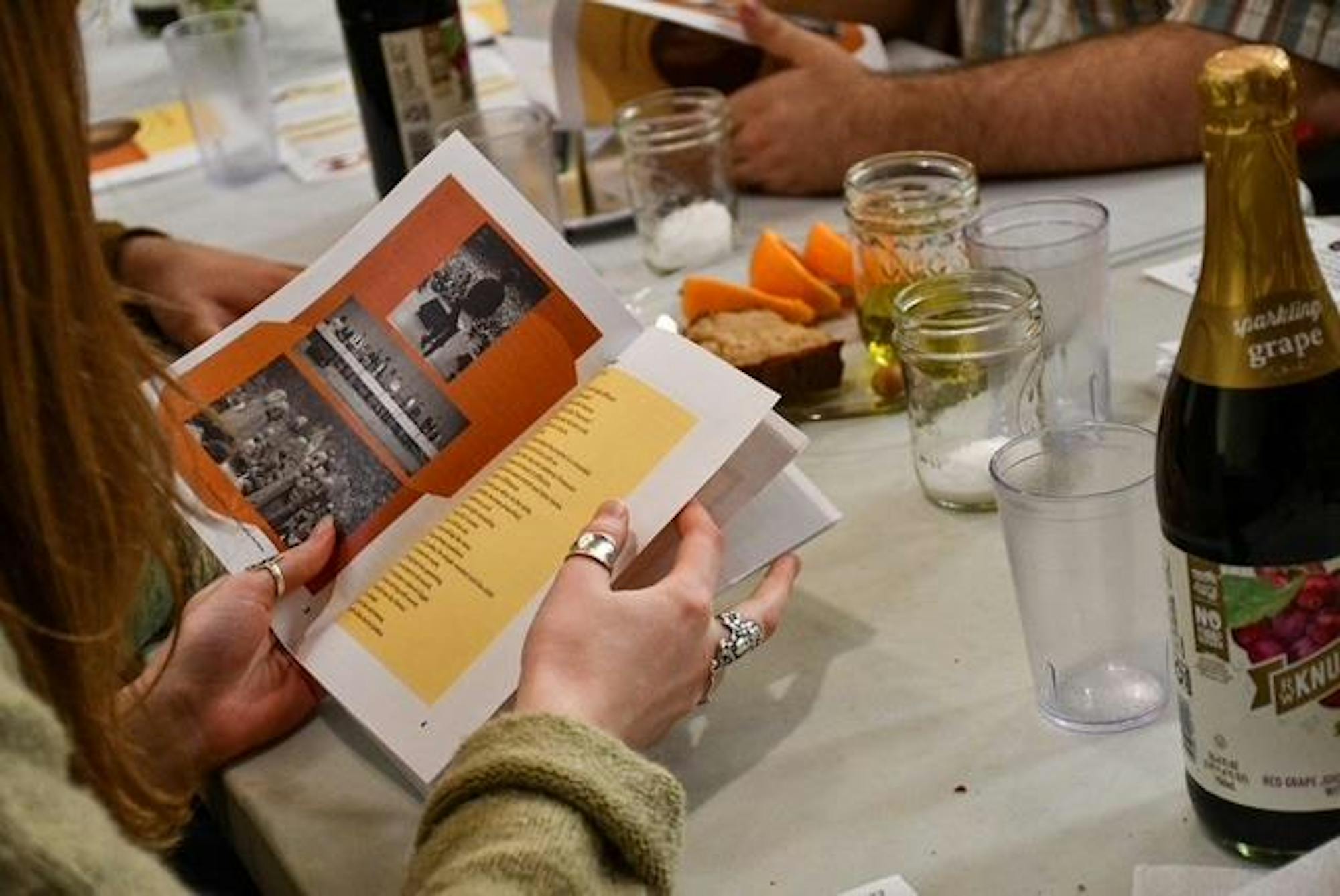
As guests arrived into the chapel, they were greeted with a Seder plate and a copy of the Haggadah — a text which walks through the 15 steps of the Seder by retelling the Passover story. For the Freedom Seder, JVP at Cornell and Chavurah at Cornell created their own Haggadah, which included poems, artwork, prayers and reflections written by students.
The first Freedom Seder was organized by Rabbi Arthur Waskow in 1969. Following the assassination of Martin Luther King Jr., Waskow created a Haggadah intended to connect the Passover story to the Black liberation movement. A year to the date after King’s assassination, 800 people gathered in the basement of a Black church in Washington, D.C. to hold a Freedom Seder.
The next year, in 1970, students organized the second-ever Freedom Seder at Cornell. Thousands gathered in Barton Hall to kick-off the “America is Hard to Find” weekend, a protest against the war in Vietnam.
JVP at Cornell organized a renewed Freedom Seder in the spring of 2024 for the first time since 1970, in the wake of Israel’s war in Gaza. The 2024 Freedom Seder was inspired by the Freedom Seder 54 years before, according to JVP at Cornell Treasurer Jacob Berman ’26.
“[The 1970 Freedom Seder] was a very meaningful thing to look back at, not only a Jewish past of anti-Zionist movements, but also a past here at Cornell,” Berman said.
The Haggadah also included “a note on language” which clarified their interpretations of the language found in the Passover story. It states that the “mitzrayim” from the Torah is not the same as the modern-day nation state of Egypt. Likewise, the Haggadah states, “The word Yisrael (Israel) when found in the liturgy does not refer to the modern nation/state of Israel.”
The Seder plate ventured off from the traditional six item plate of matzah, a hard-boiled egg, a lamb shank bone, sweet herbs, charoset and bitter herbs.
It included olives to recognize “olive trees, the source of livelihood for Palestinian farmers, [that] are regularly chopped down, burned and uprooted by Israeli settlers and the Israeli authorities,” oranges to represent “gender and sexual equality and justice” and an acorn “to remember this land and its First Peoples,” according to the Haggadah.
Throughout the Seder, students gave reflections on the meaning of Passover, and gave guests an opportunity to turn and talk to their neighbor to discuss the question, “how can you take action towards collective liberation in your life today?”
After four glasses of grape juice in lieu of the traditional wine, reflection and prayer, the Seder dinner commenced. A vegan buffet was laid out for guests, including rice pulao, chickpea salad –- and, since this Seder took place on the last day of Passover, leavened bread.
During the dinner, there was a fiddle performance by Klezmer Ensemble member Savanna Rostad ’26 and original songs from “folk-adjacent” Ithaca-based student band Vaguely Familiar.
In her performance Rostad incorporated davening, the Yiddish word for prayer. While davening, “you can just hum or feel an emotion like gratitude or awe, and I sort of just let that flow out of me in song,” Rostad said.
“The theme of the Freedom Seder is liberation from slavery, in all its forms,” Rostad said. “So in my performance, I was just feeling that tear in the heart that we all feel when we see injustice.”
Berman shared that the Freedom Seder has given students of similar values an opportunity to find community.
“We have more and more Jewish students who are interested, who are like we don’t necessarily want to go to Chabad or Hillel, because our values are not aligned with them,” said Berman. “I think by showing whether you’re a non-Zionist or anti-Zionist, you have your home here, I think it’s so important.”

Mary Caitlin Cronin is a member of the Class of 2028 in the College of Agriculture and Life Sciences. She is a senior writer for the News department and can be reached at mcronin@cornellsun.com.