

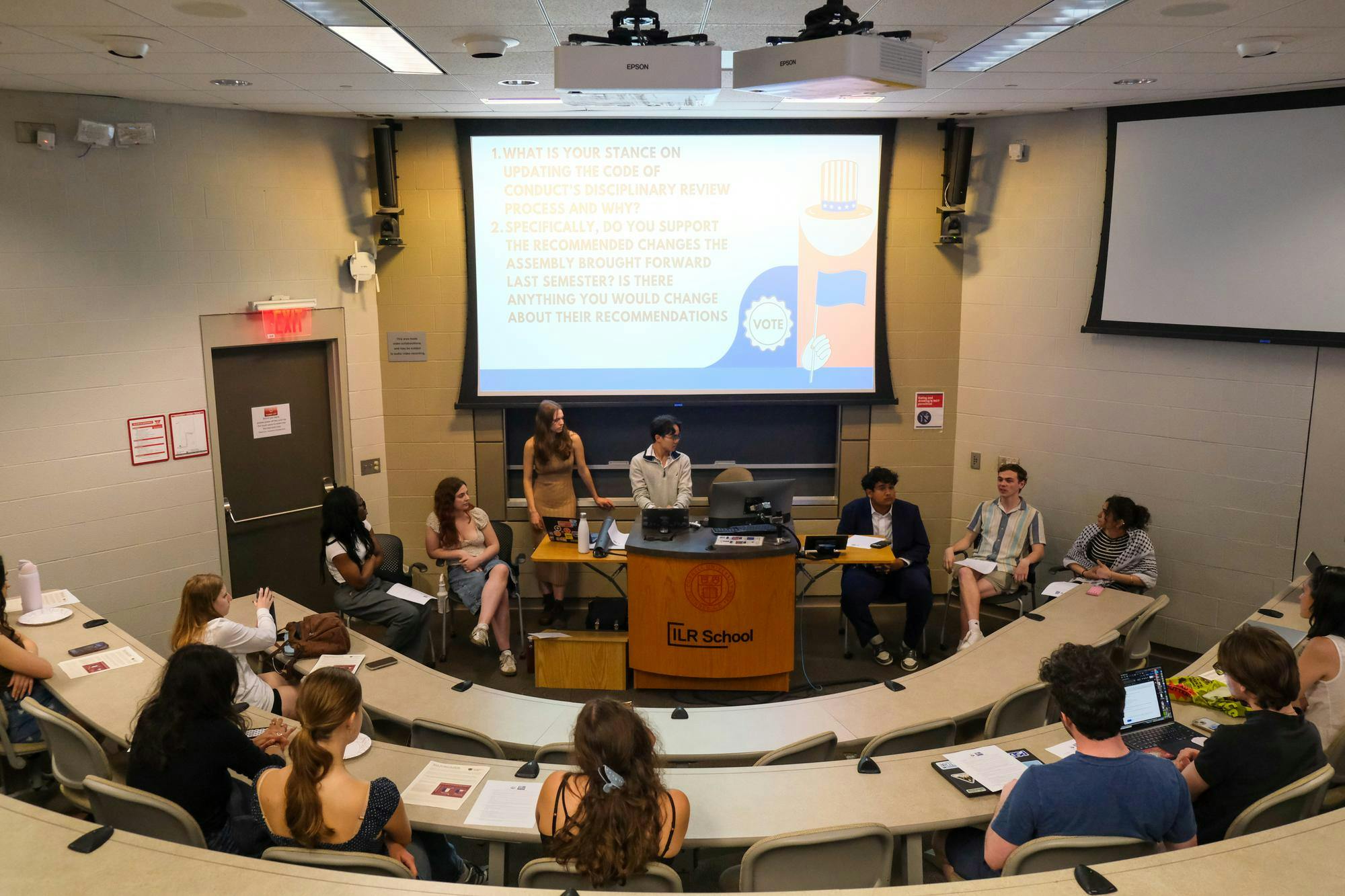
The Cornell American Civil Liberties Union Chapter hosted a town hall for Student Assembly candidates Thursday where topics such as legacy admissions, the Assembly’s effectiveness and student engagement with the Assembly were discussed. The candidates answered Cornell ACLU’s questions round-table style and then took audience questions.
The candidates in attendance were presidential candidate Eeshaan Chaudhuri ’27, executive vice presidential candidate Hayden Watkins ’28, candidate for Brooks School of Public Policy Representative Yasmeen Masoud ’28, candidate for First-Generation College Students Representative Saphira Augustin ’29, and candidate for Student Workers Representative Adriana Vink ’27.
The town hall also included readings of written testimony from candidate for executive vice presidential candidate Kennedy Young ’28 for each question and one written testimony from presidential candidate Zora de Rham ’27.
The ACLU is a national organization with the mission of protecting the rights of those in the U.S. The Cornell chapter hosts events centered around education and advocacy as well as launching political campaigns.
Cornell ACLU Co-President Jonathan Lam ’27 explained that they prioritized the candidates for President, Vice President, Student Representative and First Generation College Students Representative to speak at the town hall. Cornell ACLU then gave those who were unable to attend the opportunity to provide recordings or written testimony in response to the prepared questions.
The candidates had many aligned views on the topics discussed, from ending legacy admissions to updating the Student Code of Conduct. Most of all, they all shared strategies to make Student Assembly more effective.
“We can pass a resolution, they can go to President [Michael] Kotlikoff’s desk, but then nothing happens after that, and that's because Student Assembly members don't understand public policy right now,” Chaudhuri said. “As a public policy student, I'm trying to endorse better policy strategies. And the biggest thing there is coalition building, not only with internal student organizations like ACLU or other groups, but also external organizations as well, including big power players like alumni.”
Young shared a similar view to Chaudhuri about the importance of getting more organizations involved in her written testimony.
“When multiple governing bodies align on an issue, it significantly increases institutional pressure on the administration to respond,” Young wrote. “The Assembly cannot directly change administrative admissions policy, but it can expose inequities, represent student demand and push the university to act.”
To Augustin, the University acknowledging student demand is a matter of importance for the Assembly.
“When students are left out of decisions that directly impact them, it's very consequential,” Augustin said. “Everyone's been talking about coalition building, when we put pressure on the administration, we put pressure on faculty, that's when things really happen. They should never feel comfortable enough to make decisions without students in the room.”
Masoud similarly values student involvement.
“When Student Assembly has … gotten the most student participation it's been through Pack the Assemblies, it's been through having separate organizations also involved in our resolutions, in the campaigns that we're trying to push forward,” Masoud said.
Watkins also noticed the Assembly being more effective when there are more eyes on them.
“There are people who are going to vote for the referendum to get sent out to students,” Watkins said. “But when students aren't in the room, when those issues are being discussed, the Student Assembly will fall quiet. And I think that's something that needs to improve.”
Watkins also noted Assembly inaction beyond how the members vote, calling out their Diversity, Equity and Inclusion practices.
“The Student Assembly has so many mechanisms in place that could support diversity, equity and inclusion, but a lot of that simply isn’t happening.” Watkins said, pointing to the DEI Committee and Campus Bills committee, who according to Watkins have not met once this year. “The Student Assembly really needs to whip itself into shape, to build more passion for DEI internally, so that we can push that passion out on campus,” Watkins said.
He also noted inconsistencies in abiding by the bylaws. Article seven, section three of the Assembly bylaws require a mandatory anti-bias training for all Assembly members, but according to Watkins, the training has not been offered this year.
The candidates voiced their desire to be this change for the Assembly.
Chaudhuri also recognized himself as someone who has “done more in terms of whipping the Student Assembly into action than any other member.”
“If you don't have a student government that's working or willing to work or willing to care in the first place, you're never going to see any product that can go and be done,” said Chaudhuri, touching on a lack of participation and initiative from the Assembly.
Other candidates also expressed a desire for Assembly-wide change.
“As your Student Worker Rep, I would be in charge of the Student Employee Policy Committee, and I am committed to only putting student workers on that committee, which has not always been the case… and putting student workers on there who actually care about student workers and who care about progressive policies,” Vink said.
A change Masoud hopes to see is more professionalism in Student Assembly.
“This isn't just a school club,” Masoud said. “This is, one, a University department. Two, this is our only governing body directly for undergraduate students. It has to be taken seriously.”

Caroline McHugh is a member of the Class of 2029 in the College of Agriculture and Life Sciences. She is a staff writer for the news department and can be reached at cjm444@cornell.edu.


