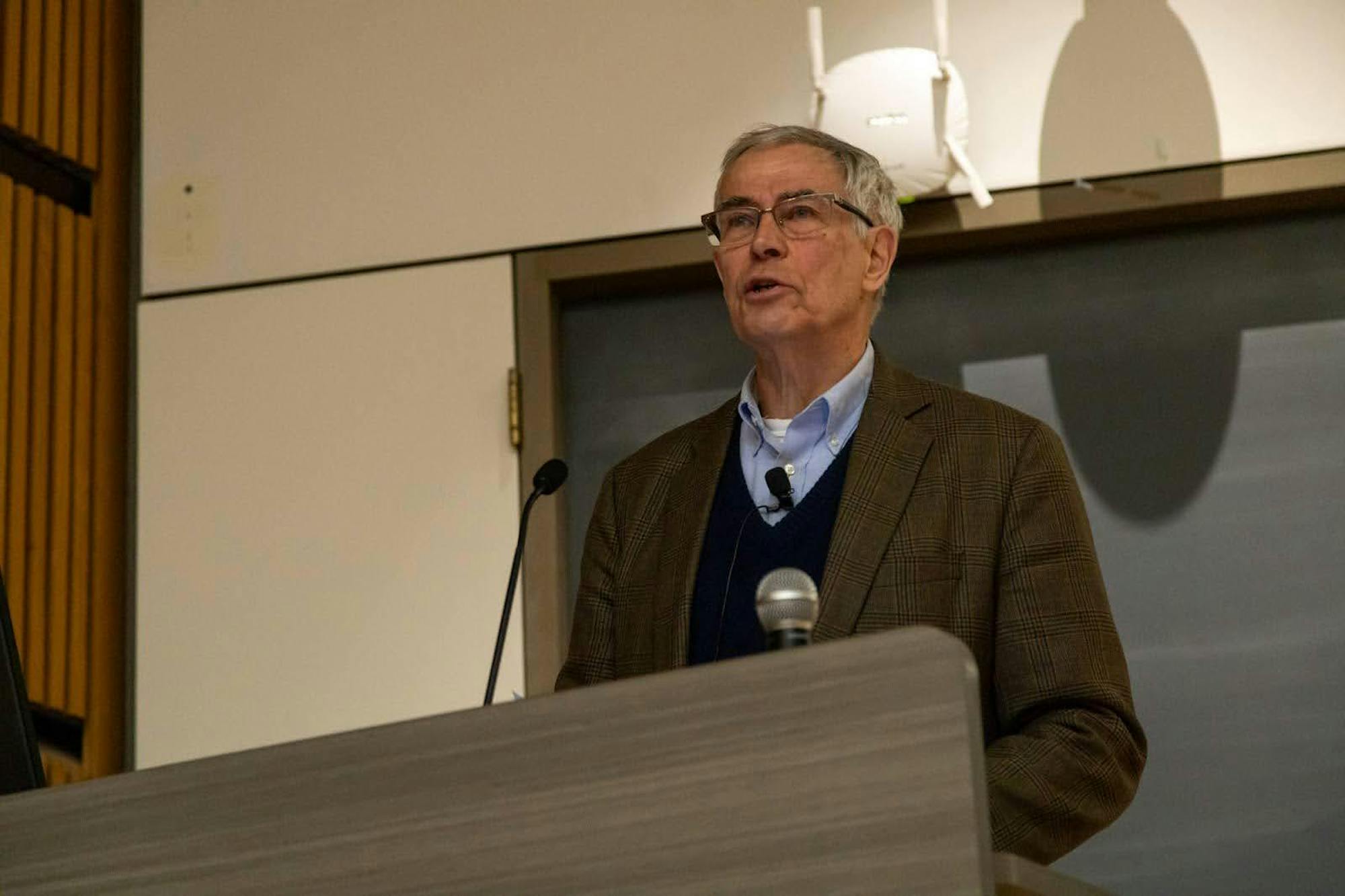
Crossing between the spheres of science and politics, former United States Congressman Rush Holt brought his breadth of experience to a talk and panel discussion in Goldwin Smith Hall on Thursday. Holt reflected on how the current state of science in the U.S. came to be and outlined possibilities for where it can head in the future.
The event followed smaller chats Holt had with students at Alice Cook House and Hans Bethe House earlier in the week. Part of the Sevin Seminar on American Political Values series, the talk was sponsored by the Cornell Brooks School of Public Policy’s Center on Global Democracy, the West Campus House System, the Committee on the Future of the American University and the Carl Sagan Institute.
Building on his background as a physicist, teacher and researcher, Holt worked in the Nuclear and Scientific Division Office of Strategic Forces for the U.S. Department of State from 1987 to 1989, and became the assistant director of the Princeton Plasma Physics Laboratory from 1989 to 1997 before being elected to Congress.
After his time representing New Jersey’s 12th Congressional District from 1999 to 2015, he led the American Association for the Advancement of Science as the CEO-Emeritus until he retired in 2019.
A diverse group of Cornell professors joined Holt as panelists, asking questions and using their expertise to offer potential solutions to improving connections with the public. This included Vice Provost for Engagement and Land-Grant Affairs Prof. Katherine McComas, communication, Prof. Lisa Kaltenegger, astrophysics, the director of the Carl Sagan Institute and Prof. Christine Smart, plant science, the Goichman family director of AgriTech, an interdisciplinary hub at the forefront of innovation in food and agriculture industries through research, education, and leading outreach efforts for New York State and beyond.
The panel discussion emphasized creating close relationships between experts and the public through shared values, distinguishing between political and scientific issues and embracing humility to be a trusted resource in the community.
“We have to do the hard work of being on the ground and forming relationships… [scientists] haven’t worked closely enough with the people to understand [their] challenges,” McComas said.
Throughout the talk, Holt highlighted the gap between scientific experts and general audiences, recognizing how essential strong communication methods are in promoting a thriving society.
“Science and democracy reinforce each other,” Holt said.
Holt recalled how at the end of World War II, American engineer and inventor Vannevar Bush introduced the concept that “science is the proper concern of the government” and that research should culminate in outputs that can be delivered to citizens. This defined the American landscape for scientific enterprise in the following century, according to Holt.
Holt also invoked former Cornell astrophysicist and science communicator Carl Sagan in spotlighting that the process of science, rather than its mere products, is the path for reliable knowledge.
“You can seek the evidence, you can reduce the bias, you can seek verification of the claims, you can start the process and change minds,” Holt said.
From mistrust to skepticism, Holt expressed concern over public perceptions of science. This was exacerbated in January 2025, when the federal government abruptly reduced research funding for many projects across the country, leaving research categories eliminated, entire grants cancelled and research managers fired, according to Holt.
“This is not a routine budget adjustment. It is a shock to the scientific system,” Holt said.
Courts have now restored some portions of funding and Congress has disregarded proposed cuts, passing a flat budget comparable to earlier years before 2025.
“But the damage was real – laboratories were disrupted, careers derailed, international partnerships shaken and trust was broken,” Holt said.
For Holt, the most striking part of the situation, however, was the “muted public reaction” and lack of “sustained national outcry” where silence signaled absence of care.
“The real crisis of science is not in the funding [or] in the survival of research grants: it is that most people do not feel that science is for them,” Holt said.
However, there is hope for recent politicized actions to serve as an inflection point. Holt reiterated the importance of scientists communicating research and encouraging evidence-based thinking to the public.
Astronomy Ph.D. students Abby Boehm, Aiden Zelakiewicz and Isabela Huckabee were among those in attendance, interested in how science communication can be used in their work — from advocating for funding to sharing research findings with the public.
“Whatever is going on in the U.S. has repercussions for the rest of the world,” Huckabee said.
Boehm took away the message that everyone can engage with science. Making observations can be the basis of participation and learning about something as vast as the universe.
“People separate scientists from themselves. The message I really want to carry forward after this talk [is] getting people to realize that they are scientists,” Boehm said.
Being proactive to establish change in all levels of science and political realms is crucial for democratic governance, said Holt. Emerging light into the darkness of uncertainty by increasing dynamic dialogue between experts and the public can shape a brighter future ahead for science everywhere.
Leah Chang is a member of the Class of 2028 studying environment & sustainability in the College of Agriculture and Life Science. She is a staff writer for the science and technology department and can be reached at lchang@cornellsun.com.