


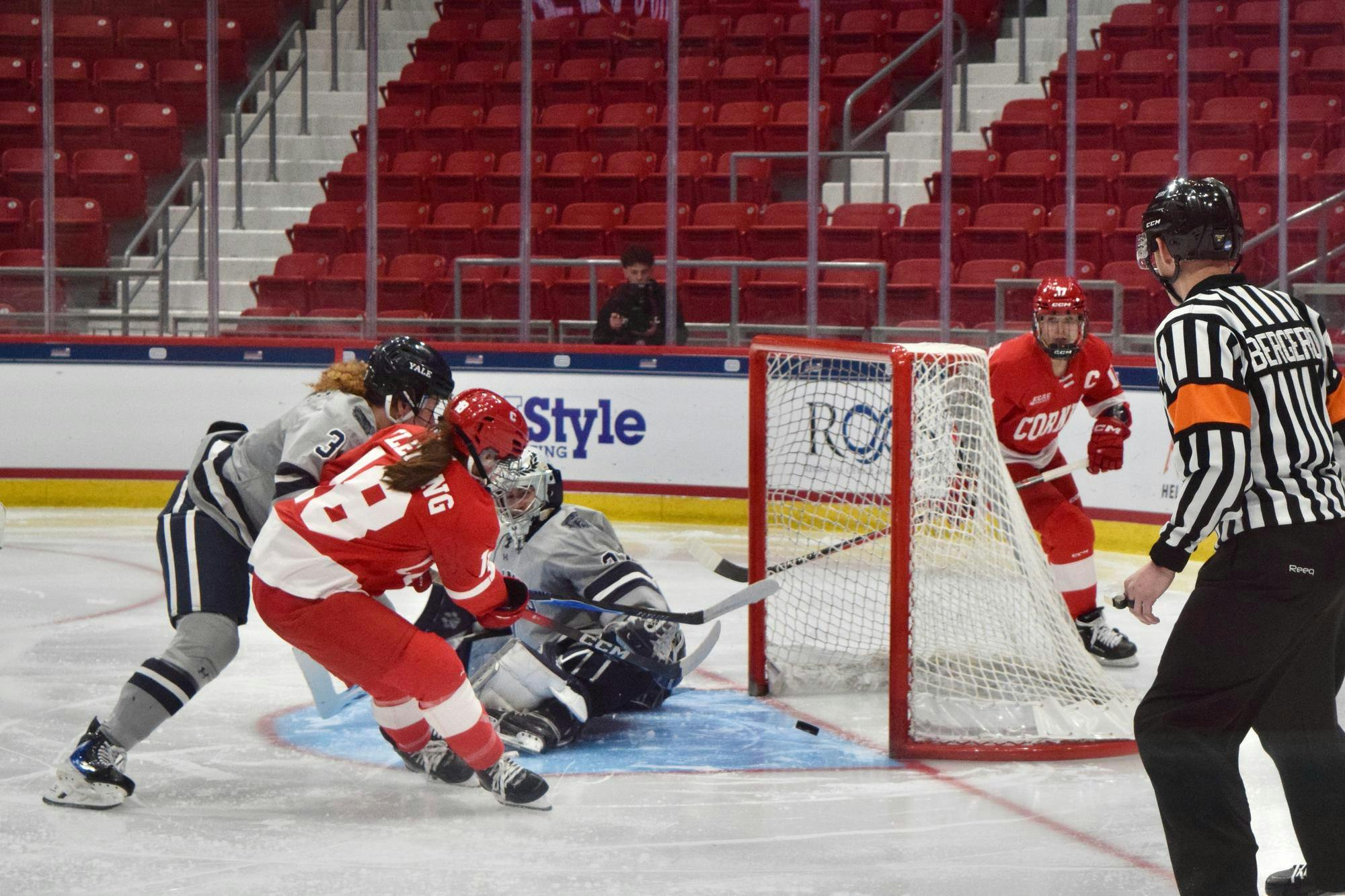
LAKE PLACID, N.Y. — For the first 44 seconds of women’s hockey’s ECAC semifinal matchup against No. 7 Yale, the Red looked like an experienced team, one primed and ready for playoff success. Senior forward Mckenna Van Gelder won the opening faceoff, junior forward Karel Prefontaine found an open senior forward Avi Adam streaking towards the net, and less than a minute into the game, Cornell had a 1-0 lead.
Just under three hours later, Doug Derraugh ’91 apologized to his team in the locker room. The Red had fallen, 7-2, and Cornell’s season was over.
“I apologized to them [because] I’m the leader of this team, and I did not feel that I got the best out of this team,” Derraugh said when asked about his message to his squad postgame. “But I [also] said, ‘I enjoyed the journey. I enjoyed the process. I enjoyed working with them, because they love to come to the rink and they wanted to work and they wanted to get better.’
“And I love that more than anything else. I love being at the rink and working with people that just want to work at the game and want to be the best they can. So it's always exciting when you have a group like that. It's just unfortunate that we weren't able to move on and do a little better than we did for the seniors.”
For the Red’s six seniors, the disappointing conclusion of the season spells the end of their Cornell careers. For defender Sarah MacEachern, her final moments wearing a Cornell sweater were not spent dwelling on the defeat, but instead reflecting on four years playing alongside her best friends.
“I had a lot of gratitude in that last minute,” MacEachern said. "There's nowhere else I'd rather be. Did I wish the game went differently? Yeah, a lot different. But I was happy to look to my left and right and be with the people that I was with on my bench.”
Cornell entered the season ranked fourth in the nation after reaching the 2025 Frozen Four, and boasted an All-American goaltender, junior Annelies Bergmann. But due to a series of surprising losses in a mid-season swoon, the Red needed to capture the ECAC title to return to the NCAA tournament for a third consecutive season.
Though the Red kept the semifinal game within reach until midway through the third period, a backbreaking shorthanded goal by the Bulldogs meant that Cornell will have to wait until the 2026-2027 season for a chance to win its first women’s hockey national championship.
Despite Adam’s early strike, Yale looked like the better team throughout the opening frame. In the face of an unrelenting forecheck, Cornell repeatedly turned the puck over in its defensive zone, forcing Bergmann to make multiple difficult saves.
Things got worse for Cornell when junior forward Delaney Fleming was whistled for slashing 13 minutes into the period. On the ensuing Bulldog skater-advantage, Bergmann made three more stellar saves, but a loose rebound and a falling Cornell skater gave Yale the netfront chaos it needed to equalize the score.
The Red’s struggles continued. With the puck rarely leaving the Bulldog offensive zone, Yale took the lead three minutes after tying the game when another second-effort shot off a rebound slipped by Bergmann.
After the first intermission, Cornell fixed some of its turnover issues, and back-and-forth play resumed. But just when it seemed like the Red was getting in a groove offensively, an ill-timed neutral zone turnover gave Yale a four-on-one breakaway, which the Bulldogs converted to take a two-goal advantage.
“I don’t think we played one of our better games this year, and it was the wrong day to not play one of your better games,” Derraugh said.
The Bulldogs’ lead increased eight minutes into the stanza when a defensive miscommunication from Cornell left a Yale skater alone in front of Bergmann.
Down three goals, the Red finally began to respond. Late in the period, Cornell hoisted shot after shot — eventually outshooting the Bulldogs 12-5 and outchancing Yale 31-9 in the middle frame — but could not beat first-year netminder Samson Frey.
“I'll give [Yale] credit. They’re really patient. I think we could have done a better job trying to attack their [defense] using our speed,” MacEachern said. “But at the end of the second going into the third, we kind of got that down and we had our chances.”
That momentum carried over the third period. 99 seconds into the frame, on a two-on-one rush, Van Gelder backhanded a pass to Fleming who found the back of the net. For a moment it seemed like the comeback was on.
“In the second half of the second period, and into the third period, I thought we carried a lot of the play and then got that quick goal. And I thought we had a good chance to make a comeback there,” Derraugh said.
Six minutes later, the Red earned its second power play of the game. But after a pair of missed Cornell shots, Yale picked up the puck and converted a two-on-none chance to extend its lead to three. Derraugh dubbed the shorthanded goal — the third shorthanded goal the Red had conceded all season — the game’s “turning point.”
Trailing 5-2, Cornell pulled Bergmann with over six minutes remaining in the contest, but the Bulldogs almost immediately capitalized on the empty net. After a final Yale goal with five seconds left ensured the five-goal deficit would be the steepest of Cornell’s season, the final horn sounded on the game and the Red’s 2025-2026 campaign.
In the locker room post-game, Derraugh had a final message for the Class of 2026.
“I said, ‘I think [seniors] always see this last game as my last game in a [Cornell] jersey, but you’re a Cornellian for life, they’re alumni for life, they’re family for life,’” Derraugh said. “It doesn’t end with this, or with graduation. … If they ever need anything the rest of their life, we’re here for them.”
Eli Fastiff is a senior editor on the 143rd editorial board and a member of the class of 2026 in the College of Arts and Sciences. You can follow him on X @Eli_Fastiff and reach him at efastiff@cornellsun.com.


