


Women’s hockey keeps losing. It’s difficult to figure out why.
The Red started the season with seven straight wins — picking up right where the team left off last spring when Cornell took a 16-game undefeated streak into the Frozen Four. But since a weekend off for fall break, over two seasons of good vibes and dominant play have fallen by the wayside.
For the first time since the 2022-2023 season, the Red (10-5-1, 6-4-0 ECAC) have lost five games in less than a month. What makes its recent slump so perplexing is that there’s no common on-ice theme in the losses.
While Cornell has come out just plain flat (like in its loss to Colgate), or struggled to score at even strength (like in its losses to Union and Quinnipiac), other times it has mostly outplayed its opponents, but committed key fatal errors (like in its losses to Vermont and Princeton).
The historical context surrounding this year’s team adds to the unexpected nature of the past four weeks.
Two seasons ago, the Red fielded the best player in the nation in Izzy Daniel ’24 and lost just four times to non-Colgate teams en route to winning its first NCAA Tournament game since 2019.
Last year, Cornell was even better, losing just twice in conference play before taking down multiple top-ranked teams in the postseason and earning a trip to the Frozen Four.
This fall, everything pointed towards another successful season. Cornell was picked to win the ECAC in the preseason coaches poll and its No. 4 ranking in the inaugural USCHO.com poll conveyed a national expectation of a third-straight NCAA Tournament berth.
With all the preseason expectations and recent track record of success, why is Cornell sitting fourth in the ECAC Hockey standings and on the outside of the national tournament picture?
The Red has forgotten how to lose. For nearly two seasons, wins were both an expectation and a reality. Suddenly, this expectation is no longer yielding the same results.
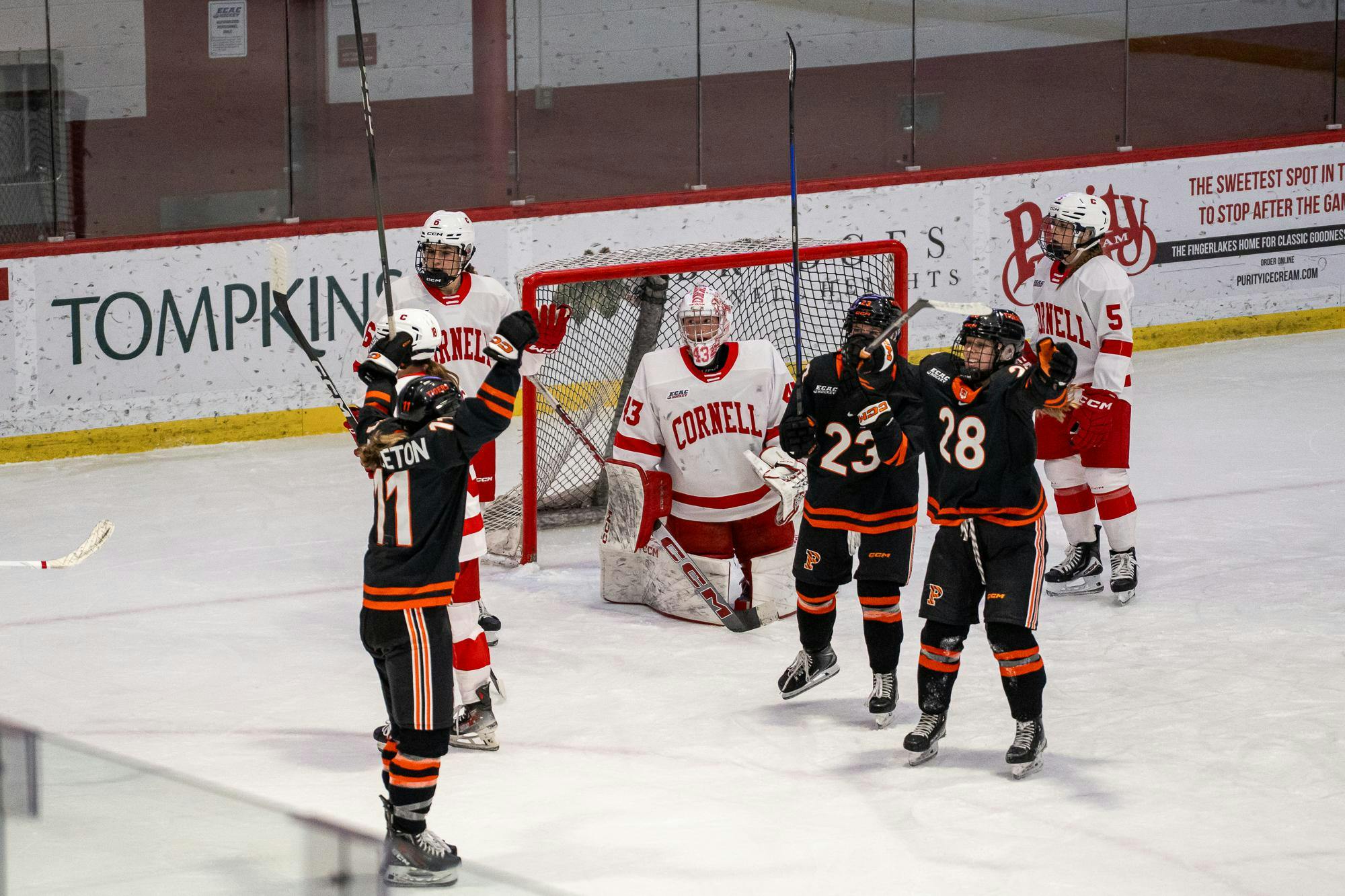
So, it’s not surprising that the team looked stunned on Saturday after giving up three goals in 118 seconds to put Cornell behind for the third time in four games.
“I don’t really know,” said junior forward Delaney Fleming after the 3-2 loss to Princeton. “Last year it obviously went a little differently, so I don’t really think we’ve been on this end of it for a while.”
Cornell, a team chock-full of players with junior national team, NCAA Tournament and overall big-game experience, is suddenly finding itself in a new place: struggling in the regular season. For 70 percent of the roster, this November marked their first time experiencing losses to unranked teams in back-to-back weekends.
“I don’t know if [the young players on the team] always understand the magnitude of each game,” said head coach Doug Derraugh ’91. “I don’t think any team in our league is good enough to have those lapses. It was almost maybe too easy early on and maybe we were rolling too good, and that message — even though you try to get that across to them as a coach — doesn’t resonate until you start having these tough patches.”
After the team’s first loss of the season, a 3-0 drubbing at the hands of rival Colgate, Cornell responded with an inspired 4-3 comeback win. Unfortunately, the next two weeks were filled with more lapses.
First, Cornell fell to Union on the road for the first time in two decades before having a 17-game winning streak against Syracuse snapped by a 2-2 tie (Cornell sandwiched a 4-1 win over last-place Rensselaer Polytechnic Institute between the two games).
After the tie with the Orange, Derraugh blamed a lack of decisiveness and aggression for the team’s mediocre play, which he felt may have stemmed from the recent surprising losses.
Despite the coaching staff preaching a return to its early season consistency, Cornell’s next weekend series ended with another disappointing split — this time against the University of Vermont. The Nov. 28 4-3 loss was characterized not by a lack of aggression (the Red seemed to break out of its even strength slump despite the loss), but by a series of defensive mistakes.
The following weekend, Cornell dominated nearly every statistical category except for goals thanks to some bad bounces and more defensive breakdowns. The pendulum had swung in the other direction. The Red’s lack of decisiveness was replaced by desperation.
“I felt like we were trying hard, but we were hurrying things,” Derraugh said after the 3-0 Friday night loss to Quinnipiac. “It’s always like, ‘play fast, but don’t hurry,’ and tonight it looked like we were hurrying our plays, rushing things.”
A lack of execution defined the program’s first winless home weekend in two seasons. 31 shots on Friday and 34 shots on Saturday yielded just two goals, while numerous phenomenal individual goal-scoring efforts from opposing skaters made the Red’s struggles seem all the more frustrating.
“You need goals to win, so that kind of sucked,” said senior forward Mckenna Van Gelder after Friday’s shutout loss. “I don’t think we prepared like we should have today.”
While Derraugh believes his veteran players understand the importance of each game’s outcome, he also thinks the team’s six freshman — five of whom see consistent ice time each game — may still be adjusting from the 50-100 game seasons played in junior hockey where “every game doesn’t quite have the importance it does in college.”
The good news for Cornell is that they will have plenty of time to reset before the second half of the season. With 24 days between Saturday’s loss to Princeton and the team’s next game, now is the perfect time for a mental reset, according to Derraugh.
“It’s a good time for a break and a good time for us to go through some things with the team, reflect, and hopefully right the ship in the second half,” he said.
But when players return to campus, the Red will need to right the ship quickly. The second half begins with Cornell’s best chance to launch itself back into the NCAA Tournament conversation, a showdown with No. 4 Penn State.
A win or a tie against the Nittany Lions, followed by a strong showing against Clarkson and St. Lawrence back at home would put the Red back on track. But wasting the chance to do damage against teams currently ahead of Cornell would keep the team in its unfamiliar position: outside, looking in.
Eli Fastiff is a senior editor on the 143rd editorial board and a member of the class of 2026 in the College of Arts and Sciences. You can follow him on X @Eli_Fastiff and reach him at efastiff@cornellsun.com.


