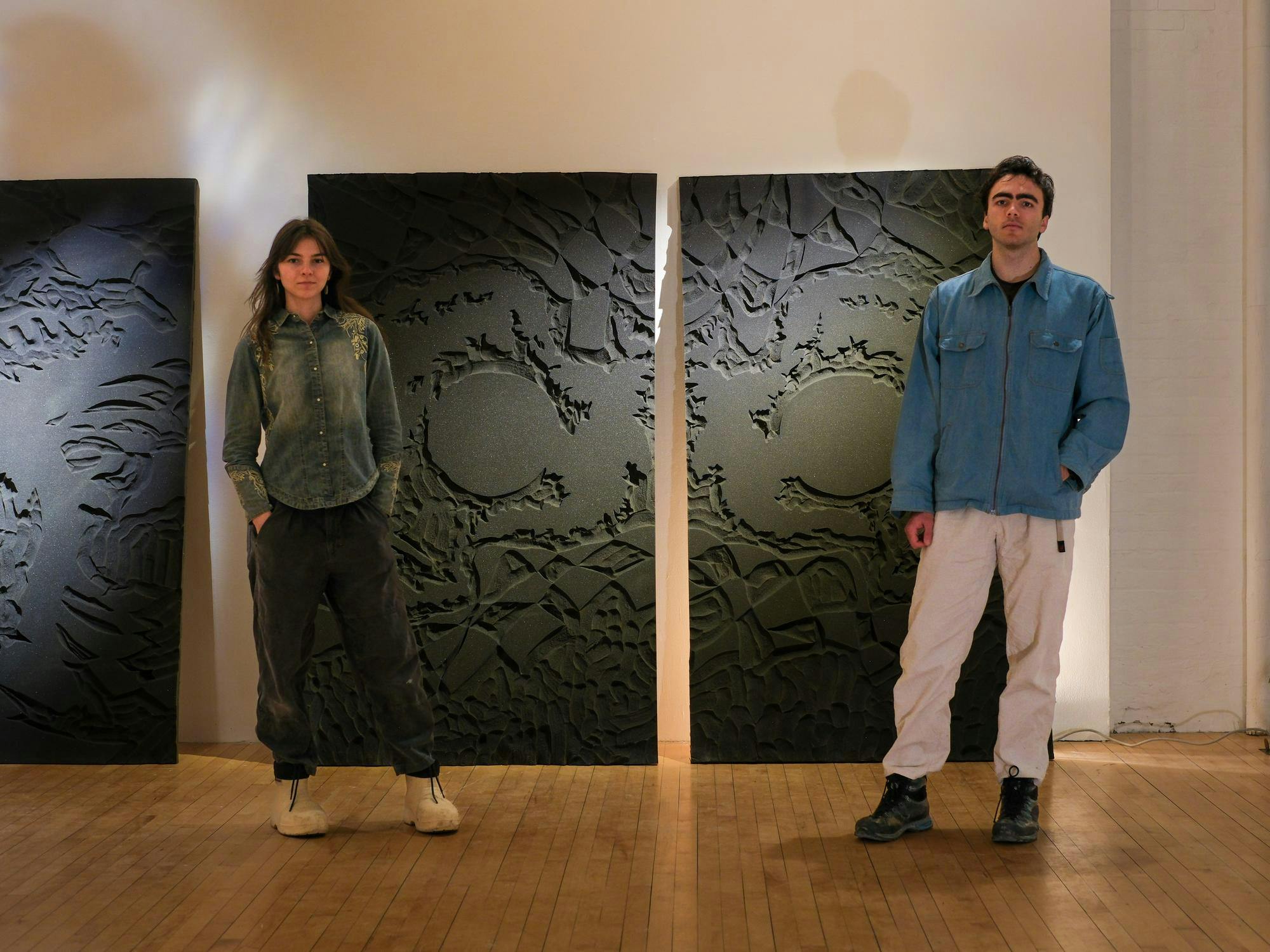
With every increasingly worrying headline I read, I wonder a few things, including but not limited to: Do people believe in science anymore? Do people believe in art anymore? Do people believe in each other anymore? And maybe those are pessimistic musings, but I’m comforted by the fact that, at Cornell, students are answering in the affirmative. Arden Conine ’26 and Jackson Fellows ’24 gave a resounding ‘yes’ to these questions in the form of an art installation. “Forcings,” a collaboration between Conine and Fellows, explored sonification, tidal frequencies and their translation into art, highlighting the process of listening and viewing in tandem.
The first thing I would have described the gallery as was confusing. Walking in with no prior knowledge about the theme or installation, the massive black panels of foam lining the walls caught me off guard. They were imposing, to say the least, especially when coupled with the deep, guttural sound playing from a speaker somewhere hidden in the room. When I spoke to Conine last year, she showed me colorful prints on handmade paper. This was about as far a cry from that as you can get. But, more often than not, the value of art is that you have to sit with it. Certainly, I felt exponentially more connected to the exhibition the longer I stood in that empty-yet-full room, resonant with unnameable sound and bathed in the diffuse light of blocked-off windows.
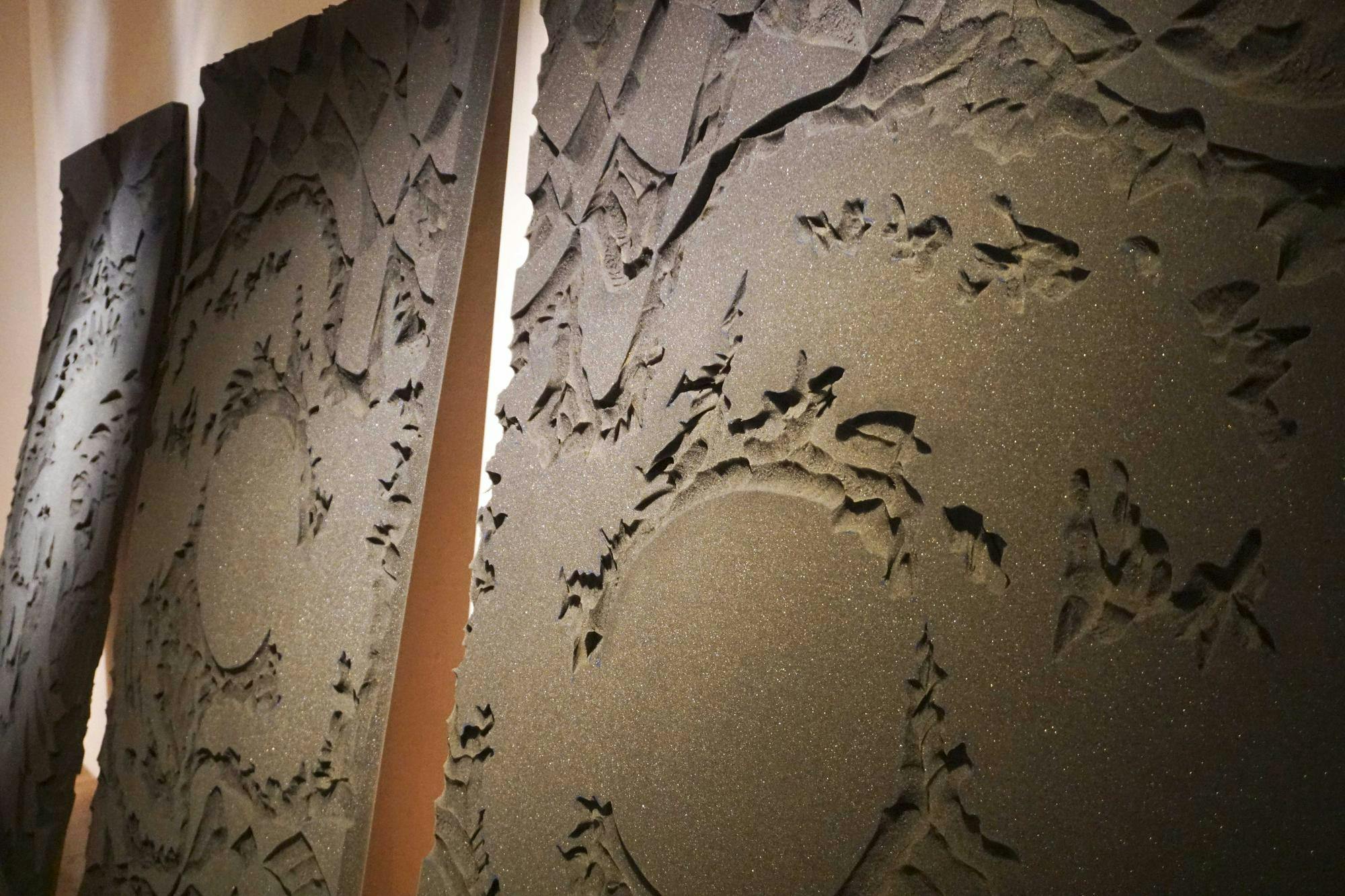
Initially, I was intrigued by the choice of material. The physicality of the foam drew me in. I could see the ridges of each carved-out piece — mini waves of shape within the broader design. Along those indents, it felt as though I could see every deliberate mark Conine had made in carving the foam, taking me back through her process just by looking. All the while taking careful steps around the gallery, I listened to the inescapable, vibrating noise (which I later learned was Fellows’ computer-generated tidal frequencies) — immersive and sonorous and somewhat haunting.
Conine explained the inspiration behind this gallery as an instantaneous one. “I found out that I had this space and immediately knew I wanted a sound piece. Just thinking about sound and ways to experience it, I was immediately drawn to foam as a material,” she shared.
The exhibit itself was an extension of Conine’s thesis work, which “has been really [centered] around the relationships of different things in nature.” Fellows, as a Ph.D. student at the California Institute of Technology, focuses his research on glaciology and the systems of ice flows responding to a warming climate. “I ended up pretty inspired by it [Fellows’ research],” Conine said. After deciding to pursue a collaborative science-art topic, it was just a matter of putting that inspiration into visual and sonic form.
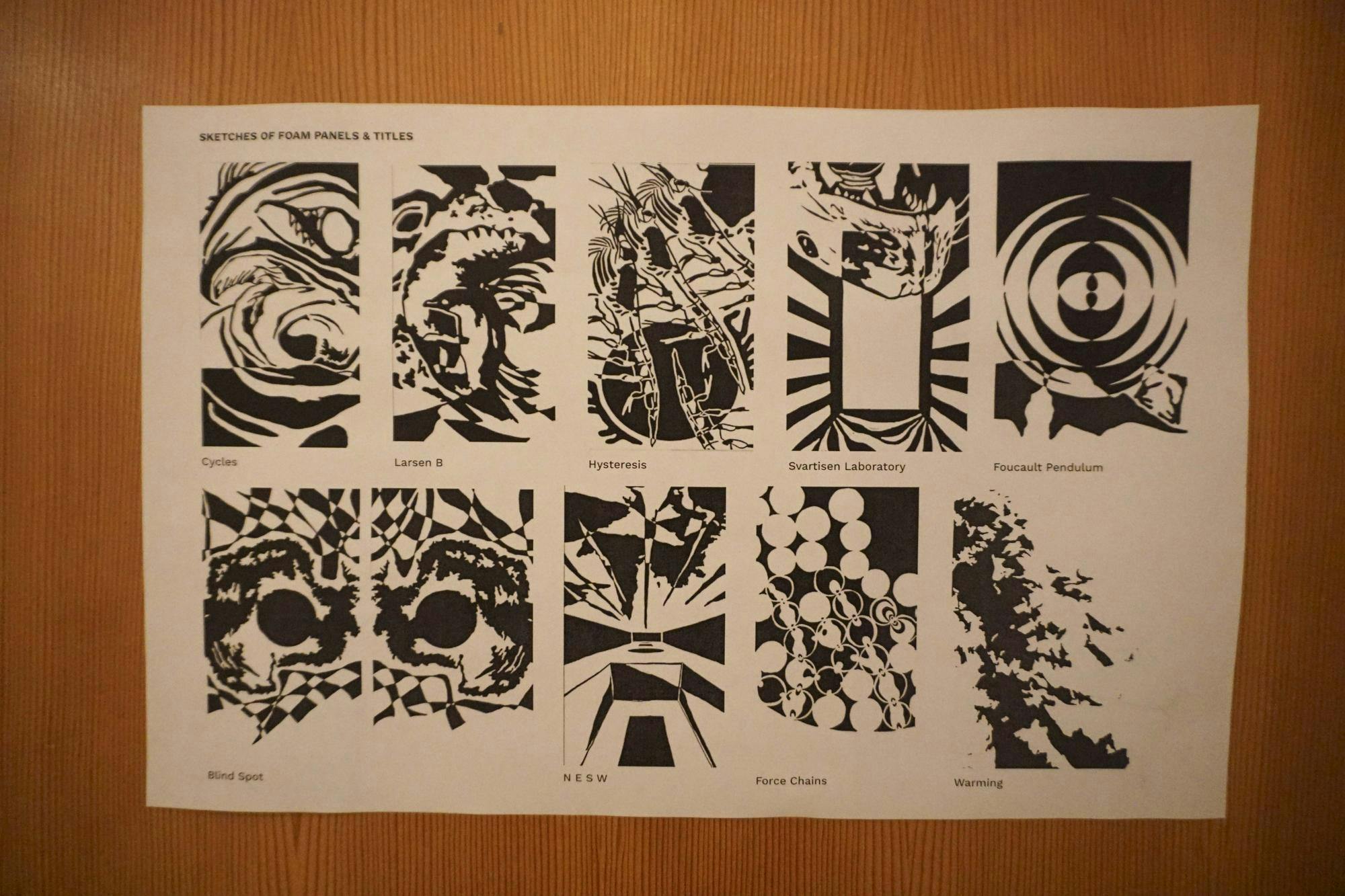
Conine and Fellows described the collaborative process as challenging but rewarding. Conine would listen to the tidal frequencies Fellows generated and allow herself to sketch what came to mind, which ended up as a mixture of representations of earth cycles, animal inhabitants of Antarctic areas, abstraction and the feeling of unknown depths to be explored. Both Conine and Fellows agreed on their favorite pieces: the two panels which made up “The Blind Spot.” These dual carvings represent the blind spot over the South Pole left by most satellites, orbiting around what they cannot see — a gap in our knowledge and an invitation to look closer embodied in physical art.
While the foam carvings were static, they felt anything but. Standing in the gallery, I felt almost buffeted by the sound of Fellows’ tidal frequencies echoing off the walls and through the floor. Certainly, the movements of the sound waves came across exactly as Conine and Fellows intended. “For scientists working on things that are related to climate change, it can be really hard to communicate that to the public about these big, abstract, scary topics. I’m optimistic that art can be a way to do that,” Fellows said. Conine agreed, adding, “Art is a great way for science to be translated for people. It’s exciting.” Seeing the result of their collaboration, I find myself sharing in their optimism. Even surrounded by so much that’s unknown, turning that unknown into art and thereby inviting viewers to explore the opaque depths is powerful, undeniably.

Melissa Moon is a member of the Class of 2028 in the College of Arts and Sciences. She is the arts & culture editor for the 144th Editorial Board and was an assistant arts editor for the 143rd Editorial Board. She can be reached at mmoon@cornellsun.com.