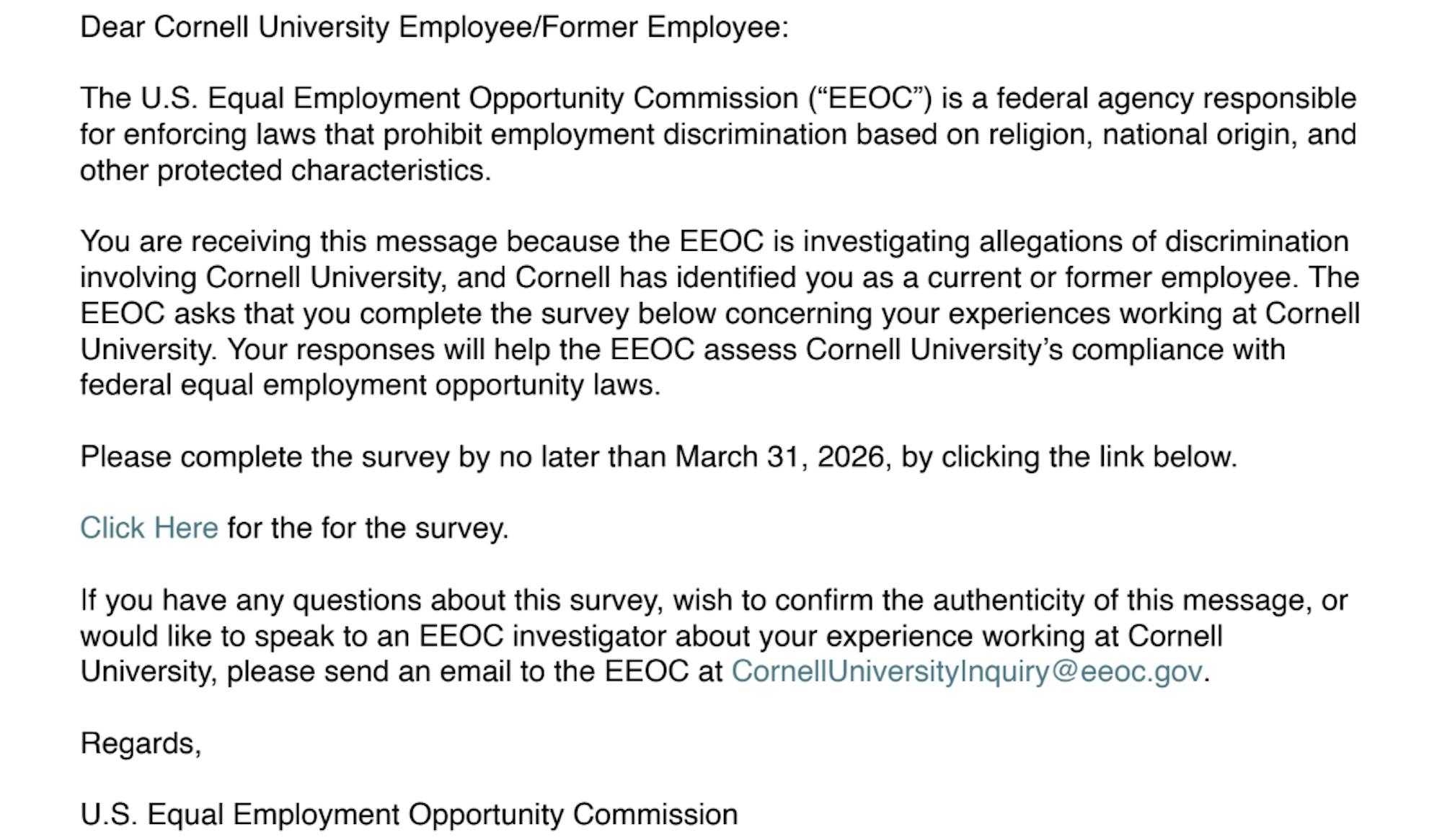
University employees received a federal survey on March 17 as a part of an ongoing investigation by the U.S. Equal Employment Opportunity Commission into alleged discrimination offenses.
This is the second time University employees have received such an email this academic year, after a survey was sent out from EEOC on Sept. 10 inquiring about antisemitic communications, hiring rubrics and anti-bias training, according to a former Cornell employee.
According to the March 17 email obtained by the Sun, the EEOC contacted current and former University employees, stating that the agency is “investigating allegations of discrimination involving Cornell University” and requesting that recipients complete a survey detailing their workplace experiences.
The email emphasized that employee participation would help the agency in “assess[ing] Cornell University’s compliance with federal equal employment opportunity laws.”
The survey asks employees whether they experienced certain conduct “because [they] practice Judaism, have Jewish ancestry, are Israeli, and/or are associated with an individual(s) who is Jewish and/or Israeli.”
It lists a range of possible experiences, including “harassment, intimidation,” “unwelcome comments, jokes, or discussions” and protests or demonstrations that “limited or obstructed access to workplaces or made individuals feel “threatened.”
The EEOC describes the questionnaire as part of “an ongoing EEOC inquiry” and states that employee responses are “a critical part of EEOC’s investigative process.” The agency also notes that it is unlawful for employers to retaliate against individuals for participating in such an inquiry.
In a March 19 statement, the University said it was aware of the EEOC inquiry and that it “will cooperate with any government investigation.” The University added that it “does not tolerate antisemitism or any form of discrimination” and pointed to existing policies prohibiting harassment and ensuring equal employment opportunity.
Media relations declined to provide additional comment beyond the March 19 statement.
The inquiry comes after prior federal scrutiny of the University related to antisemitism allegations. In November 2025, the University reached a settlement with the federal government to restore access to research funding following civil rights investigations into whether the University’s handling of antisemitism complaints met its obligations under federal anti-discrimination statutes.
In a November 7, 2025, statement about the settlement, the University said government had “not been found in violation of Title VI of the Civil Rights Act of 1964 in any of the investigations or compliance reviews of the university’s programs,” and that “the government has agreed to close all of these investigations and reviews.”
However, the closure notably excluded ongoing investigations by the EEOC.
“Nothing in this Agreement applies to any currently pending EEOC charges brought by individual charging parties or third-parties against Cornell,” according to the settlement.
The EEOC survey, the March questionnaire includes questions about whether protests or demonstrations affected employees’ ability to access their workplace or created a threatening or disruptive environment.
University policies allow demonstrations and protests on campus, but prohibit conduct that disrupts operations or blocks access to buildings or workspaces. University policy also bars harassment and intimidation based on protected characteristics, including religion.
The email instructs recipients to complete the survey by March 31 and provides an option to speak directly with an EEOC investigator. The agency also advises respondents not to complete the survey using employer-provided devices or during work hours.
The outreach was sent during the final days of Ramadan and just ahead of Eid al-Fitr, one of the most significant holidays in Islam. The University’s Muslim community has marked the month with nightly prayers, fasting and community iftars, placing the federal inquiry during a period of heightened religious observance on campus as demonstrations related to the Israel-Hamas war have continued this academic year.
The EEOC has not publicly detailed a timeline or potential outcomes of the inquiry. Cornell is among several universities facing increased federal scrutiny over antisemitism allegations, according to a March 19 report by The New York Times.
Correction, May 1, 1:01 a.m.: This article was updated to correct a typo which indicated that the information came from a formal employee. It should have read former.

Emma Spindler is a member of the Class of 2028 in the College of Arts and Sciences. She is a senior writer for the news department and can be reached at espindler@cornellsun.com.