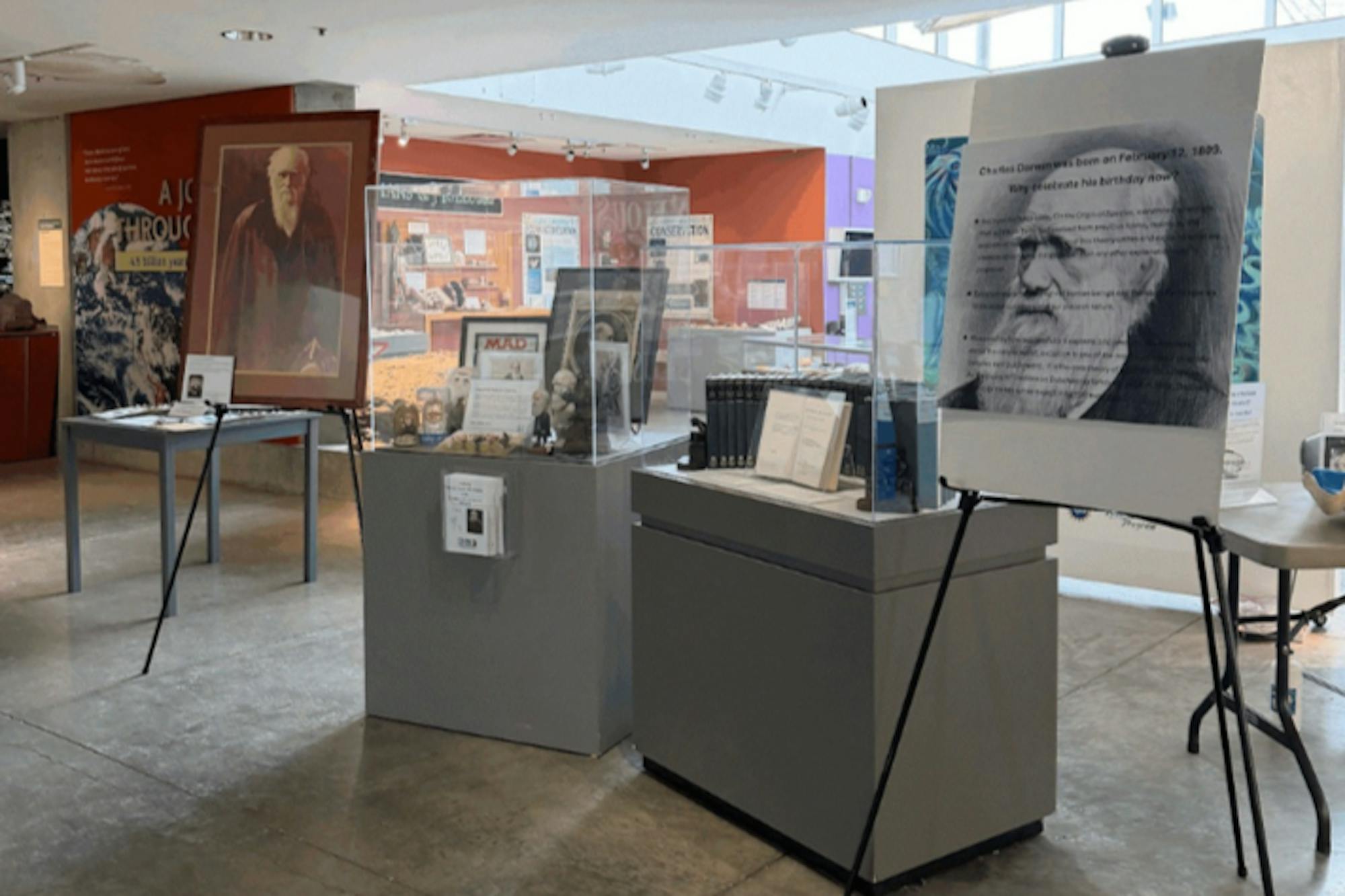
This year marked the 20th anniversary of the annual Darwin Days in Ithaca, which is hosted by the Museum of the Earth. More than 160 years after Charles Darwin's publication of The Origin of Species, Ithaca residents gathered from Feb. 10 to 14 to celebrate his discoveries.
Throughout the four-day event, students, families and local residents explored Darwin’s influential discoveries on evolution, like natural selection. From virtual academic lectures to hands-on experiences in the Museum of the Earth, community members learned about Darwin's impact on modern scientific knowledge.
Understanding Darwin’s work is foundational to understanding biology and life on earth, according to Museum Director Prof. Emeritus Warren Allmon, earth and atmospheric sciences.
“[Darwin] is one of the most important people ever to publish anything,” Allmon said. “Understanding his work is central to being an educated person.”
In February 2006, the Paleontological Research Institution, which hosts the Museum of the Earth, collaborated with Cornell and Ithaca College to host its first Darwin Days. The event was created after a national debate over evolution was intensified by the Kitzmiller v. Dover case in 2005, which challenged the idea of public schools teaching a non-scientific alternative to evolution. At the time, Cornell Interim President Hunter Rawlings III delivered a speech about the case’s widespread controversy, which helped spark discussion about science and Ithaca and beyond.
Over the past 20 years, Darwin Days has grown into a week-long celebration with participation from Ithaca and surrounding communities.
Each year, the event features a new theme. Researchers and educators are invited each year to host lectures about the given theme, many available through the Science in the Virtual Pub webinar series online, which has allowed the event to be more accessible to students. This year, Darwin Days focused on mollusk evolution with a special exhibition at the Museum of the Earth, titled “Marvellous Mollusks: The Secret World of Shells.”
The events throughout Darwin Days included informational lectures from guest speakers, networking opportunities and in-person events. A screening of Inherit the Wind, a film about how a teacher was arrested for educating his students on Darwin’s theory of evolution, was featured at Cinemapolis on Feb. 10. Additionally, a Business After Hours with Tompkins Chamber session was held at the Museum of the Earth on Feb. 11, which allowed attendees to network while admiring exhibits.
On Feb. 12, an online talk called “Invertebrate Pirates: How do mollusks steal from their prey” explained the unique abilities of mollusks, and a Darwin Family Day hosted in the Museum of the Earth on Feb. 14, featured mollusk-themed crafts, a fossil identification lab, a talk from snail biologist Rebecca Rundell and more.
Darwin Family Day was bursting with visitors and showcased exhibits such as marvelous mollusks, a glacier exhibit replicating the ice that formed along the Finger Lakes, and Amelia the Quetzalcoatlus flying reptile, to name a few, arranged in chronological order from before the dinosaur age to the modern day. A copy of Darwin's The Origin of Species was also on display. These exhibits gave evidence for evolution relating to Darwin’s findings.
Hands-on experiences, including handling fossils, allowed visitors to interact directly with mollusks and gain a deeper understanding of how evolution shapes the natural world.
PRI Associate Director for Outreach Prof. Robert Ross, earth and atmospheric sciences, explained the Museum of the Earth's reason for hosting the event was to increase awareness on his theory of evolution, and allow individuals to be exposed to the scientific community. “Our primary goal is to give people an opportunity to connect with nature and think about those ways in which evolution helps explain the patterns that we see in nature,” Ross said.
Allmon said the Ithaca community has an especially robust understanding of Darwin’s significance and importance in history, due to the large scientific community at Cornell and Ithaca college, along with the presence of the Paleontological Research Institution and Museum of the Earth. This allows deeper conversation within the public about Darwin's ideas.
“[Ithaca] is a community that exists here in part because of the importance of both learning and of scientific research, which is core to the livelihoods of many of the people that live in Ithaca and study here in Ithaca,” Ross said.
According to Allmon, the most important piece of information to take away from Darwin Days is the timeless significance of Darwin’s work. Evolution is at the center of biology, and Darwin's discovery of natural selection helped to further define this. As Allmon put it, “Everything we do touches on evolution in some way.”
Farrah Scott is a member of the Class of 2028 studying communications in the College of Agriculture and Life Science. She is a contributor for the science and technology department and can be reached at fas84@cornell.edu.