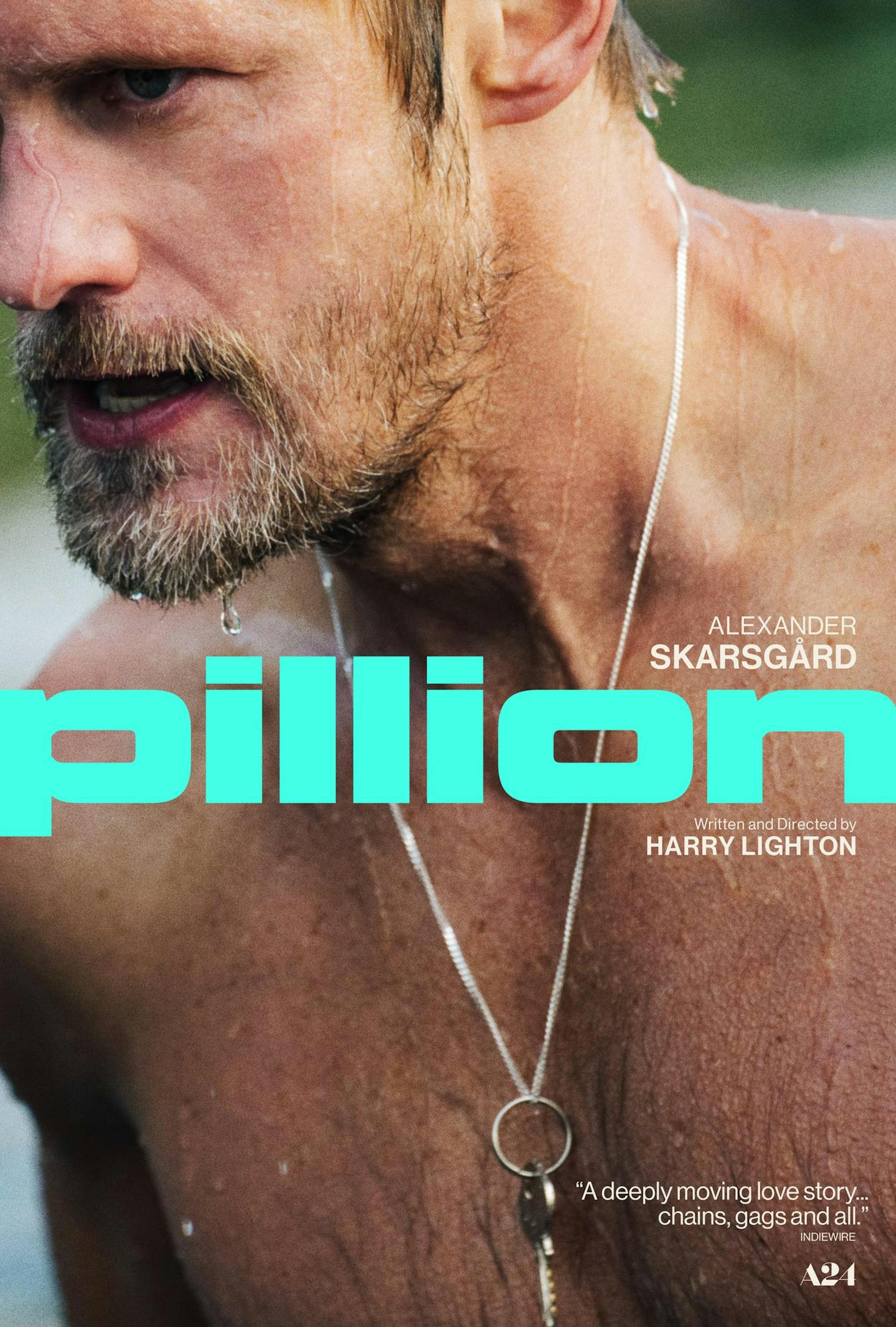
Pillion has easily been one of my most anticipated releases for the past few months. A November release in the UK, months before the U.S., only made me more anxious to see it. While I expected to enjoy it, I didn’t expect Pillion to have so much to say, and to be such a thoughtful, introspective exploration of the world of kink.
Based on a novel by Adam Mars-Jones, Pillion follows the quiet, unassuming Colin (Harry Melling) as he encounters a confident biker, Ray (Alexander Skarsgård). When Ray approaches him at a local bar, Colin expects a standard romantic relationship. Instead, Ray takes him on as a submissive and introduces him to an entirely new world. At first, Colin is happy with the attention that Ray provides him: In return for cooking, running errands and joining Ray’s biker gang, Colin receives some of the intimacy he’s been craving. It quickly becomes clear, however, that Ray lacks emotional intelligence, as he struggles to communicate his emotions. His closed-off nature, which once made him mysterious and enticing, makes it difficult for Colin to communicate his own needs.
In many ways, Pillion felt like a response to Babygirl, a film that I enjoyed but ultimately felt was lacking in its exploration of BDSM dynamics. At the center of Pillion is the London kink scene. In contrast to Babygirl, which depicted one singular relationship, here, Ray is part of a fetish community that welcomes Colin into the fold. Ray and Colin’s dynamic is contrasted with other, healthier relationships within Ray’s own biker group. Colin has conversations with other submissives that make it clear that Ray’s lack of communication isn’t the norm and help encourage him to stand up for himself. I found this incredibly refreshing in comparison to Babygirl, where Nicole Kidman’s Romy enters a dynamic with Samuel that lacks both communication and any exploration of the fetish community. Films depicting BDSM dynamics tend to follow a formula: A naive submissive enters a relationship with a more experienced man, who fails to communicate or set clear boundaries and safeguards, leading to inevitable turmoil. In different films, these relationships serve different purposes — Babygirl’s dynamic is intentionally illustrating and critiquing a toxic dynamic, while something like Fifty Shades of Grey might be more likely to romanticize it — but almost always lack any representation of healthy relationships. While Pillion begins in a similar fashion, its inclusion of a larger kink community makes it clear that it’s Ray’s guarded nature that makes the relationship toxic, rather than something inherent to BDSM.
I found this Letterboxd review from Ben Eales, who has experience in the London kink community, incredibly helpful in thinking through Pillion’s depiction of kink. While he found the central dynamic lacking, he complimented the overall film’s thoughtfulness and accuracy in portraying the larger fetish community. As Pillion begins to release in the U.S., I’ve seen some reviews claim that the film’s humor comes at the expense of the community it portrays, and that the film is even arguing against BDSM relationships. To me, writer-director Harry Lighton has successfully struck a delicate balance: Introducing a community that may feel incredibly foreign and perhaps even off-putting to some audience members, exploring facets of this community that might lead to toxic dynamics and ultimately portraying the range of positive experiences that come from kink. Through Colin, Lighton explores the kind of personality that is attracted to dynamics like these. While he starts off completely naive, Colin learns what he likes and dislikes, what he wants and needs and most importantly, how to communicate this to a partner. Pillion ends on a positive note for Colin: While his relationship with Ray is difficult and hardly healthy, it teaches him to advocate for his own desires. It’s hard for me to imagine someone coming away from Pillion’s final scenes feeling like the film had anything negative to say about BDSM as a whole. What makes the dynamic toxic and ultimately brings a melancholic note to the film is Ray’s personality.
Despite his put-on confidence, we quickly realize how uncomfortable Ray is engaging in any real intimacy. Skarsgård’s performance brings a multi-layered character to life, as we first struggle to figure out what Ray is really thinking or feeling, only to realize the real affection he feels for Colin later in the film. Ray is a fascinating character, and the discussions Pillion is willing to have about communication and repression give it an unexpected depth.
Pillion may have been one of my most anticipated films of the year, but I never expected it to be such an interesting exploration of two extremely complex characters. In the last few years, the plethora of gay movies and shows has allowed a variety of stories to be told. Pillion is unlike any other LGBTQ+ film I’ve seen, and it explores a topic in depth that would only recently be palatable to the mainstream. Above all, I think Pillion’s existence, and the range of discourse I’ve seen and expect to see as the film hits wide release, shows how important it is that stories like this are allowed to be told and released by known distributors like A24. Pillion is much rawer than you might expect, but I highly recommend giving it a chance.
Nicholas York is a junior in the School of Arts and Sciences. He can be reached at nay22@cornell.edu.
‘Projections’ is a column focused on reviewing recent film releases.
Nicholas York is a member of the Class of 2027 in the College of Arts and Sciences. He is a columnist for the Arts & Culture department and can be reached at nyork@cornellsun.com.