

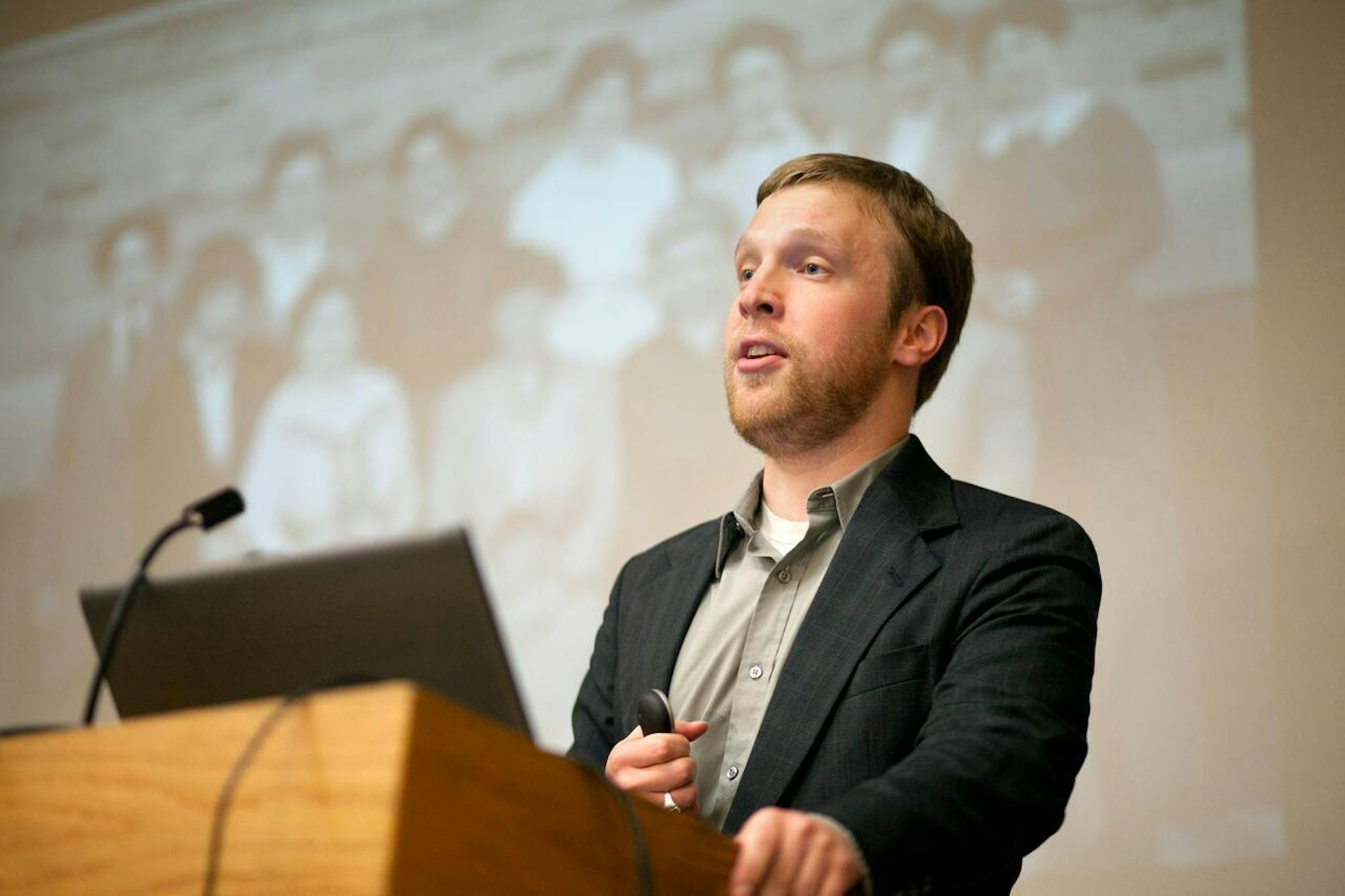
Did Cornellians invent chicken nuggets? Did The Sun previously publish details about upcoming parties? Did Ezra Cornell have nine children? AMST 2001: “The First American University,” ranked No. 7 on The Sun’s “161 Things Every Cornellians Should Do,” answers all these questions.
Students and guests fill Uris Hall’s auditorium seats and pack its aisles to watch American studies lecturer and de facto Cornell historian Corey Earle ’07 teach Cornell’s history on Monday evenings. The high-demand class has an enrollment capacity of 441 students.
According to Earle, the course centers around Cornell’s history, which is a valuable tool to assess current institutional challenges. Its lesson plans delve into faculty, the student body, the evolution of campus and important events and eras in Cornell history, according to its syllabus.
“The more we understand our history, the better we understand our present, and the better we can prepare for our future,” Earle said.
One student, Skylar Cooper ’26, said that the course has a nickname: “Storytime with Corey.” Earle’s conversational, casual teaching style often invites laughter during his lectures.
“I wish every professor taught like [Earle],” Cooper wrote in a statement to The Sun. “A history class could very easily become boring, but [Earle] continues to engage myself and fellow students.”
As an undergraduate student, Earle wrote for The Sun, which partly inspired him to teach the AMST 2001 course, he said. When he wrote a column for the paper, Earle said he was able to generate a sense of community by sharing fun facts and trivia questions to inform his classmates about Cornell’s historical events.
“There's a real opportunity to help students learn more about [historical events],” Earle said. “It helps people appreciate their Cornell experience more when they know about it.”
In 2014, AMST 2001 was canceled for the 2014-2015 academic year, which prompted students to create a petition calling for the University to bring it back. Subsequently, the class was offered as in the Spring 2015 semester.
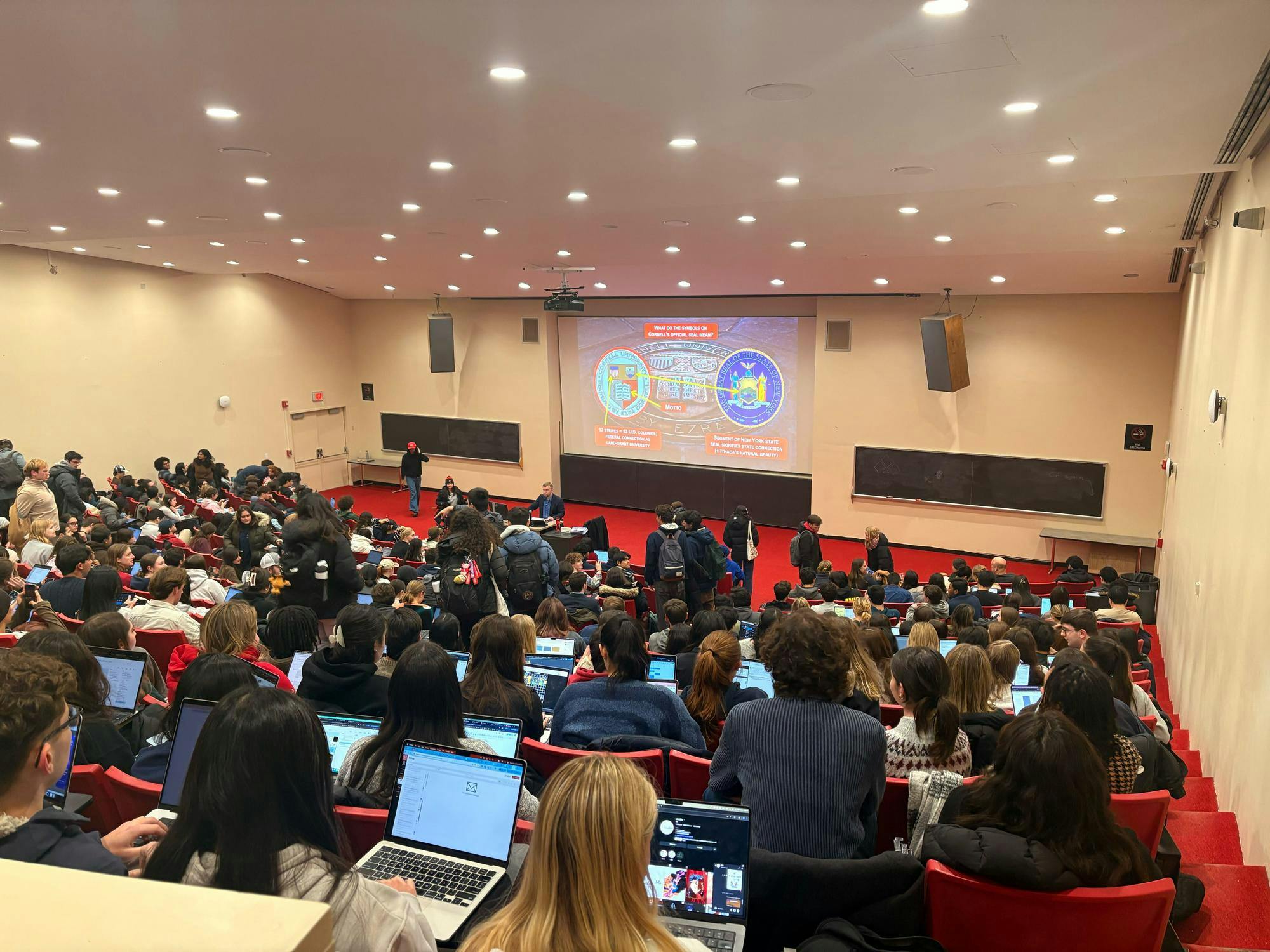
The class takes its name from educational historian Frederick Rudolph’s description of Cornell as the “first American university.” Rudolph emphasized Cornell's diversity of programs and students. Earle highlighted that the “first American university” also echoes Cornell’s motto, “Any person, any study,” which he said captures the versatility of Cornell’s curriculum.
The course also teaches students about Cornell’s differences from other higher education institutions.
Cornell was one of the first coeducational institutions that had no religious affiliation, Earle explained during a lecture. After being removed from the Society of Friends, or the Quakers, Cornell’s co-founder, Ezra Cornell, believed that any student regardless of their religious beliefs should be able to study at a university.
Earle also added that while higher education in 1865 was mostly only offered to wealthy, white, Protestant men, Cornell served as a pioneer for diverse student education.
“Students can see themselves in Cornell's history, and I think it helps them feel more of a sense of place and community and belonging,” Earle said.
Maddie Ferreira ’26, a student in AMST 2001, agreed with Earle’s sentiment, and wrote that after just a couple classes, she “already has a greater appreciation for this university.”
Maddie’s father, Jim Ferreira ’84, was a teaching assistant for Earle’s father, who graduated from Cornell in 1967. This personal connection inspired her to take AMST 2001.
“From the very first lecture it was so obvious that [Earle] loves what he does,” Maddie wrote in a statement to The Sun. “After just two lectures, I can already tell it is one of my favorite courses I have taken here in my four years at Cornell.”

Elizabeth Chow is a member of the Class of 2029 in the Brooks School of Public Policy. She is a contributor for the News department and can be reached at ec977@cornell.edu.


