Bad Bunny isn’t done making history.
Last night, at Cornell’s own Latino Living Center, a collaboration between campus organizations brought our Hispanic community together for a celebration of culture and music on the country’s biggest stage: the Super Bowl halftime show. Endearingly dubbed “Benito Bowl” by the Puerto Rican Student Association, the evening had students packed into the LLC’s lounge, ready to escape — for 13 glorious minutes — to Puerto Rico’s calentón during a freezing subzero night. While I can attest that it was a night filled with singing and dancing among our community, the evening's performance carried significance that resonated worldwide, making it a historic occasion for everyone in the Americas.
A week after becoming the first artist to win Album of the Year at the Grammys with an all-Spanish album — DeBÍ TiRAR MáS FOToS — Bad Bunny headlined the Super Bowl LX halftime show. At the Grammys, he made political statements critiquing the Trump administration's orchestration of the largest deportation campaign in the nation’s history — one that is actively targeting the Latino community. Statements such as “ICE out” and “We’re not aliens. We are humans, and we are Americans” left an expectation that he would echo these statements at halftime. It’s a strange time to be Latino in the United States, existing in a contradictory moment where relishing the success of Bad Bunny’s legendary career comes hand-in-hand with recognizing the grief and suffering of our community. What better way to resist oppression than to wave a flag of multicultural joy on the biggest stage of the very nation that wants you erased? And that’s just what Bad Bunny did, delivering a show-stopping performance that overflowed with pride, storytelling, symbolism, defiance and dancing.
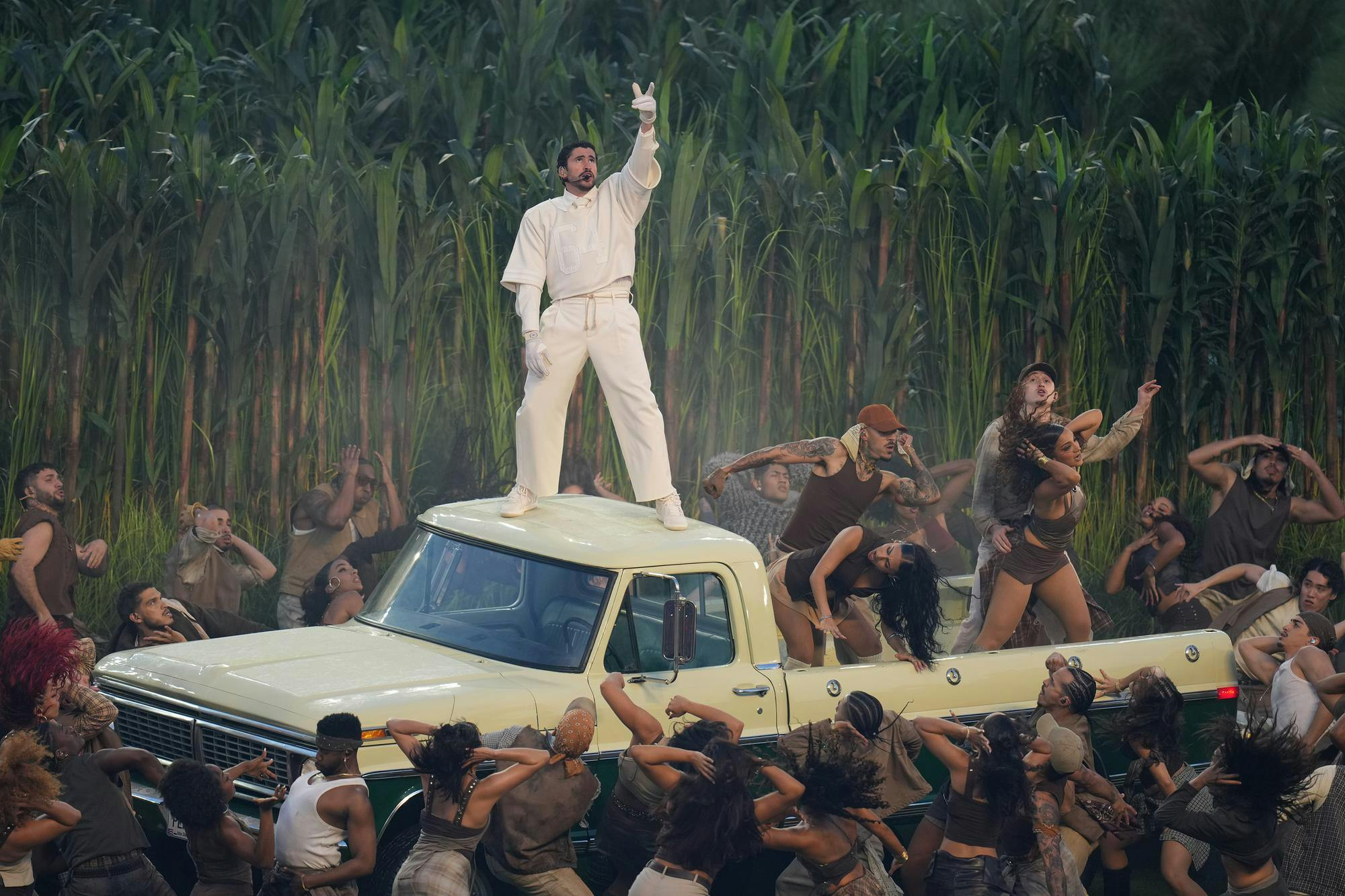
The show opened with a jíbaro (a Puerto Rican farmer), proudly exclaiming “¡Qué rico es ser Latino, hoy se bebe!” (translated: How great it is to be Latino, let’s drink today!), informing the audience that the night's performance would center around Latino pride. A title card followed, presenting “El Espectáculo del Medio del Súper Tazón” alongside our host, Benito Antonio Martínez Ocasio (Bad Bunny). A vibrant set transformed Levi’s Stadium’s 120 yards into a mini Puerto Rico. The audience was welcomed into a sugarcane field, where Bad Bunny kicked off his performance with “Tití Me Preguntó,” singing through dancers ‘farming’ and an array of nods to Puerto Rican culture, including a game of dominoes and piraguas. He transitioned to sing on the main stage, the famous pink casita (little house) from his residency in Puerto Rico. The casita was filled with star-studded guest appearances from Pedro Pascal, Young Miko, Cardi B, Karol G and more. The casita section of the show featured a sequence of his most popular reggaeton songs: “Yo Perreo Sola,” “Safaera,” “Party” and “VOY A LLeVARTE PA PR,” all accompanied by an ensemble of dancers keeping the vibes up. Bad Bunny broke through the casita’s roof, shifting the show’s storytelling to honor old school reggaeton, the formative music he grew up on. It’s here that we hear the iconic “Gasolina” by Daddy Yankee and “Pa' Que Retozen” by Tego Calderón — and then Bad Bunny’s own “EoO,” his tribute to classic reggaeton. An ensemble of violins led him into his next song, “MONACO,” quickly pivoting from Super Bowl performance to wedding reception atop the casita. The wedding interlude was, in fact, a real wedding for two fans who had invited Bad Bunny to their wedding — truly a legendary start to marriage. The wedding party split to reveal Lady Gaga as a guest performer singing a salsa rendition of “Die With a Smile.” While some viewers wondered why Gaga was there, I found it a powerful symbol of unity, solidarity and respect among artists. Gaga — an artist who primarily sings in English — remixing a pop ballad into salsa and participating in traditional salsa dancing was just one of the show’s many moments of cultural appreciation. Bad Bunny then spun Lady Gaga into “BAILE INoLVIDABLE,” his salsa ballad. The party erupted into energetic dancing, with exceptional camerawork threading viewers through the crowd, making nods to Puerto Rican celebrations — people of all ages dancing together. He exited the stage by trust-falling onto a crowd of “Nuyoricans” as his song “NUEVAYoL” began to play. The set shapeshifted yet again, this time into a New York City block, complete with its own bodega. It was here that he celebrated the diaspora through a phenomenal dance sequence and took a shot from Toñita, the founder of the Caribbean Social Club in Williamsburg.
In a heartwarming moment, Bad Bunny handed a little boy his Album of the Year award, as if to show him how far he’s come. The end of “NUEVAYoL” shifted the performance's narrative: With three minutes to spare, Bad Bunny doubled down on commentary on sociopolitical issues plaguing Puerto Rico and the U.S. Musical guest Ricky Martin sang a touching performance of “LO QUE LE PASO A HAWAii,” a song about living under colonization in PR, using the cautionary tale of “what happened to Hawaii.” Bad Bunny jumped into his penultimate song of the night with “El Apagón” (the Blackout), as dancers climbed onto electrical poles, critiquing Puerto Rico’s broken power grid. During this song, he proudly carried the Puerto Rican flag, an act of pride and protest against the island’s current government and its negligence.
The halftime show began to close with “CAFé CON RON” while a parade of flags from all over the Americas graced the field. Before closing the spectacle with his No. 1 song “DtmF,” Bad Bunny exclaimed, “God bless America,” and passionately began to name every country on every continent to spread a message of unity. He finished by holding up a football that said: “Together, We Are America,” a reminder that America is not just the U.S. As he jumped out of the field, a jumbotron message quoted his own Grammys speech, reading: “The only thing more powerful than hate is love,” and, I must say, last night’s performance was an unmistakable celebration of love.
Paulina Delgado Umpierre is a sophomore in the College of Arts and Sciences. She can be reached at pmd99@cornell.edu.

Paulina Delgado-Umpierre is a member of the Class of 2028 in the College of Arts and Sciences. She is a staff writer for the Arts & Culture department and can be reached at pdelgadoumpierre@cornellsun.com.