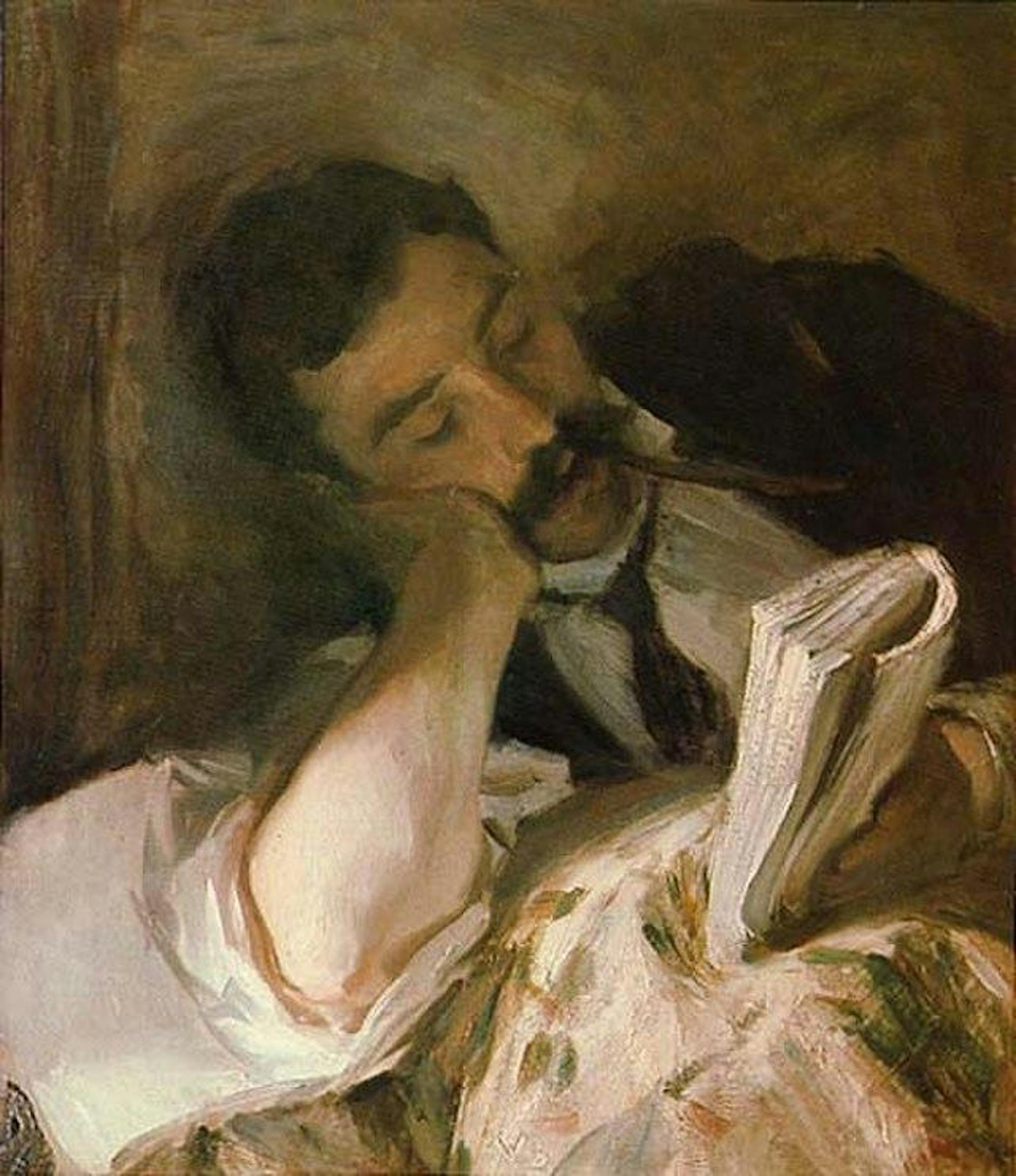
Men don’t read anymore.
I’m aware the blanket statement doesn’t apply to all men. There are active communities of 30, 40 and 50-year-olds devoted to authors like Brandon Sanderson and Cormac McCarthy. I know older men who are still avid readers and writers. I know middle-aged men who try to at least read 10 books a year. I do not know any men my age who actively put in the effort and love to read.
If you were to ask any man aged approximately 14 to 30 about the last time he read a book for fun, he’d probably have no answer. After a few awkward seconds that feel like hours, he’ll respond with uncertainty, claiming either months or years without reading a novel.
Intense reading isn’t for everyone. Reading for fun is the easiest thing to cut when our schedules get packed. The problem lies in how little these men think about reading. I don’t even think they consider it. Reading is seen as a burden, something only done for class. Except now, with ChatGPT and other AI bots summarizing each assignment, there’s no real reason to sit down and actually read your own work. And yet, reading remains incredibly indispensable.
Literature encourages the reader to empathize with the protagonist; reading their perspective and thoughts throughout the character’s journey solidifies a connection. You cannot be an ancient Egyptian artist or even a ’50s schoolboy, yet you can understand who they are after reading their stories. If men don’t read, they lose this key part of developing empathy, a skill unique and integral to humanity.
In the same vein, reading also improves vocabulary and writing. With brain rot taking over cultural syntax, defining and increasing how you speak and the syntax around you is integral to allowing yourself to think without burden. Internet slang and the shortening of language tend to damage articulation skills and can almost sugarcoat terminology, such as those regarding violent acts and topics.
The lack of male readers is not only a recipe for less empathy and articulation, it also kills the male author archetype. Ernest Hemingway. John Steinbeck. Tom Wolfe. Hunter Thompson. The “cool guy” author occupies a specific cultural place, particularly one of social commentary. While there are incredibly valid criticisms against this type of author (particularly for the various fumbles of female characters and overall removal of feminine complexity), they are incredibly important for furthering the creation of complex male characters and portrayal of masculinity.
No young male readers lead to no young male authors. Just looking at a bookstore display shelf shows more female names than male ones. At least, primarily in contemporary fiction. For an archetype as permanent to the literary world, the young male authors’ gradual disappearance is troubling. Losing their cultural commentary erases specific perspectives on masculinity and social changes from the frontlines.
When men feel their voices are no longer represented in writing, they’ll see the act and application as a direct waste of time. With reading further deemed unnecessary, the cycle continues as fewer men read and fewer men write until we no longer have a male novelist.
For those crying devil’s advocate, arguing that men of this age group do read, it’s just specific titles. Let me guess: it’s business or classics titles like Meditations or The Art of War. Of course, there's nothing particularly wrong with classics or business-related books. With a larger trend of men my age studying and looking to go into investment banking, economics or finance, reading books centered around business would be completely reasonable. I would also never diminish anyone for reading a classic. With a variety of types and cultural importance, classics are usually classics for a reason. The problem with the modern young man's chosen classic type is their pretentious dispositions and power fantasy fulfillment. The copy of Meditations is less for genuine introspection under Marcus Aurelius, but rather to sit as a piece of proof for eventual Wall Street dominance.
Another problem with the typical male-chosen genres is their lack of variety. Business and male power encouragement are alright in theory; however, they don’t allow for a differing change in perspectives. If men read from the same mindset, telling them to hustle, make money and choose themselves, they will invest entirely in that mindset. If men solely see their perception as the only one to ever exist, they will hurt themselves and those around them.
Mixing perspectives from Austen to Twain to Baldwin creates the ideal literary palette — one of variety and strength. Empathy is only strong when yielded by the right intentions. If we lose all sense of empathetic thinking in this world, we destroy our society, one entirely built on community.
I can only hope that guys will begin to read again. Not for me, not for society, but for themselves. They deserve to be great authors, akin to Beatniks or Orwell.
Give us new literary icons.
Kate LaGatta is a freshman in the College of Arts and Sciences. She can be reached at klagatta@cornellsun.com.

Kate LaGatta is a member of the Class of 2029 in the College of Arts and Sciences. She is a columnist for the Arts & Culture department and can be reached at klagatta@cornellsun.com.