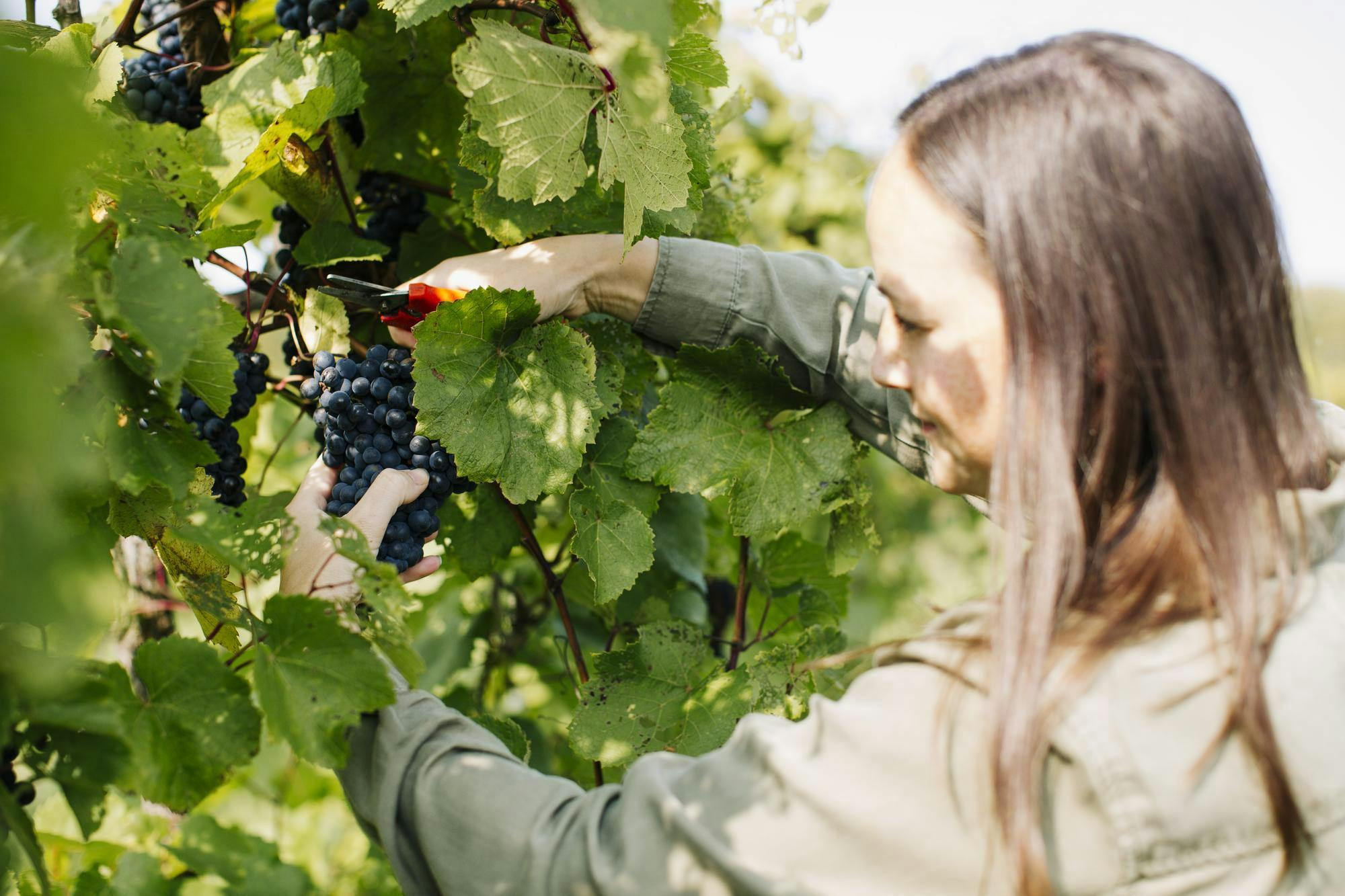
The Cornell Grapevine Breeding Program is in its final stages of evaluation for new grape hybrids that are highly resistant to disease.
Prof. Maddy Oravec ’14, grapevine breeding, genetics and genomics in Cornell AgriTech, leads CGBP, a selective breeding program. The program’s goal is to breed new grape hybrids that can grow in the northeast, resistant to diseases and capable of producing high-quality wine.
Certain characteristics of grapevines, such as disease resistance, can be selectively bred by choosing specific grapevines that exhibit the trait and breeding them together. The intention of selective breeding is for the offspring produced to inherit the desired trait from its parents and exhibit it.
Climate change is intensifying disease pressures in grape-growing regions, which researchers say makes disease-resistant grapevine breeding all the more important.
“In the face of a changing climate, we have new challenges for production, and so our goal is to develop new cultivars that are more productive and profitable for growers, but still produce that really high-quality wine,” Oravec said to The Sun.
Oravec described how the milder winters and more humid, wet conditions that come with climate change increases the risk of disease for grapevines.
Breeding disease-resistant grapes is important to reduce powdery mildew, downy mildew and black rot, which can hinder the growth of grapevines and the production of healthy fruit. Powdery mildew is a type of fungi that grows on living tissue or swathes of cells, while black rot is a type of fungi that grows on both living and dead tissue, infecting living tissue and leads to dead tissue in plants. On the other hand, downy mildew is a microbial disease that travels through water.
Aliyah Brewer and Victoria Lan Cheng, Ph.D. candidates in plant breeding, research disease-resistant breeding in CGBP. Both graduate students use imaging techniques to track disease and use this data to identify disease-resistance genes in grapevines.
Cheng explained that the group has different cameras, the Blackbird and the Hyperbird, capable of detecting disease in different ways.
“With diseases, you have symptoms that you see with the human eye, and that's what's identified by the Blackbird,” Cheng said to The Sun.
On the other hand, the Hyperbird is a hyperspectral camera. It is capable of collecting data in wavelengths from 400 to 1000 nanometers, according to Brewer and Cheng, which gives them the ability to collect data about disease on grapevines beyond what they can observe with their eyes.
In addition to these disease-imaging endeavors, Brewer is bringing more downy mildew-resistance genes to CGBP. Brewer said she ships seeds from Europe and California to obtain new resistance genes for CGBP, “measuring and characterizing the ability of the genes and then also creating genetic markers” for tracking these genes inside grapevines.
Another challenge that climate change poses to grapevine breeding is early bud break, where plants start growing and flower buds form earlier in the year than usual.
“As we have these more mild winters, our plants are coming out of dormancy sooner, and that leaves them really susceptible to this variable spring temperature,” Oravec said.
A late spring frost, for example, would kill buds on grapevines that already started growing. To prevent this, the program focuses on trying to breed grapes that do not exhibit early bud break.
Another trait researchers breed grapevines for is cold hardiness — how well the plants can survive cold temperatures. Oravec said CGBP breeds for cold hardiness by using wild grapes capable of surviving in cold climates as background material.
When wild grapevines are bred with the common grapevine, Vitis vinifera, used for many high-quality European wines and grown in warm regions, the resulting grape hybrids inherit both wine quality and cold hardiness.
In northern regions of New York, the winters are too cold for V. vinifera grapevines to survive. And although some regions of New York are able to grow V. vinifera, the grapevines tend to be more susceptible to disease, sensitive to the cold and management-intensive.
“By growing some of these hybrids that have more of these disease [resistant], environmentally adaptive traits, you can reduce that environmental impact of producing the wines and also improve profitability if you're not spending as much money on management,” Oravec said.
According to Oravec, wine industries located in colder climates, such as northern regions of New York, largely rely on growing grape hybrids.
Beyond wine grapes, CGBP also grows table grapes and juice grapes. These grapes still require traits such as cold hardiness and disease resistance, but they have additional traits that are favored since they are meant to be eaten directly. For example, table grapes have big berries, big clusters, crisp texture, thin skins, good flavor and no seeds, whereas wine grapes have small berries with seeds, which add flavor when processing them into wine.
Oravec describes how creating these grape hybrids is a year-round endeavor. She carries out this process with four graduate students, two technicians and some undergraduate help.
In the beginning of every June, the team removes the male reproductive organs of grapevine flowers and selects two parents to be cross-bred. Throughout the summer, these vines are cared for, and disease incidence and growth of the vines are evaluated.
The fruit is harvested during the fall and taken to the College of Agriculture and Life Sciences Craft Beverage Institute to make wine. This is also where wine and juice analysis takes place. At the same time, seeds are collected for planting.
During the winter, the team analyzes collected data and decides what new cross-breeds to make. The seeds collected in the autumn are planted in the greenhouse, and these plants are grown through the winter.
In the spring, tissue from these greenhouse-grown plants are collected. The team gathers genetic information from the material and, during breeding, selects for genes that may be responsible for desirable grapevine traits.
The entire process involves collaboration with multiple groups, including Prof. Katie Gold’s grape pathology team in plant pathology and plant-microbe biology, Prof. Yu Jiang’s agricultural robotics program in horticulture and Prof. Jason Londo’s cold adaptation program in horticulture.
The collaboration between groups enabled CGBP to evaluate the cold hardiness of their vines in the wintertime and use robots to collect data and evaluate grapevine traits. A collaborating enologist, or expert in winemaking, also does sensory analysis of the wines created by CGBP.
Beyond releasing newly developed cultivars, CGBP aims to make the grape production industry more sustainable by lessening the environmental and societal impact of grape production.
Brewer believes her research in disease resistance will help reduce “harmful inputs in viticulture” like fungicide and pesticide sprays that can result in human exposure and contaminate the environment, she said.
“For the winemaking community here in the Finger Lakes, it means less exposure to workers of these chemicals,” Brewer said. “It also means less spending and labor towards vine maintenance.”
Danbi Lee is a member of the Class of 2028 studying nutritional sciences in the College of Agriculture and Life Science. She is a staff writer for the science and technology department and can be reached at dalee@cornellsun.com.