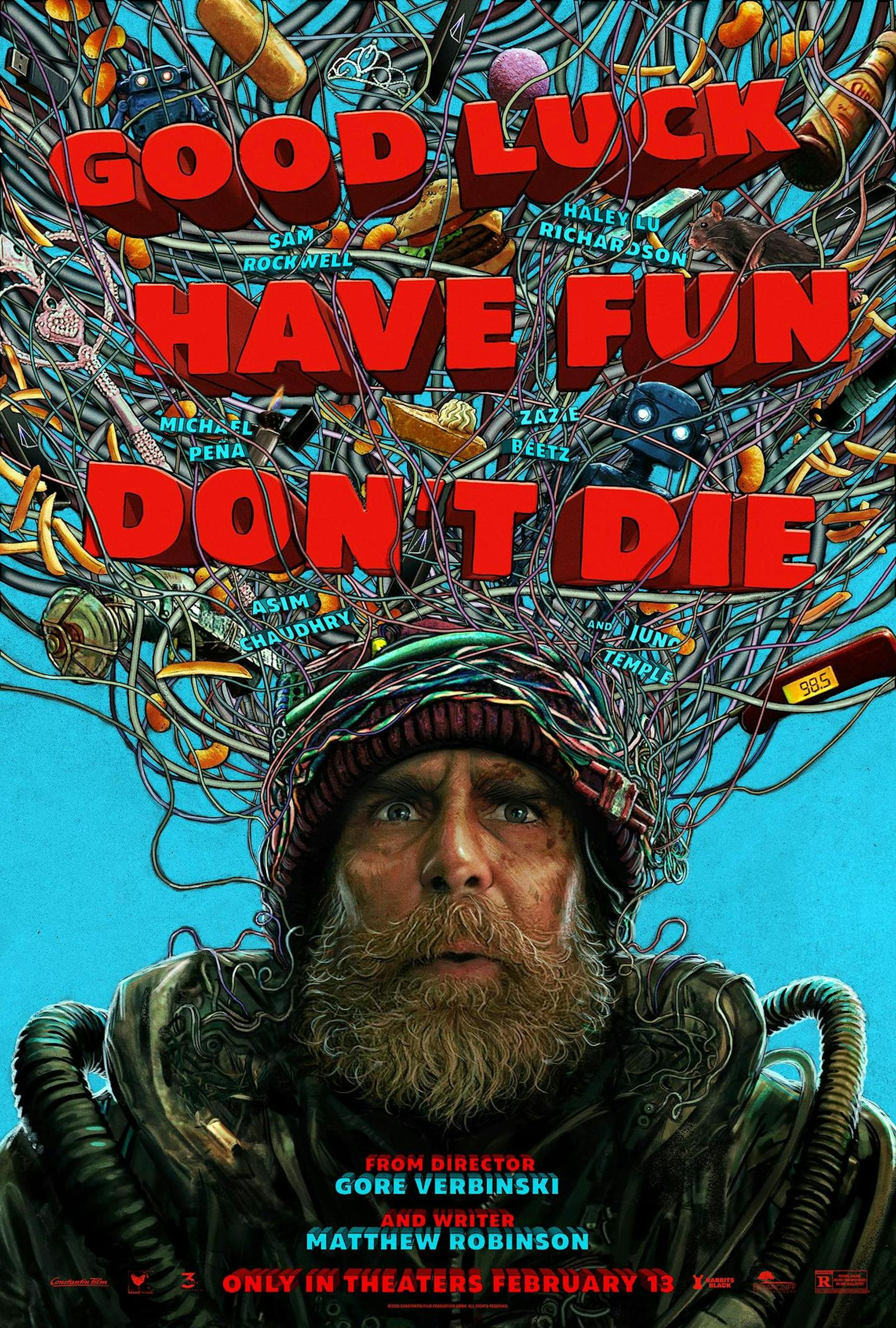
On Feb. 13, Good Luck Have Fun Don’t Die was released theatrically. Directed by Gore Verbinski, the man behind the original Pirates of the Caribbean trilogy, the movie is a wild action-thriller ride striated with social critique. It is a fun watch, following in the tradition of movies like The Terminator and the recent horror film Y2K, and it’s unmistakably endued with Verbinski’s stylistic touch. Its execution of action sequences is impressive and during its two satirical interludes I was laughing out loud. I would definitely recommend watching it.
The film opens in a diner, everyone glued to their phones, when Sam Rockwell’s ‘man from the future’ bursts in demanding help to save the world from AI: specifically a 9-year old kid developing the next SkyNet in his room. Over the course of the film, an increasingly dwindling cadre from among the customers encounter resistance from police, strange men in crochet pig masks and … a giant chimerical horse-cat? … as they barrel forward toward the house to insert a chip that will prevent the AI from turning against humans.
The film is enchantingly absurd. The production design and costumes are funnily kitsch, perhaps best observed in Rockwell’s outfit made out of circuit boards, a translucent raincoat and excessive rubber tubes. At a moment when those left alive ‘suit-up’ to fight off an invasion of Gen-Z TikTok zombies, faces glued to phones, I was reminded of Plants vs. Zombies. The team dons football helmets, hockey pads and other intentionally ridiculous regalia to defend themselves as they ultimately resort to the bastion of a suburban roof, shooting ray-gun looking tech-deactivators at the mob. In the climax, the film blatantly borrows from Toy Story as Frankensteined dolls and toys threaten to execute our protagonists.
Rockwell delivers a captivating performance in the form of the oddball, self-interested and very visually eccentric future-man in what feels like a similar archetype to Verbinski’s Jack Sparrow. More broadly, one of the pleasures of the film for me was in recognizing the director’s sensibility throughout. As someone who grew up on the Pirates movies, it felt like seeing a childhood friend. The score, composed by Geoff Zenneli, feels almost like a new extended release of the soundtrack from those films (primarily composed by Hans Zimmer). It injects rock-and-roll distortion guitars over the traditional orchestra, charged full of heavy action-oriented momentum. During one fight scene, I even recognized a nearly identical leitmotif. The finale poses a kraken-like final boss, and, in a transposition of Dead Man’s Chest, one of the characters initially thought to have fled from the battle returns to retrieve and use the kill-chip against it. The execution of the final fight in each film is highly similar. In both, we witness a striking frame of our heroes outlined in silhouette against the raging monsters as they confront them.
Then of course, there’s the theme of the piece. It attempts to address the very timely worries over AI, screen-dependence and human disconnect that seem to dominate this moment in history. The cinematography, perhaps, more than anything else conveys the idea. It feels gross — saturated with neons, but simultaneously murky and dull — engendering our disgust for this world. Passionate monologues condemning modern society punctuate the action, but it is the flashback interlude centering on the character Susan that both addressed the issues most interestingly and was hilarious. In her world, after her son is killed in a school shooting, she is given a business card directing her to a cloning center. School shootings have become as common as Ithaca snow in this reality; during a therapy session, one couple explains that they are on their fourth clone, all of which the government funds (even the deceased school shooters). When Susan receives her son, however, practically the only thing he says is that he would like a mango-strawberry smoothie, currently on 70% discount at a store nearby, it tastes delicious, regurgitating a paid ad. During this section, both capitalism and our fault in becoming numb to essential human experiences like love are critiqued. The couple from earlier chortles hysterically when they reflect on their daughter’s multiple deaths. They share that they decided to reprogram their daughter to make her funny this time around. They’re much happier now because she makes them laugh all the time, assigning her random traits like being extremely tall and Muslim even though they are not. It is a very effective observation on the increased shallowness with which we value other humans in the modern era. The greatly expanded range of choices available to us has entrenched us to act upon the first impression, to seek titillation upon those most salient features displayed in high-relief.
Good Luck Have Fun Don’t Die is a mixed goodie bag of action, social commentary and plain absurdism. Watching it, you really do feel like you’re pulling out a stretchy man after a hardened Tootsie roll, only to gawk at some Pez dispenser of a discontinued mid-2000s cartoon. It’s a strange bird, but a memorable one, maybe like a Dodo. And the end teases a sequel, so who knows, maybe we’ll have another Verbinski trilogy, this time Rockwell at the head.
Tommy Welch is a senior in the College of Arts and Sciences. He can be reached at tsw62@cornell.edu.
Tommy Welch is a member of the Class of 2026 in the College of Arts and Sciences. He is a staff writer for the Arts & Culture department and can be reached at twelch@cornellsun.com.