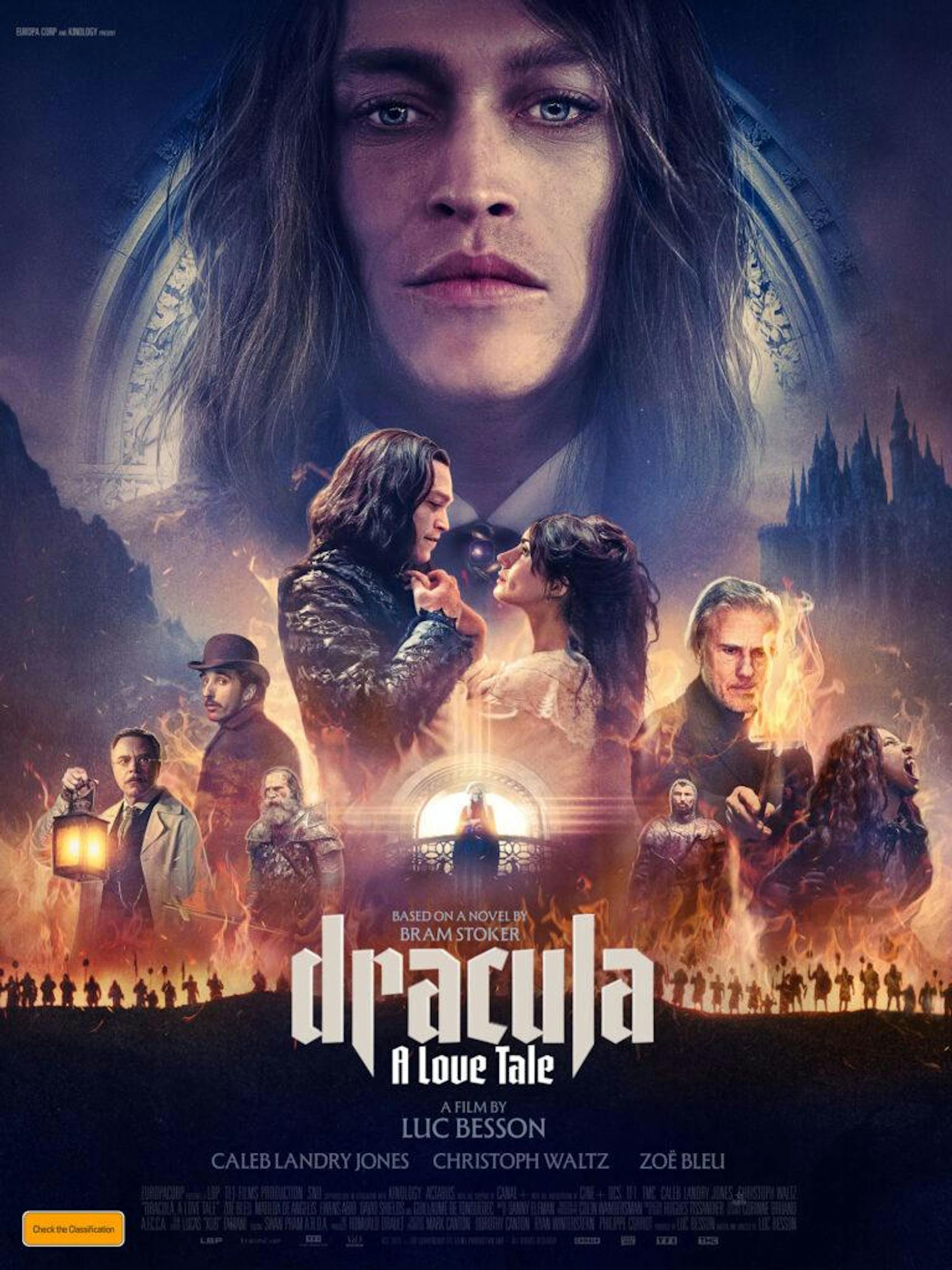
The character Count Dracula has become synonymous with monsters, Halloween and various adaptations ranging from cartoons for children to horror films that have adults running out of movie theaters. Every few years, a new generation’s Dracula, or Dracula look-alike, comes along to remake Bram Stoker’s famous, and perhaps even notorious, character anew. Last year, French film director Luc Besson took on this endeavour and produced Dracula: A Love Tale.
Besson takes an interesting perspective on the story. We first meet Dracula not as a vampire, but as the notorious Vlad III (also known as Vlad the Impaler) Prince of Wallachia. The story begins with his love for his wife, Elisabeta, and the crusades where he must fight off the Ottoman forces that are encroaching on his territories. Before he leaves for battle, he prays for victory but also asks one thing of God: that his wife is spared in the process of the battle. When this wish is not granted, Dracula impales a priest with a crucifix, and curses God’s name. In return, God curses Dracula to an eternal life; he spends centuries searching and hoping his true love will be reborn.
What starts out first as a story of love, turns into a very moralistic tale. Dracula spends the years after the death of his wife wandering the Earth, developing an enticing perfume and creating a legion of vampires to help him track down where and as whom his wife would be reborn. He notes again and again that the greatest punishment God ever gave him was not death, but an eternal life without the love of the woman he cares about most. He claims that God gives both life and death, and that both have equal importance to a person.
The movie jumps between what Dracula has done in the 400 years since Elisabeta’s death, and the modern day, when a priest and doctor duo — who follow the archetype of Victorian detectives – are working to rid the world of vampires. Though the story of the two detectives is humor-filled at times, the ends to which Dracula eventually goes to in order to track down Mina, the reborn version of Elisabeta, can only be described as foul, despicable and disgusting. Yet, in the end, we cannot help rooting for him. Besson manages to create this beautiful dichotomy in a character: the embodiment of death and immorality in a man who merely wants to have love in his life. We at once cannot help but look away when he drains an entire monastery of nuns of their blood, and cannot help but cry when he must leave his beloved. It is a hard sell but is fully carried by Besson’s script-writing and the choice of the main actor.
The casting of Caleb Landry Jones as Count Dracula was perfect. He was at once seductive and aversive. You could not look him in the eye but you could not look away when he spoke. There was something deeply intriguing and forceful in the way he played his character. The other actors in the movie were notable, but nobody matched Jones’s performance in this role. He had this old world charm about him that makes it believable that he lived both in the 15th and 19th centuries.
Despite positives such as incredible costuming, powerful performances and vibrant story-telling, the movie struggled with a plot that felt very rushed. With so many jumps between tones of romance and horror, at times felt as though the film was failing to interweave both. In the end, it seemed as though Besson was also trying to make the film a moralistic tale. After Dracula complains that he killed in God’s name and only lost in return, a priest tells him that he killed in his own name and continues to do so, as he points to the corpses that surround the two men. He continues by saying that many men justify their acts by saying it was in the name of God, when in fact that is not the cause of their actions. However, even then it seemed like a rather rushed ending. There was too much time spent on gore and Victorian mystery to truly process the love and Christian values that the film hoped to convey.
Even in the end, when Elisabeta (Mina) and Dracula finally reunite, the Christian morality comes once again to the forefront of this film. They discuss if God would forgive them, and then they decide if not then: “He can go to Hell.” In the end Jones’ Dracula realizes that not only had he cursed himself, but by continuing to live like this he had condemned the woman he loved as well. I think Besson meant to imply that death and leaving is also a form of love. Dracula realizes that he is condemning his beloved to eternal damnation, and in order to spare her, he allows himself to be staked in the heart by the priest. Once Dracula is dead, the curse is lifted. God forgives him, because in the end love was also caring about the other person’s soul, not just the love they gave you. That was his repentance.
I believe Besson tried to turn what has for generations been a character of classic horror into a story of love and faith, one which reminds us that we cannot defy God, or the forces of the world, just to meet the ends you wish for. Life and death both come at us in turn, and we are forced to meet them as we are.
Lusine Boyadzhyan is a Junior in the College of Arts and Sciences. She can be reached at lboyadzhyan@cornellsun.com.

Lusine Boyadzhyan is a member of the Class of 2027 in the College of Arts and Sciences. She is a staff writer for the Arts & Culture department and can be reached at lboyadzhyan@cornellsun.com.