


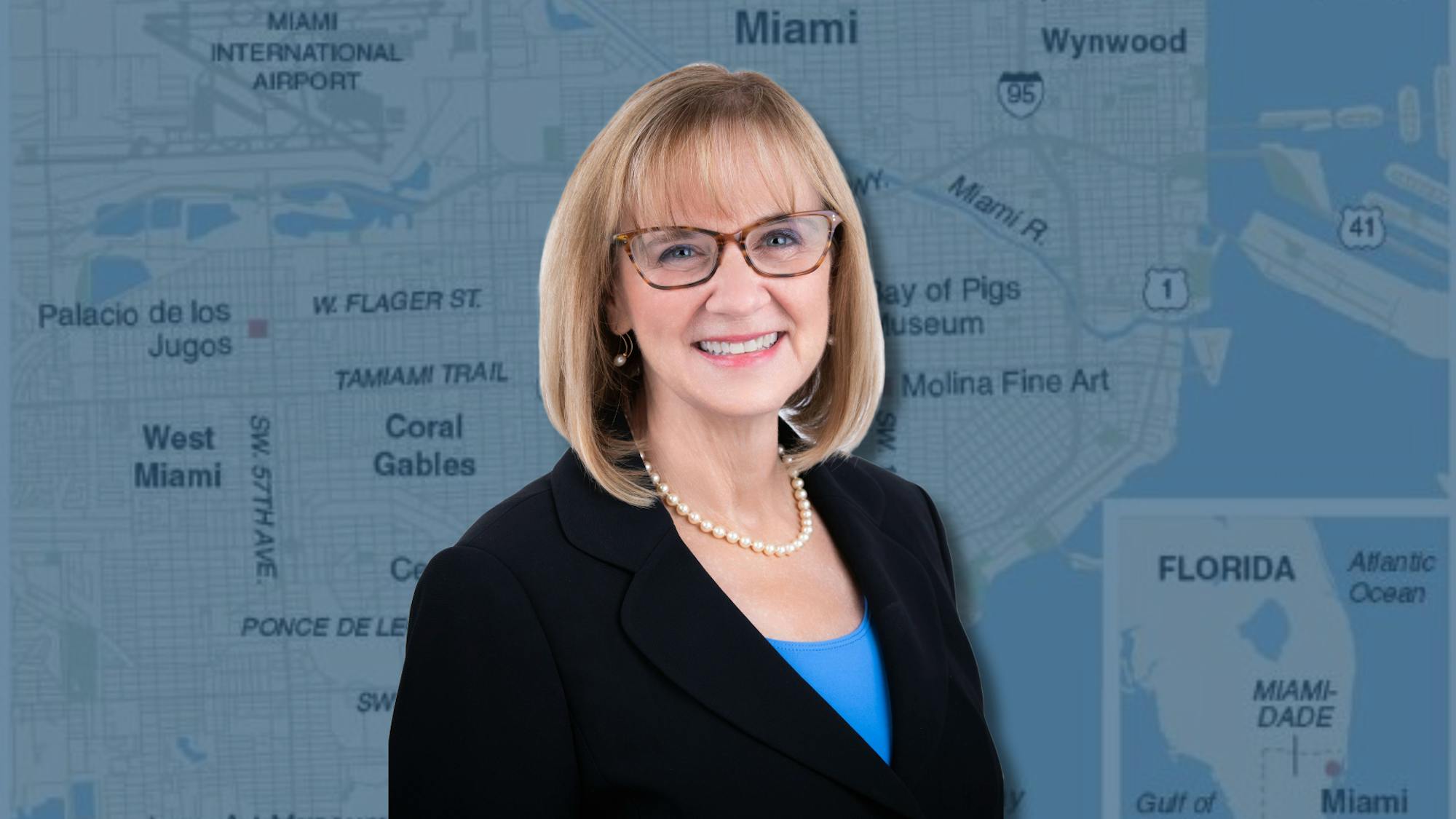
Eileen Higgins MBA ’89 made history on Dec. 9 when she was elected as Miami’s first female mayor. She is also the city’s first Democratic mayor since 1998 and its first non-Hispanic mayor since 1996.
Higgins won the mayoral election, earning 59.46% of the vote against Republican candidate Emilio T. González, who earned 40.54%. While Miami elections are typically non-partisan, both major parties were represented in this election. President Donald Trump publicly endorsed González in a Truth Social post on Nov. 16, while the Democratic National Committee helped Higgins secure funds for her campaign.
González, a Republican former city manager for Miami, publicly conceded on Dec. 9 after unofficial results from the county elections supervisor showed Higgins leading by nearly 20 percentage points. In an interview with the New York Times, he said that he called Higgins after the election to wish her the best as mayor.
Higgins’ platform focused on affordable housing, affordable healthcare, environmental sustainability, accessible transit and small businesses. But Higgins told The Sun that she saw one “top of mind crisis” for those in South Florida: current Immigration and Customs Enforcement tactics affecting immigrants.
Immigrants account for approximately 22% of Florida’s population, with an estimated 5.2% of all Florida residents being undocumented, according to data released in 2023 by the American Immigration Council.
Since Trump's reelection, more than 20,000 people in Florida have been arrested for immigration-related charges. Under Gov. Ron DeSantis (R-F.L.), the state has allocated more than $298 million to immigration enforcement, including hiring new officers and leasing two state-run detention facilities, as well as more agreements for local and state agencies to act as federal immigration agents than any other state. Last June, Miami city commissioners voted to allow police officers to collaborate with ICE.
Higgins told The Sun that she will fight for immigrants and be a “mayor that talks about them as valuable members of the community and valuable human beings.”
Higgins has spoken against the looming elimination of Temporary Protected Status, which is the temporary immigration status granted to nationals of specifically designated countries where there are unsafe conditions.
“This move creates unnecessary fear and instability for hundreds of thousands of people who are living and working legally, raising families, and contributing to our communities,” she said in a press release. “It is cruel, and it inflicts even more uncertainty and hardship on a community that has already endured far too much.”
TPS was scheduled to expire on Feb. 3, but a federal judge blocked the program’s termination before it was set to end.
The issue has resonated beyond Miami. Protests against the most recent ICE tactics have taken place at Cornell and across the country. Two-thirds of Americans believe that ICE has gone “too far” with immigration enforcement, according to a Feb. 5 NPR/PBS/Marist poll.
In an interview with The Sun, Higgins said that her ability to appeal across party lines helped her win the election.
“So many of the crossover votes were people who like my business competency, my transparency agenda and many others that crossed over are just ready to have a local government and a mayor that talks about them as if they are valuable members of our community and valuable human beings,” she said.
Higgins thanked voters in her victory speech, saying, “You chose competence over chaos, results over excuses and a city government that finally works for you.”
Higgins earned her bachelor’s degree in mechanical engineering from the University of New Mexico. She then went on to earn her Master's of Business Administration from the S.C. Johnson College of Business.
After Cornell, Higgins built a career in public service. She went on to serve as country director for Peace Corps Belize, then as foreign service officer with the U.S. Department of State and as a Miami-Dade county commissioner.
Higgins remains an active member of the Cornell community. She sits on the board of the President’s Council of Cornell Women, an organization that mentors and empowers female Cornellians and provides grants to female professors. She was a featured speaker at the council’s symposium on Feb. 6 in Washington, D.C.
When asked about her time at Cornell, Higgins spoke affectionately of her classes in organizational behavior and professors like Prof. Emeritus Joseph Thomas, operations management, former dean of the Johnson School, saying the experience taught her that organizations are “living, breathing organisms filled with human beings.”
Higgins spoke most fondly of the community that Cornell provided her.
While attending Cornell, Higgins was in a cohort of about 200 students in the Johnson School, allowing her to form close-knit relationships that have lasted decades, she said. She added that she still speaks to her Cornell friends every week, and that a group of them came down to Miami the week before the election to knock on doors and work on her campaign.
“Cornell gave me the education I needed, but it also gave me a network of people who have been my support system for more than three decades,” Higgins said.
Correction, Feb. 23, 8:17 p.m.: This article was updated to clarify that Higgins is Miami's first democratic mayor since 1998.

Valencia Massaro is a member of the Class of 2029 in the School of Industrial and Labor Relations. She is a senior writer for the news department and can be reached at vmassaro@cornellsun.com.


