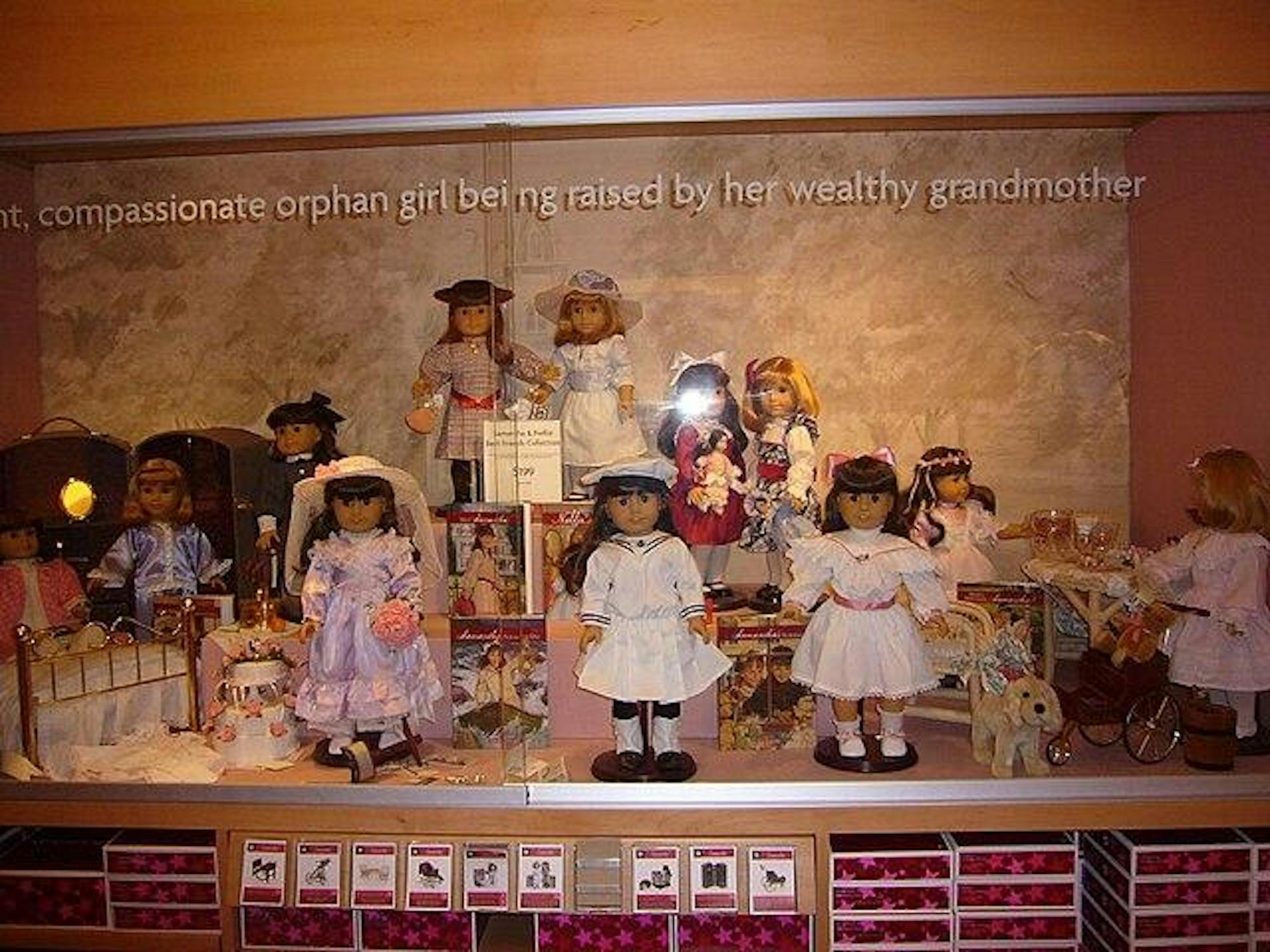
My first experience with American Girl was through its quintessential catalogue. The catalogue was more addictive than any television show, able to entertain preschool me for hours as I flopped through all the different types of dolls, such as the limited edition Girl of the Year, the My American Girl line of dolls with different features and no set story and the ones I was undoubtedly most taken by: the collection of historical dolls. Each historical doll had two consecutive pages, with the doll herself featured alongside her story, information about her time period, different outfits and sometimes a complementary best-friend doll representing an opposing experience during the same period. The dolls and their corresponding stories sparked a desire in me to learn more about their historical periods. Suddenly I wanted to better understand Samantha's world in 1906 or Felicity's America of 1774.
The catalog was not the only way American Girl transported young minds into the past. Each historical doll had her own book series, which offered a first-person account of her life, providing an immersive education in the daily life of people in a specific historical era. Some dolls even had accompanying movies that brought to light a specific arc of their story. For example, Kit Kitterage: An American Girl focuses on how Kit helps her family stay afloat after her father loses his job during the Great Depression and how Kit, an aspiring journalist, investigates a crime to clear her hobo friend Will’s name. American Girl also emphasized how each girl’s background shaped her experience, promoting early awareness of the diversity of the American experience. For example, Samantha represented the experience of the early 20th-century upper class, while her best friend, Nellie, represented the experience of the urban working class, highlighting issues such as child labor and inhumane factory work conditions. Similarly, Rebecca’s story examines the immigrant experience, focusing on conflicts between her Russian-Jewish identity and the pressure she faces at school to assimilate, while also highlighting tenement living conditions. The books also did not spare young readers from the cruelties of the past. For example, Meet Addy details a scene where the slave master forces nine-year-old Addy Walker to eat live worms after he is unsatisfied with her work. Addy’s account of slavery was my first in-depth exposure to slavery in the U.S., helping to build an early understanding of slavery’s cruelty. The dolls’ stories bettered my understanding of humanity from an early age. When watching Felicity: An American Girl Adventure, I remember feeling her pain during her grandfather's funeral.
Against conventional wisdom, the educational aspect of the dolls did not deter young kids from the brand but rather encouraged them to engage in history and literacy on their own. I would have playdates where my friends and I would act out sequels to set stories or completely make up our own. American Girl promoted a culture that valued and inspired interest in history and stories. However, in recent years, the company has drifted away from making history and literacy central to its brand, mirroring the declining respect the humanities hold in mainstream society. The most recent addition to the historical line was the 2023 release of twins Nicki and Isabel Hoffman from 1999. The twins embody the preppy vs. sporty aesthetic trope and seem more ready to jump into a classic late ’90s tween movie than a history book. Yes, the ’90s are technically historical, but I doubt most kids today find it hard to find firsthand accounts or media that represent the reality of life in the late ’90s.
Although the changes in American Girl are striking with the release of Isabel and Nicki, the shift in American Girl’s message started many years before with the BeForever rebrand. In 2014, American Girl rebranded its historical dolls as BeForever characters, introducing new outfits and books. The new outfits seemed focused on aesthetic appeal rather than historical accuracy. For example, Julie’s original meet outfit, realistic for a girl in the 1970s, was replaced with an outfit more suited for sale as a hippie Halloween costume. Furthermore, the BeForever rebrand abridged the original book series into two books per doll, along with a third ‘create your own adventure’ style book narrated from the perspective of a modern girl who travels back to the historical character’s time period. Additionally, the “Looking Back” section, which provided historical context to the story, was significantly shortened.
Although the BeForever rebranding was removed in 2019, the shift in American Girl’s priorities remains. In February, American Girl announced the upcoming release of Modern Era dolls, which intend to represent how the historical characters would look if they were growing up now. These new dolls share more similarities with Barbies than the Modern Era dolls’ historical counterparts. For example, the Modern Era Kirsten swaps 1864 Kirsten’s apron for a sparkly heart-shaped purse with her initials.
Mattel is a smart company; the logical explanation for these changes is that Mattel believes it needs modern and flashy aesthetics to appeal to young kids. This belief is emblematic of the fact that, as a society, we no longer hold our kids in as high esteem. We expect that the harrowing stories from girls of the past are no longer enough to draw in the newest generation of toy consumers; by not providing that option kids will never develop the same appreciation for history they otherwise would have. Kids today are not fundamentally different from kids 15 years ago, but as a society, we have accepted that they are. As a child, I did not spontaneously decide I was interested in history and seek out historical toys; rather, I was exposed to history through my toys. As the reading level for American children drops, American Girl’s rebrand reflects the lower expectations we now have for kids. A return to American Girl’s iconic historical origins might prove a small but symbolic step to reverse our youth’s declining academic skills.
Caroline Kelly is a member of the Class of 2028 in the College of Arts and Sciences. She is a staff writer for the Arts & Culture department and can be reached at ckelly@cornellsun.com.