

Park Chan-wook, the Korean director of Oldboy, The Handmaiden and more, added another masterpiece to his catalog: No Other Choice. Released in South Korea in September 2025, No Other Choice was granted a limited United States release in December 2025, before finally receiving a wide release in January 2026. The dark comedy-satire showcases the talent of Park Chan-wook as a filmmaker, editor and writer, all while thrusting the film’s lead actor, Lee Byung-hun into the best comedy role and performance of 2025.
No Other Choice tells the story of Man-su and his family as they navigate unemployment in South Korea. Man-su (Lee Byung-hun) is laid off from his job at a paper production plant. He spends the next year searching for another job in the paper industry, which he believes is his sole passion. With no luck, Man-su decides to assassinate a paper company director and, before that, eliminate any rival candidates for the job.
Throughout the film, the phrase “no other choice” is repeated by everyone. Man-su believes he has no other choice but to kill the competition to solve his unemployment situation. The company heads have no other choice but to fire the manual laborers and overseers to automate paper production. The competition for paper jobs has no other choice but to continue in their search for exclusively paper production-related jobs, as their skills are not applicable elsewhere.
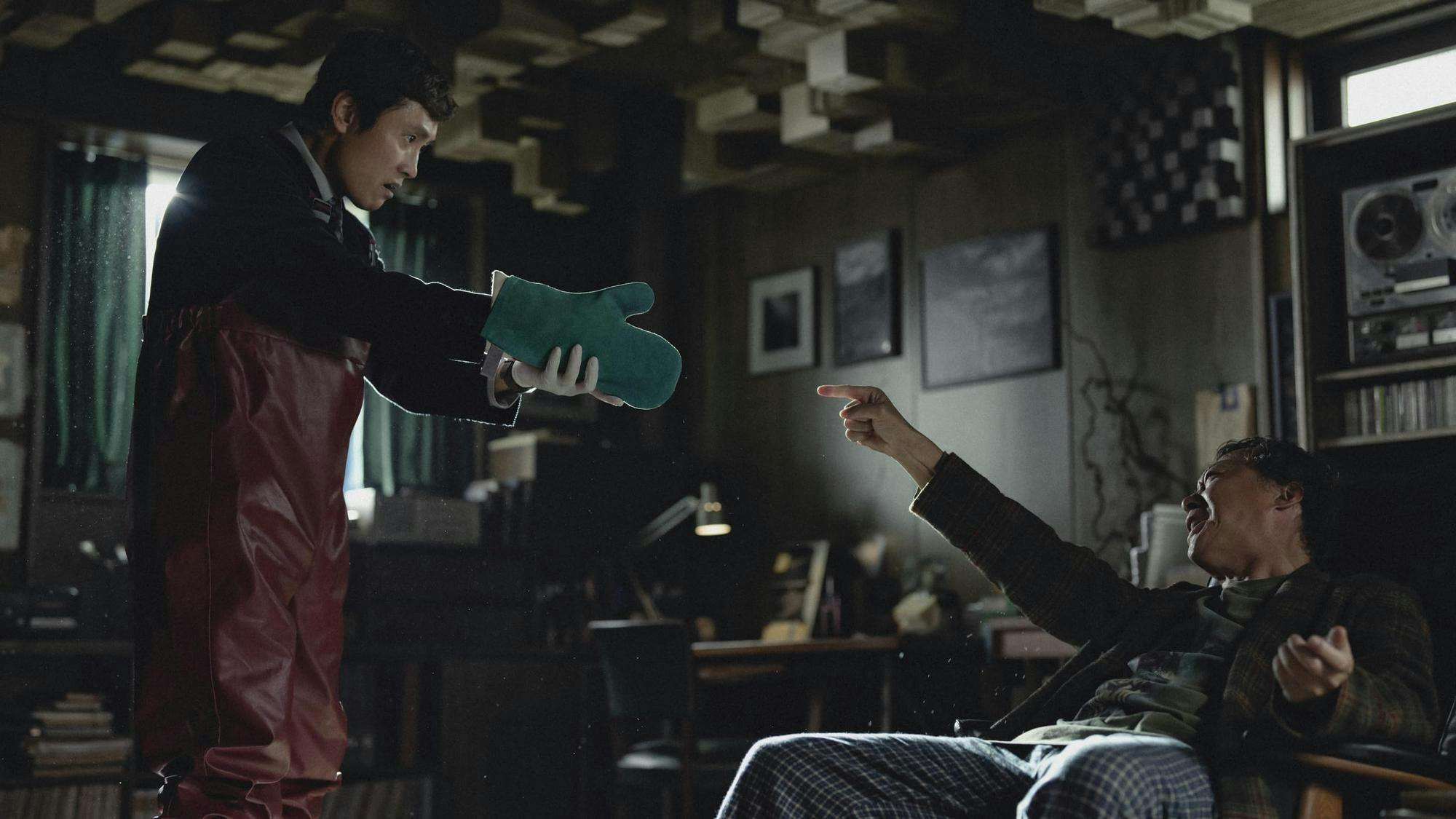
The film, presented as a dark comedy and satire, masterfully blends South Korean humor with commentary on capitalism, creating a thought-provoking work that never feels like it is shoving overt messaging down viewers' throats. The best scene in the film exemplifies this blend: Man-su, confronting one of the candidates for the paper company job, stands before his target with an oven mitt on his hand to conceal his weapon. Prior to shooting, he removes one oven mitt to reveal another, then another, and so on. The scene continues as the music swells, finally revealing a comically small pistol. What follows is a struggle between Man-su and his target; all the while, elegant classical music scores the scene, juxtaposing the graceless assassination attempt.
Even with the comedy, the film feels real. It depicts a struggle that has befallen not just South Korea but the entire world. Working-class and middle-class workers feel that they are being phased out, replaced with automation and artificial intelligence. There is no other choice for these companies, they claim, as they try to maximize their profits for the executives. However, as Man-su does, hundreds of millions around the world in real life lose their jobs for the sake of shaving pennies.
The struggle does not end there. The film asks these job candidates at the paper companies numerous times if they could just work somewhere else. All of the candidates say they have no other choice but to apply for paper-related jobs. They have lost their personal identity to capitalism; they are their job and very little more. Man-su barely escapes this fate with his love of gardening, while another victim has a love for music. However, when confronted by their spouses and asked about pursuing their other passions, they retort that paper has provided for them for so long, it must continue to do so.
The film is a masterful commentary on the human inability to look inward as a result of being trodden on by capitalism. Man-su, the job competitors and the targeted executive are all cogs in this system's wheel. Some of them are more self-aware than others of their role in allowing this perverse system to continue, but all of them are unable to break free and find something in themselves to be truly proud of beyond the ability to be patriarchs and make money for their households.
Beyond just the writing, Park Chan-wook is a maestro with the camera. Multiple times while watching, shots left me in awe. The setting, beautiful as it was, was not the reason; rather, it was Chan-wook’s ability to maneuver the camera across the terrain to showcase certain elements at specific moments that contribute to the shock, the comedy and the film's messaging. Furthermore, this incredible filmmaking is intercut with perfect editing and transitions which help the movie glide from scene to scene, making it a joy to watch from a cinematic perspective.
The messaging and comedy would not be complete without mentioning Lee Byung-hun. Lee’s ability to control his face is effortless. He contorts his face to demonstrate comedic effect in one scene, then shows utter lifelessness in the next as a result of his life’s work being replaced by a machine. Lee clearly has experience in dark satire, as displayed in this role. The ability to balance the writing of a satire film is a difficult task, but one he pulled off.
Man-su, with no other choice but to go through with his plan of killing the competition, receives a fate that drives the message home. The man who was once pro-union and proud to work alongside his coworkers is forced into his nightmare, managing an automated “dark-factory,” where there are no employees but himself, watching over AI machines producing the paper in a factory devoid of light. Man-su falls victim to a debilitating system in which he never stood a chance to come out on top, because even the victory of getting a job sacrifices the last bit of identity he had that stopped him from being a drone to the system, of which he is one now.
For its incisive commentary, razor-sharp humor and exceptional artistry, I have no other choice but to call No Other Choice the most thought-provoking film of 2025. It powerfully illustrates how people tie their identity to work, losing their individuality, while those in power see only profit — never the individual.
Brayden Rogers is a sophomore in the College of Arts and Sciences. He can be reached at bjr236@cornell.edu.
Brayden Rogers is a member of the Class of 2028 in the College of Arts and Sciences. He is a columnist for the Arts & Culture department and can be reached at brogers@cornellsun.com.


