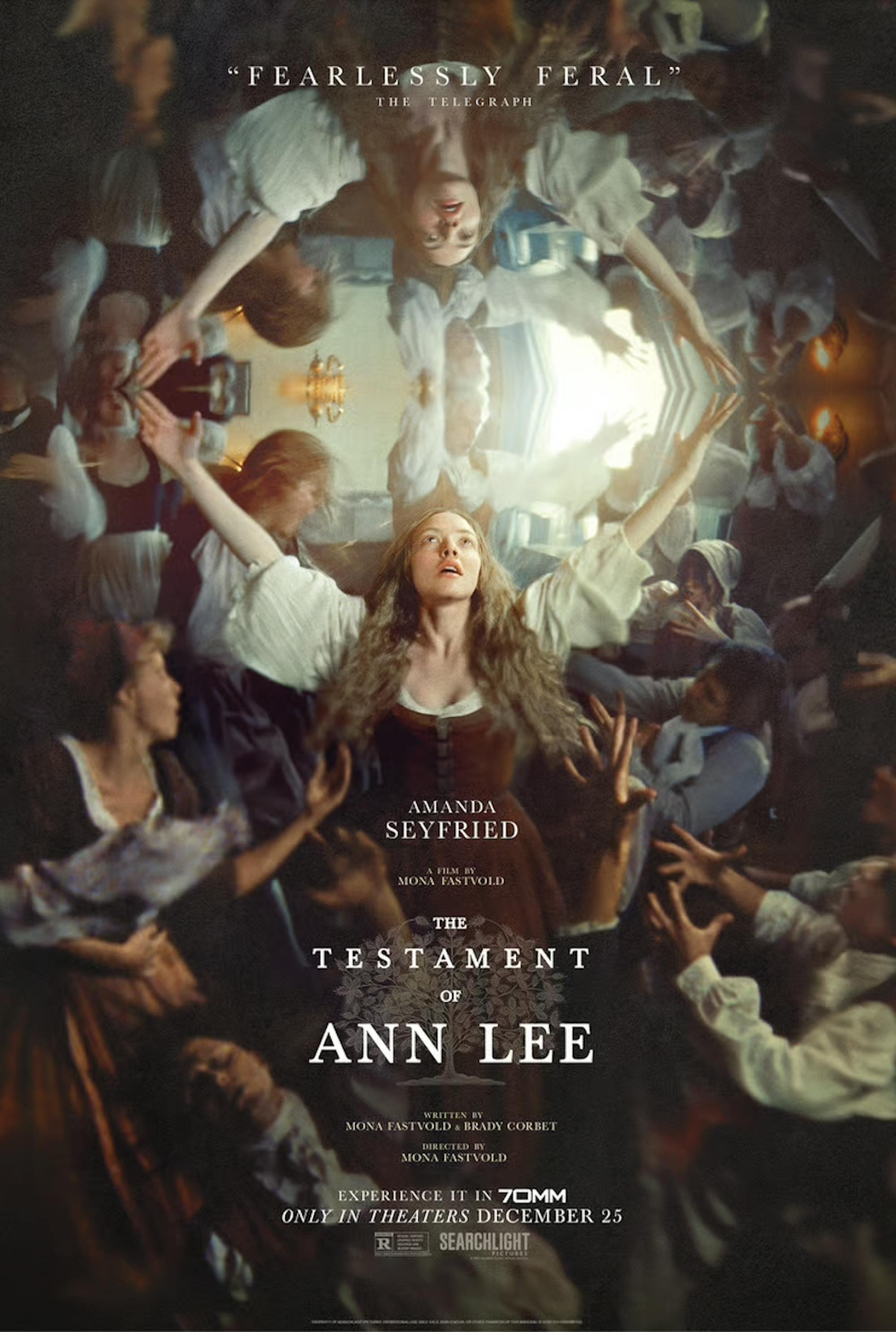
2025 has been one of the best years for film in recent memory. With so many great releases, The Testament of Ann Lee has gone somewhat unnoticed, especially since its wide release is slated for late January. As it finally rolls out to theaters nationwide, I cannot recommend making the effort to see it enough.
Directed by Mona Fastvold and co-written by Brady Corbet (the team behind The Brutalist), The Testament of Ann Lee is a feat of filmmaking similar in scale to their previous work. The film follows the life of Ann Lee, the founder of the Shakers, an offshoot of the Quakers known for incorporating song and dance into their worship. We follow Ann, played by Amanda Seyfried, from her simple childhood in Manchester to her journey to New England in the 18th century, where the Shakers became established. Ann Lee, called “Mother Ann” by her followers, is notable for becoming a religious leader at a time when women were barred from preaching. The Shakers believed that Ann was the Second Coming of Jesus, presented in the form of a woman to create balance.
Ann Lee is a fascinating figure and it is impossible not to become invested in her journey over the course of the film. Seyfried’s performance provides the emotional core of the film, giving humanity to a figure that feels so distant. Early in Ann’s life, we witness her judgement of her violent father and her discomfort with her husband’s sexual appetite. When Ann has a vision of Adam and Eve and determines that the Shakers must become celibate to avoid sin, we understand how her own experiences have shaped her view of sex. These glimpses of Ann’s life before becoming “Mother Ann” make a distant religious figure feel much more personal.
What makes The Testament of Ann Lee most special, however, are its musical numbers. In scenes of worship, Daniel Blumberg used actual Shaker hymns as the basis for his compositions. The choreography is frenzied, allowing these scenes to feel like improvised moments of prayer rather than carefully planned dance numbers. With these elements combined, it’s easy to immerse yourself in and connect to these scenes. The Testament of Ann Lee easily has the most innovative and entertaining musical numbers I’ve seen in 2025, and just as the film humanizes the figure of Ann Lee, these scenes make a religious practice that may feel completely foreign to modern audiences seem natural.
The Testament of Ann Lee is crafted with the same grandeur as The Brutalist, but somehow felt much more personal to me. Ann Lee, her brother William (Lewis Pullman) and the rest of the Shakers live a quiet, unassuming life, dedicated to service, and yet are constantly berated and attacked for their style of worship. At the center is Ann, who has dedicated her life to helping others, only to be a constant victim of misogynistic attacks and accusations of witchcraft. The film tells a story rooted in history, but the plight of Ann Lee feels deeply human and not too withdrawn from our modern world.
Most of all, I was impressed with Fastvold’s ability to portray Ann Lee in all her complexities, without ever losing that sense of empathy. Ann is a figure full of contradictions, and Fastvold explores her place as a woman at the head of a religious movement juxtaposed with her conservative views around sex. She is firm in her beliefs, unwilling to budge even when her own sister wants to pursue a relationship. Fastvold explores the selfish nature of Ann’s decree with extreme sympathy and understanding. Another contradiction quickly arises: the simple lifestyle of the Shakers paired with the erratic nature of their worship. This is handled with equal understanding and grace. In one sequence, we see the Shakers in a frenzied song and dance. As the song ends, they line up and file silently (men in one line, women in another) out their respective doors. Fastvold’s ability to portray the complexities and hypocrisies of Ann and the Shakers without judgement makes The Testament of Ann Lee a more personal, and in my opinion, a more successful film than The Brutalist. So far this awards season, the film has gone somewhat unnoticed. Despite its slow rollout, The Testament of Ann Lee is one of the most ambitious films of the year and one I recommend making the effort to seek out.
Nicholas York is a junior in the School of Arts and Sciences. He can be reached at nay22@cornell.edu.
‘Projections’ is a column focused on reviewing recent film releases.
Nicholas York is a member of the Class of 2027 in the College of Arts and Sciences. He is a columnist for the Arts & Culture department and can be reached at nyork@cornellsun.com.