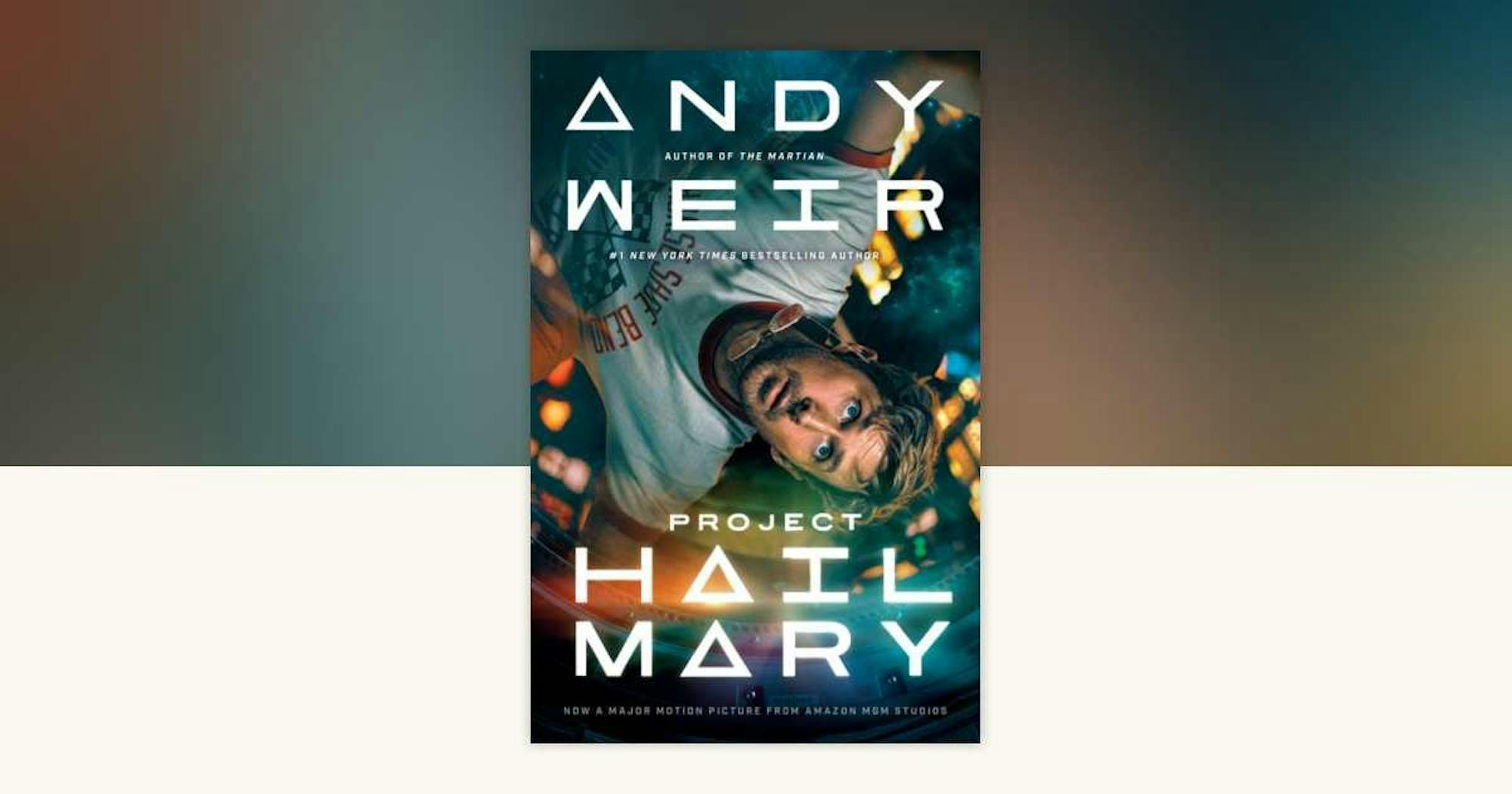
Spoiler Warning: The article contains details from the plot of Project Hail Mary.
In 2021, Andy Weir, the bestselling author of The Martian, released another award winning novel: Project Hail Mary. Project Hail Mary reuses many of the tropes from The Martian: it is a science fiction adventure featuring a lone hero stranded in the cosmos with nothing but science, a penchant for sardonic internal reflection and a bunch of fancy equipment way above his pay grade. But this time, there are many more lives on the line, the hero is a lot farther from home and the science is just a touch more alien. With the movie adaptation of Project Hail Mary scheduled for release on March 20, now is the perfect time to take a look at the story in its original form.
The book opens with the protagonist's eyes stuck shut. There isn’t anything holding them closed, but he just can’t seem to open them and his hands are equally immobile. After a ridiculous ordeal exemplifying the humor that made The Martian a success, the protagonist is able to will his eyelids apart and reveals –– get this –– a sterile room awash in bright light and a robot looming down from the ceiling. Topping off the list of starting clichés, the protagonist has lost his memories.
Fortunately, Weir’s humor allows him to handle this lack of novelty with a somewhat unconventional solution: basic math. Instead of trying to subdue or harm the protagonist, the looming robot only repeatedly insists that the recently awakened protagonist share the answer to one plus one. After a confirmed sum of two, a series of groggy mishaps and a few conveniently-timed flashbacks, the protagonist finally remembers who he is: Ryland Grace, a middle school science teacher on a spaceship hurtling at near lightspeed towards a galaxy that is lightyears from Earth. And if that’s not overwhelming enough, Grace is supposed to save the world.
Like The Martian, Project Hail Mary is primarily a series of scientific puzzles and mysteries that Grace needs to solve as a part of his extended mission. However, because Weir finds his unlikely hero in a middle teacher, the science presented in Project Hail Mary is extremely digestible and lands in the ballpark of high school physics. Anyone who has ever drawn a free body diagram with more than three vectors will be able to solve the vast majority of the problems right alongside Grace. And the ones that fall outside this category Weir usually explains with aliens, allowing for a fun exploration a little further from the realm of science and a little closer to fiction.
The definite highlight of the novel was one such alien who gives Grace a bit of company on his journey. The lovable hard-shelled creature whom Grace names Rocky, provides both Grace and the reader with a fun distraction from the looming doomsday, the anxious flashbacks and the protagonist’s lonesome inner monologue. This is especially important when considering that Grace’s other social interactions are locked within the vault of his amnesia. Even as Earth fades in the background, the several consecutive chapters that Weir dedicates to Grace and Rocky getting to know each other are some of the most enjoyable to read.
I also appreciated that unlike The Martian’s sailor-mouthed protagonist, Grace’s language is entirely clean. As a middle school teacher, Grace proves that one doesn’t need to use “mature” language to handle adult problems or to be funny. Often, Grace’s exclamations are even more entertaining, and certainly more creative, than their foul-mouthed counterparts.
Overall, Project Hail Mary, even with large parallels to Weir’s first successful novel, is a fantastic read in its own right. I highly recommend Project Hail Mary to any science fiction lover, especially those who prefer a little more science than fiction, and to anyone looking to see the film this spring. Too often, we skip over incredible writing in favor of heading straight to the action-packed brevity of the movie adaptation. With two months till the movie’s release, I encourage you to take the time to read (or listen to) the book and experience the story before it appears only in theaters.
Wyatt Tamamoto is a freshman in the College of Arts and Sciences. He can be reached at wkt22@cornell.edu.
Wyatt Tamamoto is a member of the Class of 2029 in the College of Arts and Sciences. He is a staff writer for the Arts & Culture department and can be reached at wkt22@cornell.edu.