


After going through the new member education process for two different pre-professional organizations his freshman year, Paul Passarelli ’27 said he was very “intrigued” by the recruitment process and how it was managed.
Passarelli, who hails from Boca Raton, Florida, said by the fall of his sophomore year, he was so interested in recruitment, that he ran and was elected Vice President of Recruitment for Phi Gamma Nu, a business fraternity at Cornell.
“I remember they shared the Google Drive and templates for recruitment and my jaw just dropped and I was thinking there is no way this is how they actually do it,” Passarelli said. “Most clubs like my fraternity, run recruitment by piecing together dozens of Google Forms and Google Sheets which ultimately makes it very difficult for the student volunteers to run the process.”
Passarelli also told The Sun that he felt the previous method was not a good way to get a “clear picture” of candidates when going through recruitment rounds. Both "frustrated and inspired” by his own experiences, Passarelli developed a potential solution to make recruitment a less time consuming process.
“Built to Be Customized”: Developing Delibity
Passarelli started designing a platform to help streamline recruitment in the spring of 2025. He noted that the development of Delibity also coincided with his decision to become an information science major.
“I get to go to class and learn things about databases or improving user experience and then go straight to the platform and implement them,” Passarelli said.
Passarelli’s goal with the program is to save the students who run recruitment time since it can be “a time-consuming process.” He explained that the platform is a play on the word “deliberations,” where organizations decide which new members to admit.
During development of Debility, Passarelli worked with several organizations at Cornell, the University of Pennsylvania and the University of Michigan to understand how different groups managed club recruitment.
While building the platform, Passarelli explained that his goal was to streamline the recruitment process rather than “reinvent” it. Clubs and organizations that use the platform have the flexibility to create applications directly on Delibity or upload existing ones from Google Forms.
The platform also contains an interview feature which allows interviewers to assign overall scores and take notes on candidates. Coffee chats and other event attendance can also be tracked into comprehensive candidate profiles for clubs to review when selecting new members.
All of the information on an applicant can be generated into a PowerPoint-style slide which Passarelli pointed out could help review prospective new members more efficiently and clearly during the deliberations process.
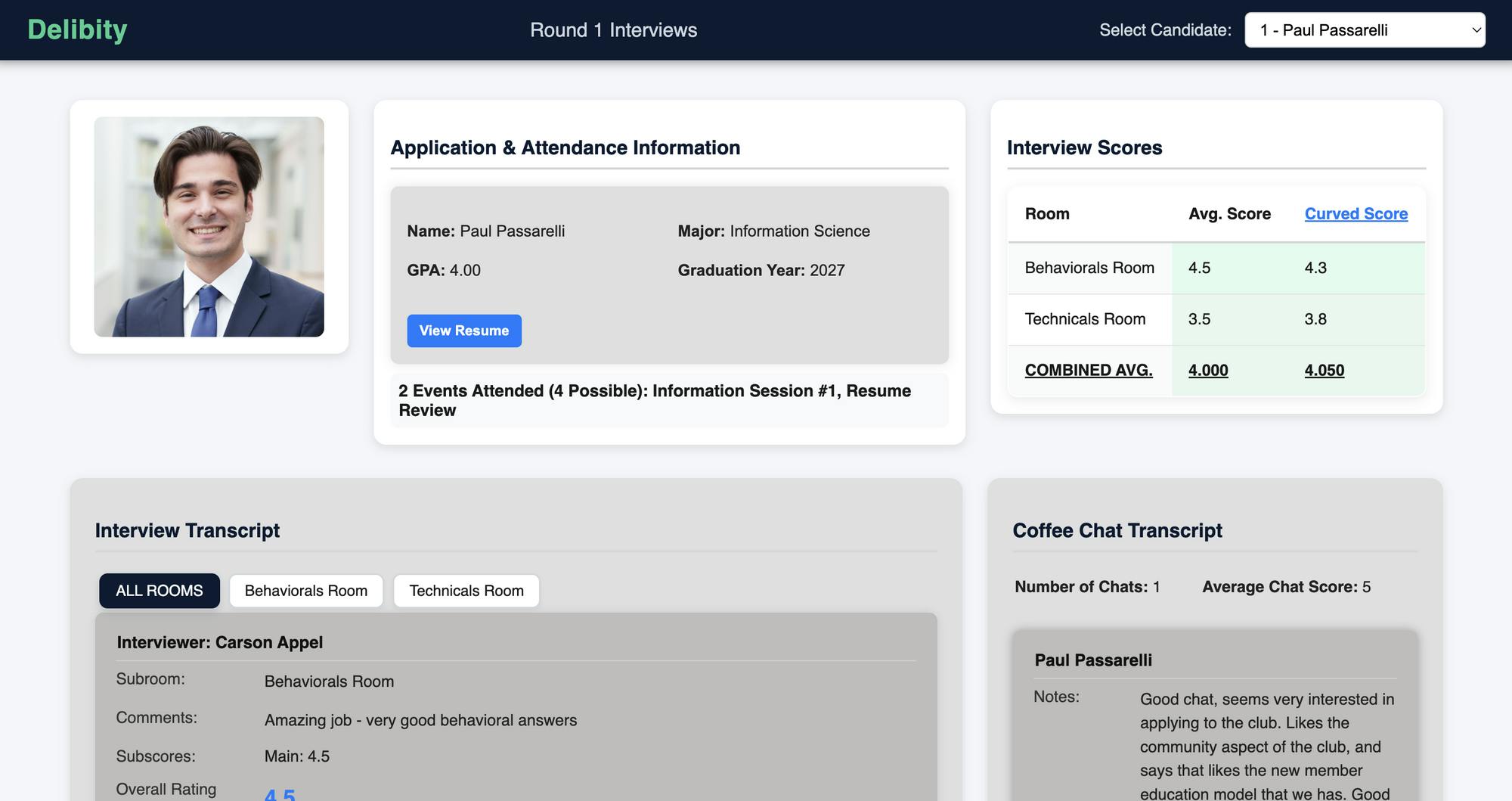
“Psychologically when you see all the information and effort a candidate puts into joining a club all in one place it helps increase fairness and transparency during when clubs are doing their deliberations,” Passarelli said.
Delibity also automates tasks such as pairing members for coffee-chats and sending out emails to applicants. Passarelli explained that Delibity was “built to be customized” so pre-professional groups, Greek life and other types of clubs could utilize the platform.
Arnav Chinchankar ’26 met Passarelli through Phi Gamma Nu and was the previous president of the fraternity. In an email statement to The Sun, he described Passarelli as “very receptive” to changes to the platform as it was adapted for Phi Gamma Nu’s recruitment process. Chinchankar noted that Passarelli’s flexibility has made the software user-friendly for anyone to use.
“Before Delibity, [Phi Gamma Nu] had to manage and compile several different forms, spreadsheets and presentations,” Chinchankar wrote to The Sun. “Delibity brings everything together in one intuitive platform, so I would definitely recommend it to other student groups.”
Jason Orenstein ’27 is the president of Alpha Fund, an investment group at Cornell. He uses the platform for managing Alpha Fund’s recruitment, and explained that Passarelli was always willing to meet one-on-one with Zoom to walk through the platform and address questions in real time.
He explained that by decreasing time spent on organizational tasks, club leaders can spend more time “connecting with potential new members” and ensure that all parts of the recruitment process are taken into account when evaluating a candidate.
“Working with Paul was extremely efficient and effective,” Orenstein wrote in an email statement to The Sun. “He incorporated all feedback promptly … he continued to develop features for the platform … that enhance the platform's usefulness and support his claim that Delibity will be an all-in-one product for clubs at Cornell.”
What’s Ahead for Delibity
The public version of Delibity has been available since November, though Passarelli explained that he is continuing to add new features to the platform including “Delibity Assign,” a virtual classroom designed to streamline new member education and assist clubs with the onboarding process.
“Delibity Assign” allows clubs to create club courses, track deliverables and grade submissions for new members on projects or assignments. Additionally, groups can preserve resources for the next semester’s educator according to the website.
One of Passarelli’s goals this semester is to encourage more organizations to use the platform and to hear from clubs that utilized Delibity to “gain more insight” into how to improve the program. He is also interested in expanding the platform to other tasks that clubs run annually.
“I hope to continue to expand the limits of the platform and hear from students,” Passarelli said. “I want to maintain the integrity that built this platform in the first place above all else.”
Passarelli hopes to continue improving the platform this semester and launching it to more clubs. Part of his plan is to make the platform more accessible to smaller clubs, given that access to the platform requires a subscription, which starts at $30 a semester.
“It has been such a rewarding experience and process in so many different ways,” Passarelli said. “From the small victory nights when you finally watch an idea materialize to knowing that you are improving someone’s life and saving them time and energy … I’m forever grateful for this.”
Zeinab Faraj is a member of the Class of 2028 in the College of Arts and Sciences. She is a senior editor for the 144th Editorial Board. She was a features editor and an assistant sports editor on the 143rd Editorial Board and can be reached at zfaraj@cornellsun.com.


