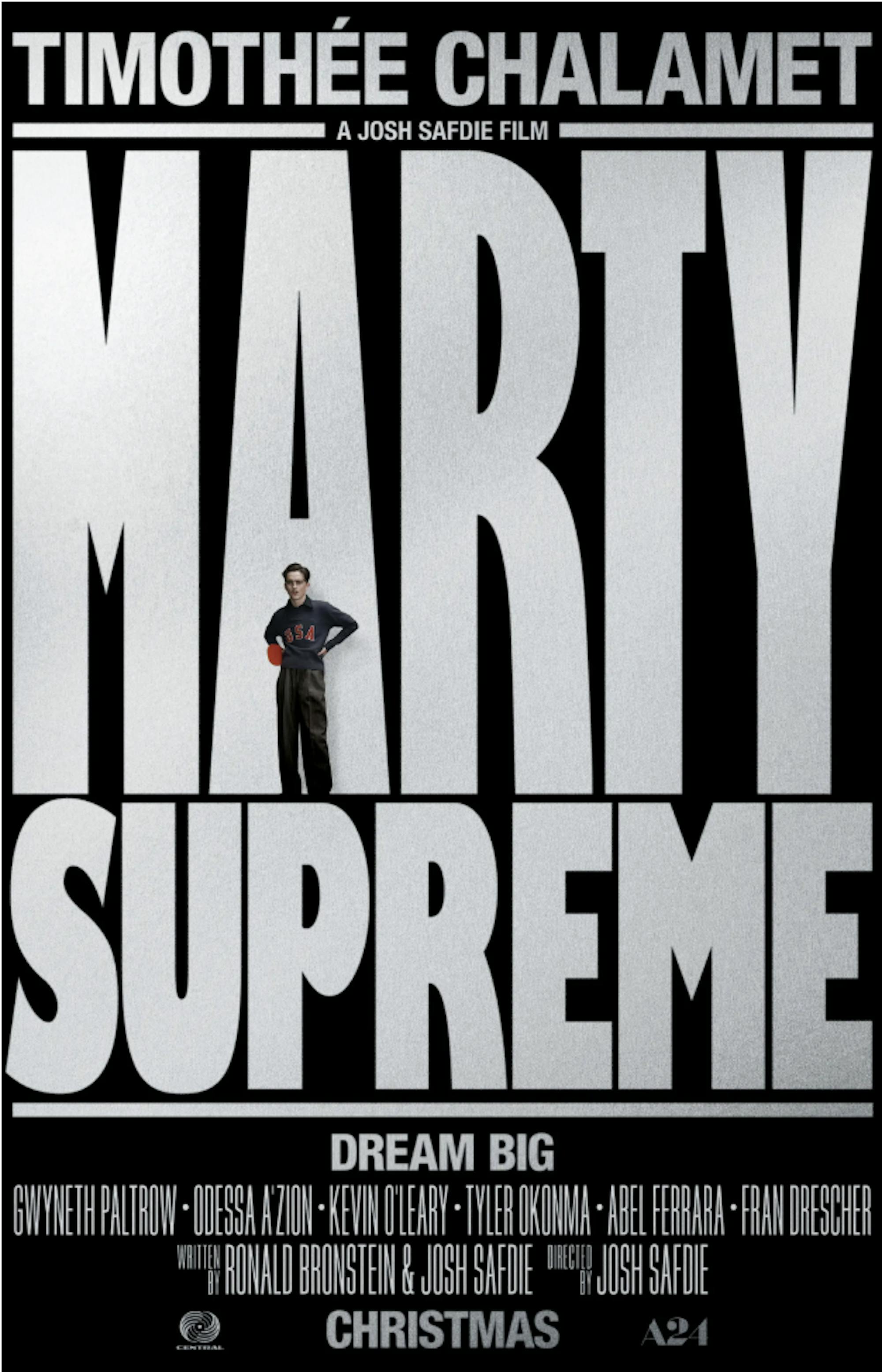
Why do we root for our national sports teams even when our opinion on the country is negative? Why are passionate people willing to sacrifice virtually everything for their singular and arbitrary goals? Sometimes the answers to these questions do not follow clear logic, yet these inexplicable choices have large impacts on the people involved. Director Josh Safdie explores these questions in Marty Supreme, his high-octane epic of Marty Mauser’s journey to the table tennis world championships in Tokyo.
The film introduces Marty Mauser (Timothée Chalamet) as he works as a shoe salesman in his uncle’s store, scrounging up the money to travel to Great Britain to represent the United States in the Table Tennis Open. Within the film’s opening minutes, Marty engages in an affair with a married woman (Odessa A’Zion) and holds someone at gunpoint to obtain money for his flight. When he returns home from the Open after eight months of aimless travel with even less money than before, he suddenly has to face the consequences of his actions while (yet again) raising the funds to fly to the championships in Tokyo. Much like Safdie’s film Uncut Gems, co-directed with his brother Benny, the absurdities of Marty Supreme are unrelenting. Just when things have gotten bad, they somehow get worse in new, unexpected ways.
Marty is an almost-but-not-quite table tennis star, representing the United States on a world stage, even if the stage is small. In spite of his glaring character flaws like spewing cutting insults and uncomfortable jokes with ease, Marty is an exemplary American sports star. He is honest at the tennis table, mastering the classic playing style and celebrating his wins with the expected American arrogance. Even his loose morals show American grit and autonomy, doing whatever he can to pull himself up by his bootstraps, even if that sometimes means pulling on other people’s bootstraps –– and reaching in their pockets.
Josh Safdie is a lifelong New York Knicks fan. The prominent fascinations of the NBA fandom, like on-court ethics, the rat race that underprivileged players must partake in and the importance of classic American players, all reflect in how he constructs the table tennis ecosystem of Marty Supreme. Marty doesn’t change his paddle grip even after he sees that the new pencil style successfully elevates his Japanese rival Koto Endo’s game. When he cons an amateur player at the bowling alley for money, he still gets genuinely irritated when the opponent won’t play the game by the book.
Often, sports fans care significantly less about personal character in their sports stars than they do about in-tournament integrity, and ruthless personal sacrifice is even idealized as the pinnacle of dedication. While Safdie’s depiction of athletic highs and lows commands attention in the theater, it is the unglamorous depiction of personal sacrifice that leaves a lasting impression.
Marty lives in a tenement with his emotionally manipulative mother, with his future inevitably leading to him managing his uncle’s quaint shoe store. It is solely through athletic talent that Marty is able to travel the world. His dreams of professional admiration and class mobility are not completely unrealized, but as quickly as Safdie lifts Marty up, he crashes him back down. Once Marty returns from his extended trip after the British Open, he is still impoverished and largely in the same circumstances as before he left.
As is often the case when individuals with underprivileged backgrounds find athletic success, Marty comes in proximity to the world’s most wealthy while not being afforded the respect of those truly brought into the fold. While millionaire Milton Rockwell takes a liking to Marty’s entrepreneurial mindset, he still expresses resentment towards Marty and his fellow player, Bela Kletzki, for their Jewishness because his son died serving in World War II.
Due to the relatively objective nature of professional sports, they have often sped ahead of other industries in allowing disadvantaged Americans to represent the country. Although table tennis wasn’t a major sport, it still meant something for a Jewish person to represent America when many held resentful sentiments similar to Milton Rockwell. For better or worse, Marty embodies American exceptionalism when he is photographed with all of the participants at the British Open: the photographer tells them to be serious, and just before the shutter clicks, Marty cracks a smile that stretches to all four corners of his face. On the surface, the moment is obnoxious. But seven years after the end of World War II, when many Jews wanted to go unnoticed, Marty believed that he should be seen.
As important as the film’s discussion of identity is, Marty Supreme is only as successful as its execution. The fast pace commands your focus for the film’s entire duration. When you watch table tennis, the reliable clinks of the ball sometimes remain stuck in your head for hours after, and Safdie mirrors this rhythmic pacing throughout the film.
One of the most indelible examples of the stellar pacing comes when Marty faces Kletzki at the British Open. When Kletzki accepts defeat, he walks away from his end of the table before the final point has even finished, meeting Marty in an excited embrace. As soon as they grab each other, the kinetic opening notes of the score’s “Pure Joy” ring out. There is a lot more to invoking excitement in an audience than interesting shots or good lines. Frame by frame, note by note, the pacing has to align with what our brains can grab onto, speeding ahead while still keeping us on the rails. Marty Supreme masters this from start to finish.
Chloe Asack is a senior in the College of Arts and Sciences. She can be reached at casack@cornellsun.com.

Chloe Asack is a member of the Class of 2026 in the College of Arts and Sciences. She is a staff writer for the Arts & Culture department and can be reached at casack@cornellsun.com.