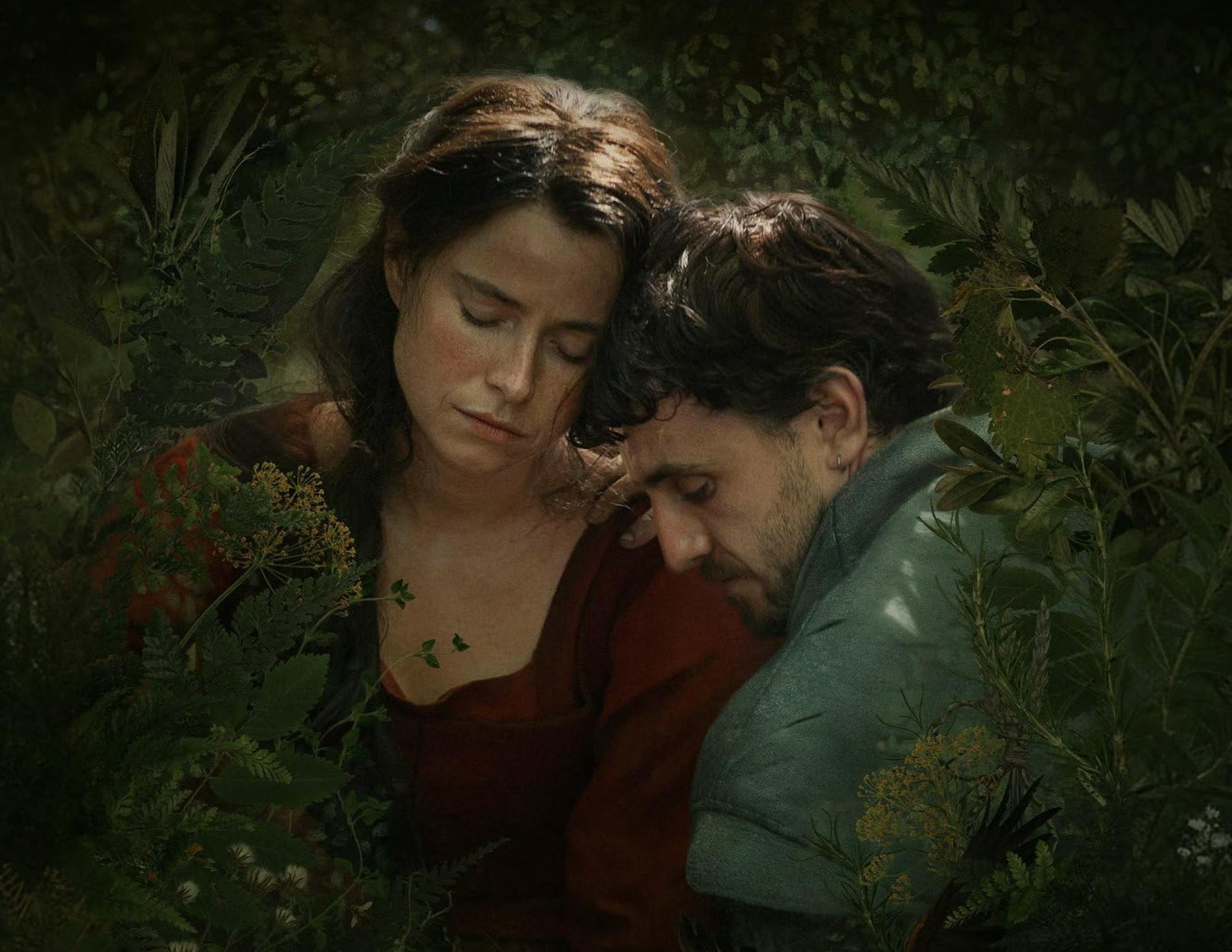
On Jan. 11, much to her shock, Chloé Zhao’s Hamnet won the Golden Globe for Best Motion Picture in the Drama category. Just last Thursday, the film was nominated for eight Academy Awards, including Best Actress, Best Picture and the much coveted Best Director and Best Casting prizes. The movie’s only snub was Paul Mescal for Best Supporting Actor, which was tolerable in spite of Mescal’s sharp portrayal of William Shakespeare. In the face of Jessie Buckley’s career-defining turn as Shakespeare’s wife, Agnes, I doubt that very many viewers were thinking about Mescal even an hour after seeing the film.
Zhao’s Hamnet opens with Agnes sleeping in the forest moments before she meets William. His attraction to her is immediately apparent even as she outwardly resists his forward advances, but, despite Agnes’ initial hesitance, the pair falls in love at near-montage speed. Children follow soon after, and as Agnes dedicates herself to raising them, William, while loving, grows increasingly discontent as he is unable to realize his playwriting ambitions in rural England.
Agnes sends him to London to develop his work. Although his long absences sadden their three children, William’s mood improves as he accumulates professional success, and their family relationships become idyllic. If you happen to know literally nothing about this movie at all, stop reading now. As may be discerned from the subtitle of Maggie O’Farrell’s original novel (Hamnet: A Novel of the Plague), the couple’s young son, Hamnet, dies while William is away in London. Agnes is left alone as she tries every natural remedy she knows to heal her son, but he succumbs to disease in her arms. She throws her head back in agony, and there is a short breath of silence before she cries out.
There is perhaps no other subject matter that can so easily reach the heart strings as the death of a child, which may be why some critics have questioned if the film is not just “grief porn” or “emotional manipulation.” While I, like many, reflexively eyebrow-raise at such harsh accusations, I don’t find them to be beyond the pale.
I found the film incredibly poignant upon first watch, and with such a sensitive subject, I thought the handling of grief and love to be beyond reproach. Now that I’ve reflected, I don’t think that emotional manipulation is an entirely unfair descriptor, although the term is puzzling, seeing as all films are trying to invoke some sort of reaction in their audience.
Emotional manipulation alone is not necessarily detractive or a malicious thing for a film to do, but overt emotional manipulation is distracting. In other words, we needn’t see the man behind the curtain, and there are moments in Hamnet where we do. The most glaring offense is when, early in their courtship, Agnes asks William to tell her a story. Mescal’s rendition of Orpheus and Eurydice reveals his understated intelligence and deep desire to win Agnes’s favor. It’s one of Mescal’s finest moments, but it is drowned out by the score’s intense swell, cueing the audience to comprehend the attraction and the intensity. But we already did! The sound cue is just distracting and indulgent.
There are a few other moments like this. We understand that Agnes is imagining Hamnet performing at the Globe at the film’s end before we see the literal depiction of her fantasy. We surely grasp that Hamnet and Hamlet are similar names before the film’s epigraph ensures that we understand.
But these much-discussed, heavy-handed moments have little overlap with the movie’s strengths. My qualm with the emotional manipulation charge is that most of the film’s indelible emotional moments don’t come across as heavy-handed at all. My eyes didn’t prickle when the score ramped up, but they did at Agnes’s excited, fearful smile just before she marries William.
Hamnet’s most impressive triumph is in overcoming the thorny challenge of making the audience care particularly deeply about one of the many young children who died of the plague. Of course, we were going to care at least a little bit, but Hamnet (Jacobi Jupe) was a revelation. In very limited screentime, Jupe portrayed the naïveté and idealism that we admire most about childhood in crystal clarity — no overt manipulation needed. At risk of sounding heartless, some kids are lovely but unmemorable. Hamnet is like your favorite kid that you babysit. When William is about to leave for London, you see Hamnet hiding his sadness before it balloons and colors his entire face, not wanting to let his dad go. It is through Jupe’s performance that the rest of the film succeeds. The audience never has to sympathize to understand why Agnes grieves so deeply for Hamnet. We also cared about him for the fleeting minutes he was on our screen.
Buckley’s performance has its extremely showy moments, but that isn’t why it’s so lauded. Like most (see: the widespread critical acclaim), I found those showy moments incredibly earned, but her performance remains in your mind because of the subtle choices she makes to craft the whole of Agnes around the limits of the movie’s duration. If Buckley’s award streak continues, it will be a well-deserved sweep.
The widespread fear of death is not trite or sentimental, even if nowadays we act like intensity is inherently embarrassing. Loss is one of the most important stories of our lives. As Chloé Zhao said at the Golden Globes, part of making art is being “vulnerable enough to be seen for who we are, not who we ought to be.” And who are we? We are people who clutch our loved ones tight, wanting to keep them safe even if we know we can't control fate.
Hamnet’s overtness may detract from its technical attributes, and perhaps another filmmaker would’ve made some slightly less indulgent, somewhat more effective choices. But I truly don’t believe there’s much likelihood that another filmmaker would have captured the core of this story as expertly as Chloé Zhao, and I’m satisfied with that tradeoff.
Chloe Asack is a senior in the College of Arts and Sciences. She can be reached at casack@cornellsun.com.

Chloe Asack is a member of the Class of 2026 in the College of Arts and Sciences. She is a staff writer for the Arts & Culture department and can be reached at casack@cornellsun.com.