

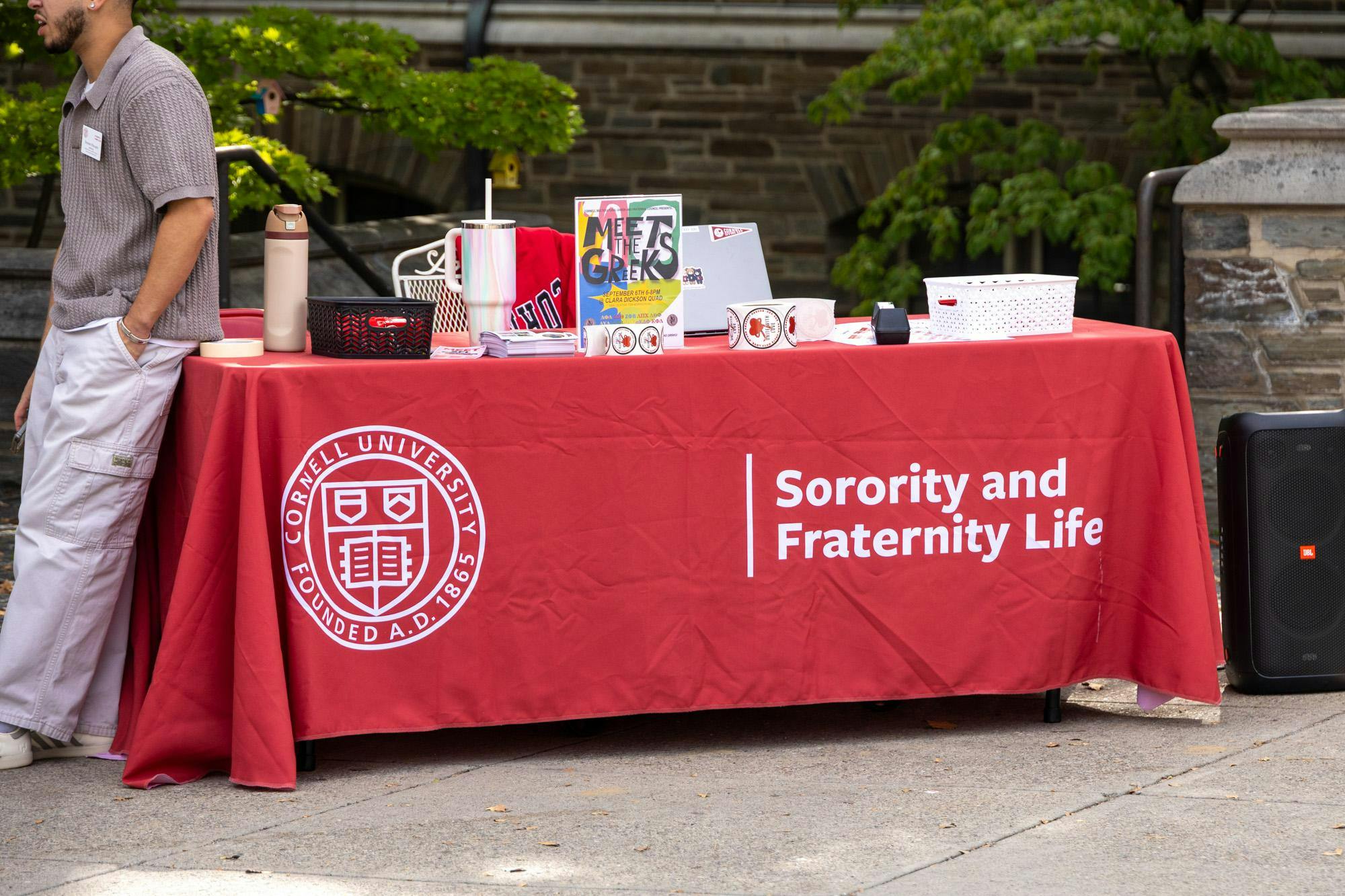
The Panhellenic Council posted higher member cumulative grade point averages than the overall Cornell undergraduate student body, according to data released for Spring 2025 by Cornell University Sorority and Fraternity Life.
Panhel is the governing body for social sororities and currently recognizes 1,793 members of Cornell’s 11 sororities. It works under the National Panhellenic Conference to set policies, plan recruitment and events.
According to the published data, the average Cornell GPA in Spring 2025 was 3.44 and the Panhel community wide average GPA was posted at 3.65. The Interfraternity Council and Multicultural Greek and Fraternal Council had lower GPAs than the average at Cornell at 3.24 and 3.20, respectively.
Similar to Panhel, IFC and MGFC oversee Greek Life chapters at Cornell, with IFC responsible for 26 social fraternities and MGFC governing 13 recognized chapters.
The Sun spoke with presidents of Greek Life chapters at Cornell to discuss the data and their redactions to it ahead of the spring semester.
Cornell Fraternities
Zeta Beta Tau is the first and largest Jewish fraternity according to its website. Its 69 members at Cornell as of Spring 2025 posted the highest GPA out of any Greek Life group.
Behind Zeta Beta Tau was Kappa Sigma, a social fraternity with 35 listed members and an average spring 2025 member cumulative GPA of 3.67 — 0.23 points higher than the Cornell average.
“I was not particularly surprised but I was very proud,” said Davian Gekman ’27, president of Kappa Sigma, when asked about his initial reaction to the fraternity's GPA.
Gekman explained that while prospective and current new members are not required to disclose their GPAs, Kappa Sigma has a “strong work hard play hard culture” that he believed contributed to the high GPA. He also personally claimed that his GPA improved the more he "integrated" himself into Kappa Sigma.
“One of the best ways to do well at Cornell is also to kick back and relax from time to time,” Gekman said. “[Kappa Sigma] has a motivating culture so all the brothers are motivating each other and alumni really motivate us to prioritize our academic and professional success.”
Gekman supported the release of the data, explaining that it helped dispel a “general negative stigma” around Greek Life. He noted that it is useful for new prospective members of fraternities and sororities to reference and also promoted transparency.
At the same time, Gekman emphasized that GPA is not the “end all be all” metric for academic success. He explained that there are many different reasons why a GPA could fluctuate and that different majors, grade deflation and personal circumstances could impact averages.
“The Greek life community at Cornell is different from other universities,” Gekman said. “The value of the community here is that it provides you a support system, a way to enjoy Cornell and lifelong friends.”
Tied with Kappa Sigma was Pi Kappa Alpha, a social fraternity with 91 active members. In an email statement to The Sun, IFC explained that each chapter had set “mentorship and peer tutoring” in place to help its members succeed. In addition, alumni serve as mentors, which IFC attributed as one of the reasons joining a fraternity “often has a positive measurable effect on a student’s GPA.”
“A fraternity provides the physical and mental support system that makes that success possible,” IFC wrote in an email statement to The Sun. “By offering a social outlet and a community where members can relax and recharge, we help prevent burnout.”
Cornell Sororities
Kappa Kappa Gamma is a social sorority at Cornell University with 167 members and the highest sorority GPA of 3.78 as of Spring 2025. Behind it, Pi Beta Phi had a GPA of 3.75.
In third place was Sigma Delta Tau with an average GPA of 3.73. President of Sigma Delta Tau Alexandra Damast ’28 attributed the high GPA to the sororities “strong emphasis on academic excellence” and different initiatives that the sorority's Vice President of Academic Development puts together.
“The sorority has joint study sessions and dedicated study rooms where people are always collaborating and studying together,” Damast said. “We also have academic bigs and littles which really transformed my academic experience at Cornell personally.”
Damast also stated that Sigma Delta Tau has an honors society, Order of the Lapis, which motivates members to push themselves academically. Order of Lapis has a GPA requirement of 3.7 or higher for juniors and 3.5 or higher for seniors, according to their website.
Damast added that being a part of Greek Life provided her a “good balance” between her social life and academic responsibilities. She explained that having a “social outlet” to “recharge” helps improve academic performance and mental health.
She hopes that potential new members use the data to help “reassure them” that joining Greek Life could be a positive experience and one that helps make “the big campus feel smaller.”
“There might be many reasons not to join Greek Life but if your only concern is academics at least from my experience it has been a nonissue,” Damast said. “It has likely positively impacted my academic performance.”
Cornell Multicultural Groups
For Cornell’s multicultural groups, Alpha Kappa Delta Phi, with 35 members, had the highest member cumulative GPA at 3.64 and is the third-largest multicultural group at Cornell.
Alpha Kappa Delta Phi’s President Bomi Kim ’27 described the achievement as "surprising" given the number of multicultural groups at Cornell. She was “very pleased and proud of the sisters.”
Kim described some of the academic initiatives that Alpha Kappa Delta Phi has in place, including a mandated five hour weekly study session for members. Additionally, she added that members often study together at different libraries across campus which “promotes the values of accountability and community.”
“All of the sisters are very academically rigorous,” Kim said. “At least half of the active house last year was pre-med and the other half was engineering so we all prioritize our academics.”
She also said that while some freshman might “shy away” from joining Greek Life due to concerns about it taking away from their time to study, Kim felt that being a member of Alpha Kappa Delta Phi provided her a “built in academic community” and several pre-professional resources such as the “extensive and strong” alumnae network.
“Being in Greek Life helped me expand my social circle and meet people who were academically inclined like me,” Kim said. “I think anyone who is interested in joining [Greek Life] should give it a try because it might end up being the best decision you make socially and academically.”
Zeinab Faraj is a member of the Class of 2028 in the College of Arts and Sciences. She is a senior editor for the 144th Editorial Board. She was a features editor and an assistant sports editor on the 143rd Editorial Board and can be reached at zfaraj@cornellsun.com.


