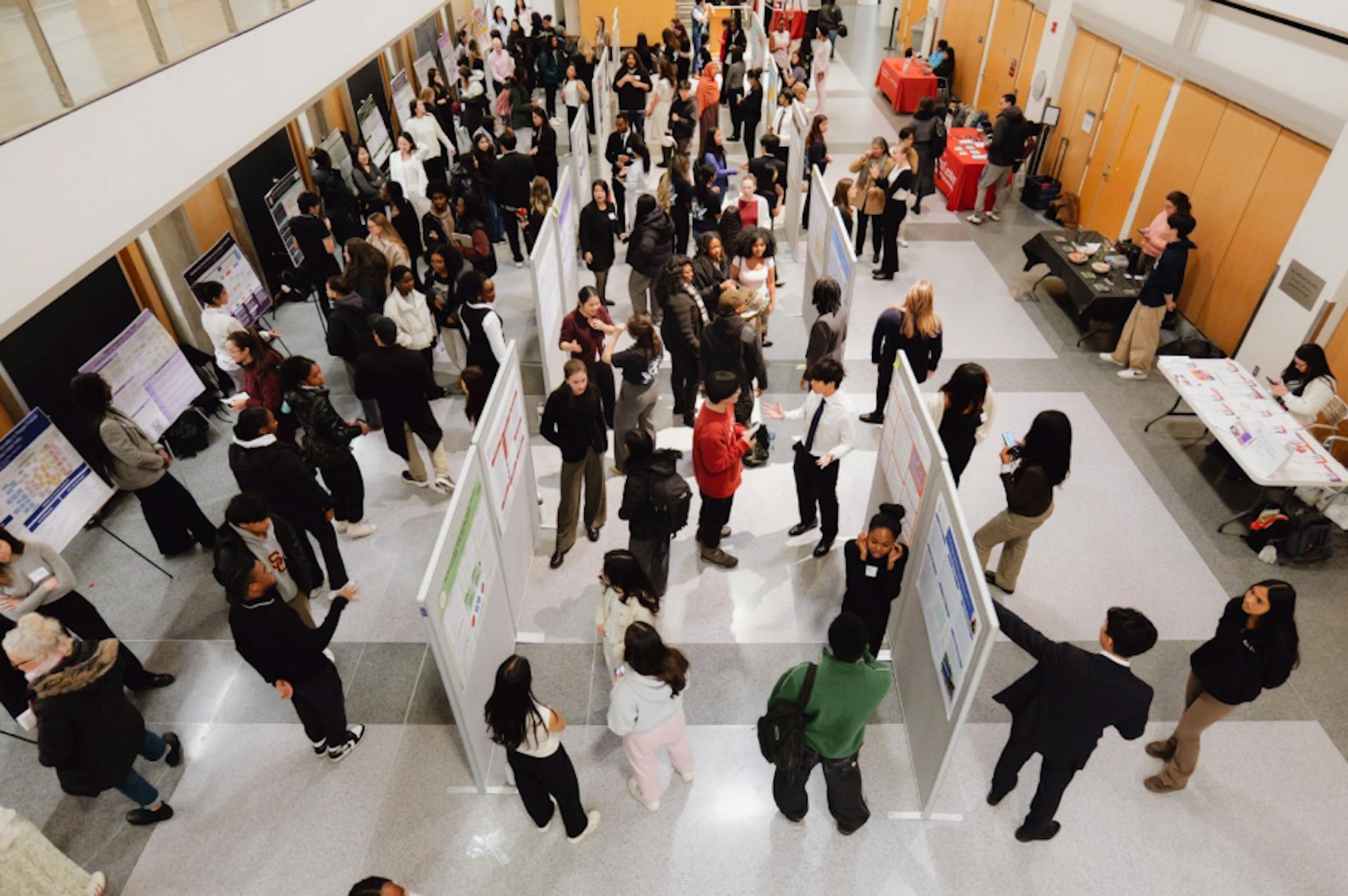
The annual Experiential Learning Symposium was held on Nov. 13 celebrating its 11th anniversary. Over 50 undergraduates majoring in global and public health sciences, along with five graduate students studying public health, presented their research at the symposium.
The event was presented by the Global Health Student Advisory Board, a student organization that helps GPHS students find research and internship opportunities. As a part of their graduation requirement, students present their research findings and work during the annual symposium.
The symposium demonstrates how many GPHS students are engaging with their major outside of academics and applying their career interests, according to Haylee Law ’26, president of GHSAB.
“I worked on climate change preparedness for medical students in Moshi, Tanzania that started from following Professor [Jeanne] Moseley on her research in Tanzania,” Law said. “What is interesting is that there can be vastly different projects about medical translation applications in just the next booth.”
While the specific topics of the students’ work varied, the overall theme of the presentations were all tied to healthcare and equity. For instance, Lauren Byun ’27 took part in a research internship at Weill Cornell Medical School over the summer and presented her experience on human immunodeficiency virus and acquired immunodeficiency syndrome research.
“The program contained community engagement on infectious diseases, which is what I have been passionate about for a long time,” Byun said.
Another student, Ose Imoisili ’26, was involved in field work in Africa. She explained that her research took place in Yaounde, Cameroon. Imoisili found out the strong correlation between socioeconomic status and health outcomes, while also discovering how underfunded the average Cameroonian is when it comes to healthcare. She proposed a voucher-based system where financial support is given for major health events, like child birth.
This system, which is under consideration for implementation, ensures cost reductions for patients and reduces pressure on insurance companies for performance-based profits.
Some projects were motivated by students’ personal stories as well. Cameron Lincoln MPH ’26 created a free online resource for multilingual HIV case management for his project.
Part of his project included the creation of a digital guide where patients who could not speak English could gain access to information on HIV care in their native language. Lincoln said that the experiences of his mother, an immigrant, motivated him to create the platform.
The ELS helps students learn how to present their research and communicate science with the broader community.
“All the projects contain unique interest in various areas related to healthcare and health disparity while being united under the spirit of passion and dedication,” Law said.
Val Kim is a member of the Class of 2028 in the College of Human Ecology. He is a staff writer for the science department and can be reached at vkim@cornellsun.com.