

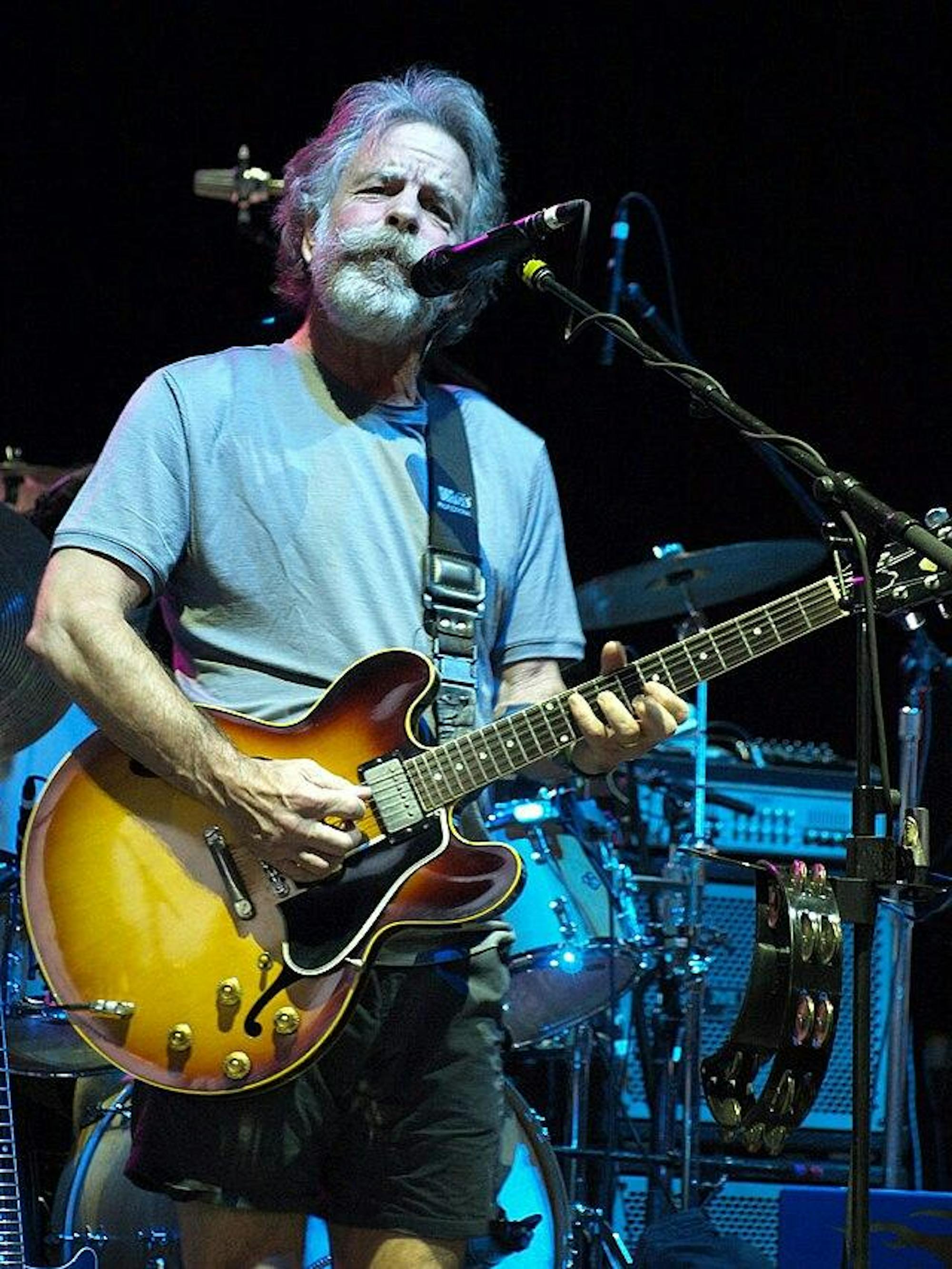
On Jan. 10, co-founder of the Grateful Dead Bob Weir died at 78, per a statement his family released. As the band’s rhythm guitarist who also helped write some of their best-known songs like “Sugar Magnolia,” “Truckin’” and “Playing in the Band” Bob Weir contributed to one of the most influential legacies in the history of psychedelic rock.
The Grateful Dead emerged during the height of hippie culture in the 1960s, but even after the decline of their original zeitgeist they have had legions of devoted fans behind them, having sold millions of records and performed thousands of concerts. Perhaps the quintessential jam band, the Dead were famous for their long, improvised live performances that cohesively united psychedelic rock with rootsy folk rock. As a founding member of the Grateful Dead, Bob Weir played a literal instrumental role in grounding the band’s soaring solos and chaotic licks with his innovative use of the rhythm guitar.
With a history spanning over 30 years, the Grateful Dead became one of the most celebrated live acts, so much so that Deadheads hold the band’s greatest live performances in perhaps higher esteem than the band’s actual studio releases. The band seems to have embraced this mindset as well, as they hold the Guinness World Record for most live albums released at 233, surpassing the likes of Elvis Presley and Frank Sinatra. Along with the rest of the Grateful Dead, Weir received a lifetime achievement Grammy award in 2007 and became a Kennedy Center Honoree in 2024 for his work.
Fans of the Grateful Dead have had their own way of showing appreciation and saying goodbye for decades after the deaths of unofficial frontman Jerry Garcia in 1995 and bassist Phil Lesh in 2024. Weir was no different; on Jan. 16, fans gathered at the venue Brooklyn Bowl for a free memorial concert in his honor. Despite the cult following the band achieved, one fan at the show told the New York Times, “I wouldn’t say [Deadheads] worshipped [Weir]. He was more like a friend.” The cover band, Bushwick’s Dead, played not only as a tribute to Weir and the band, but also to continue the band’s story and soul over 30 years after the band officially dissolved. Though this idea of continuing what the band represented is not a new one — Weir and other Grateful Dead members continued playing as part of many Dead-affiliated successor acts like Dead and Company with John Mayer — the concert in celebration of Bob Weir’s life demonstrated that this continuation had become firmly transgenerational.
The Grateful Dead’s history is particularly entwined with Cornell’s, as many a tour guide have said to visiting prospective students. Their fabled 162-minute live album recorded in Barton Hall, Cornell 5/8/77, quickly became a fan-favorite and indeed one of the most famous live albums of all time. The album has a legendary status among so-called Deadheads and non-Deadheads alike: In 2011, the album was included in the National Recording Registry in the Library of Congress, and in 2017, the album had an entire book dedicated to it. But this album isn’t merely legendary — it’s good. Despite — or perhaps due to — an average song length of over eight minutes, Weir and the Grateful Dead play tight, endlessly enjoyable grooves without ever running out of steam. The album’s consistency is one aspect to admire; the commendable extension of the 3-minute Marvin Gaye written hit “Dancing in the Street” to become a 17-minute tour de force is another. The songs on this record that Bob Weir wrote are also, personally, among its best. As any Deadhead will tell you, “Jack Straw” and “Estimated Prophet” were why this live performance became the Grateful Dead’s most well-known and revered.
Bob Weir, having been affiliated with a group called “the Dead” since he was a teenager, was no stranger to death. He told the Rolling Stone in March of 2025, “I look forward to dying. I tend to think of death as the last and best reward for a life well-lived. That’s it…I’ve still got a lot on my plate, and I won’t be ready to go for a while,” he said. It’s hard to see what more Bob Weir wanted to do, given all he has already done for millions of music fans around the world. Though he will be missed, he will be especially remembered by his fans, young and old, for his contributions to musical history to which Cornell University was lucky to have witnessed.
Gustavo Ponzoa is a freshman in the College of Arts and Sciences. He can be reached at gap87@cornell.edu.
Gustavo Ponzoa is a member of the Class of 2029 in the College of Arts and Sciences. He is a staff writer for the Arts & Culture department and can be reached at gap87@cornell.edu.


