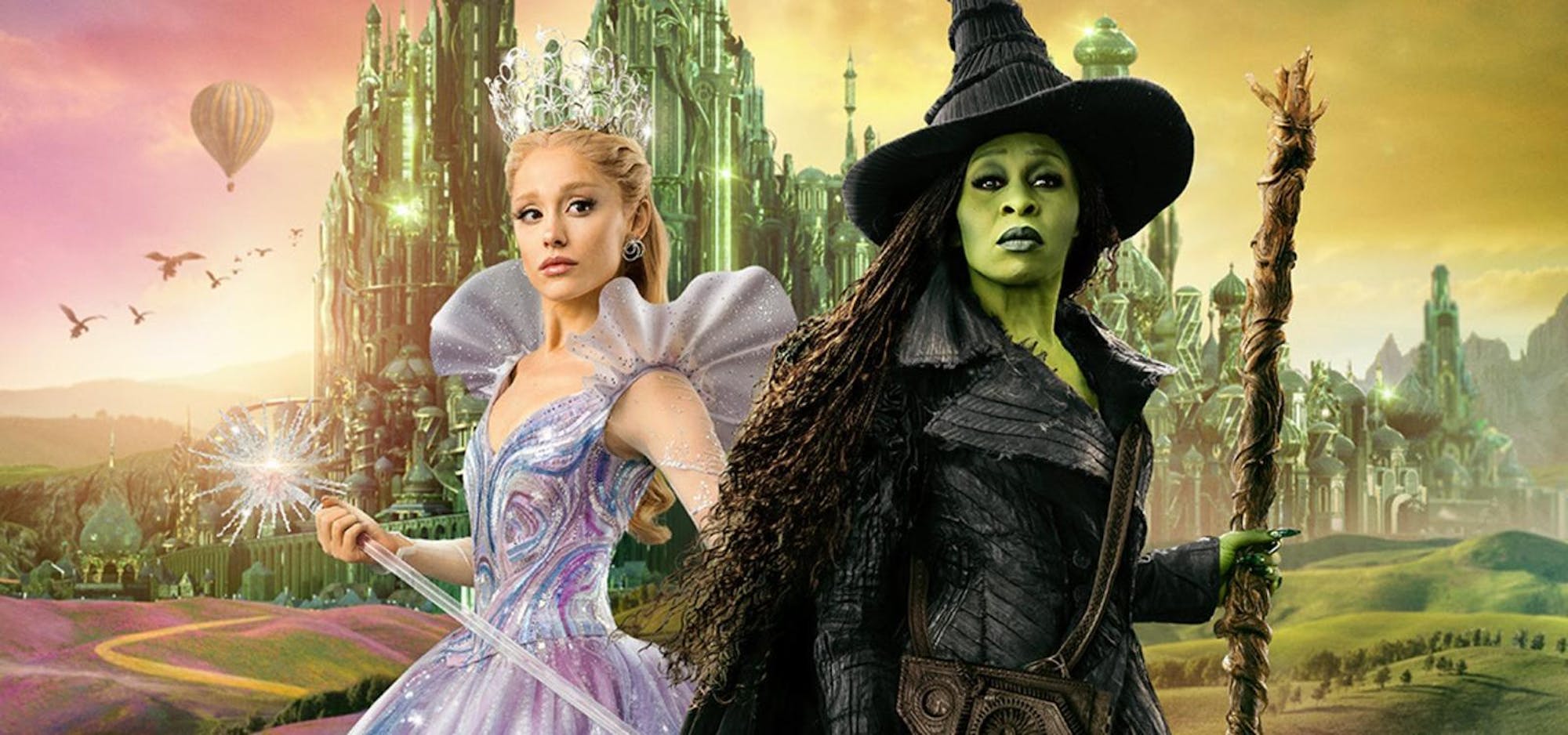
Wicked: For Good was my most anticipated movie of the year, following the smash-hit success of the first film last year. On Wednesday, Nov. 19, I burst through the doors of our local Regal Cinemas, overflowing with excitement to watch an early screening of Wicked: For Good, and while I left content with the movie, I kept asking myself if I had enjoyed it because it was an inherently good movie or if it had simply appealed to nostalgia.
From the ripe age of six, little old me has been “holding space” for the lyrics of the iconic Wicked act one finale “Defying Gravity” and dancing to “Popular,” hopping around my room pretending to be Glinda. At 12, I begged my dad to take me to New York City to see Wicked on Broadway — let’s just say I was changed for the better. Since then, I’ve seen Wicked on stage two more times (all equally as glorious) and anticipated the first movie, anxiously awaiting a faithful adaptation of Wicked that does the stage play justice. After watching the two films, I can confidently say that the stage play version of Wicked is simply unbeatable, but the first movie came close to harnessing the uniquely magical and comedic aspect that makes the story so special. For Good, however, fell short in comparison, feeling cluttered and practically overdone.
The second act of Wicked was originally one hour long, dramatically shorter than the two hour and 17 minute run-time of the film version. Act two serves to connect the story back to the source material of Wicked — The Wizard of Oz — explaining how Elphaba became the “Wicked Witch of the West” and how Glinda became “Glinda the Good.” Part two of Wicked is a more serious story, as the protagonists are thrown into diverging chaos when Elphaba chooses to publicly go against the Wizard, and Glinda becomes his propaganda machine. Glinda and Elphaba, who were best friends in school, are now public enemies, yet both of them secretly yearn for the other’s friendship and company during their turbulent lives. These circumstances up the stakes and lead Glinda and Elphaba to put aside their friendship and decide what’s better for the fate of Oz, ultimately sacrificing their friendship for the good of the Ozians during their emotional ballad “For Good.”
During the press tour for Wicked: For Good, director John M. Chu stressed that this sequel has a much darker tone than the first film. Now, if what he meant by darker was darker color grading, he would be very right! The color grading for the Wicked films has been thoroughly criticized; especially for a movie that’s meant to honor the original Technicolor masterpiece, The Wizard of Oz, Wicked’s color saturation was nowhere to be found. It’s a genuine shame Wicked fell victim to “Netflix lighting,” dulling the beautiful practical sets designed by production designer Nathan Crowley.
Colors aside, the tone of the story takes a dramatic shift from the lively fun of the first film into a serious, high-stakes, tragic story. It’s almost too tragic, leaning on the suffering of the protagonists so much more than the play does. This works for Elphaba’s character, in that she’s literally hunted like a monster and is perceived to be a “wicked witch” when all she wants to do is help free the animals and expose the Wizard’s fascistic lies; her suffering is felt and earned. Her new ballad, created specifically for the movie, titled “No Place Like Home,” gives her a moment to explain her deep connection to the animals and how, while she is hated in Oz, it’s her home, and she’s willing to fight for it regardless of how the public feels about her. Among the many changes and additions they made to the original story to adapt it into a film, this song felt like the best decision — it marks a positive shift in the movie's pacing, which had felt a little senseless and slow, while also explaining Elphaba’s motivations. My problem with Wicked: For Good was that it kept trying to shove Glinda’s “suffering” in my face when all the poor girl had to deal with was people pleasing. Act two of Wicked is stronger when it’s Elphaba’s story, so why am I seeing so many shots of Ariana Grande crying? Glinda’s new ballad, “Girl in the Bubble,” is meant to mark her “bubble popping,” meaning she’s finally ready to step up and live up to her “the Good” title. It was just all right.
So, let’s sum it up, the good and the wicked.
The Good:
Ethan Slater’s performance as the Tin Man was masterful. He had a frightening tenacity that blew me away. Cynthia Erivo’s rendition of “No Good Deed” was easily the highlight of the entire franchise; lives were changed. The tie-backs to The Wizard of Oz were entertaining and added an unexpected level of excitement to the watching experience. The allegory for fascism was stronger and clearer than ever, efficiently demonstrated visually through propaganda posters and narratively through Madame Morrible’s character.
The Wicked:
Fiyero, played by Jonathan Bailey, is a fatally underused character to drive the story forward. A ballad for his arc would’ve been more interesting than Glinda’s ballad. Michelle Yeoh as Madame Morrible (meme aside) is a hard watch; there are so many Broadway legends that could’ve brought this character to its evil glory. Finally, Ariana Grande’s extremely distracting false eyelashes.
While I do think Wicked: For Good is an enjoyable movie, it comes nowhere close to the stage version or the first movie’s charm. Nonetheless, l loved watching it because of the experience and unique moment in pop culture that the Wicked movies have harnessed. Wicked has long been a fundamental part of who I am, and now the story is available to the masses for future generations to discover and love as much as I have, ensuring that Glinda and Elphaba’s story is here to stay, for good.
Paulina Delgado-Umpierre is a sophomore in the College of Arts and Sciences. She can be reached at pmd99@cornell.edu.
Paulina Delgado-Umpierre is a member of the Class of 2028 in the College of Arts and Sciences. She is a staff writer for the Arts & Culture department and can be reached at pdelgadoumpierre@cornellsun.com.