


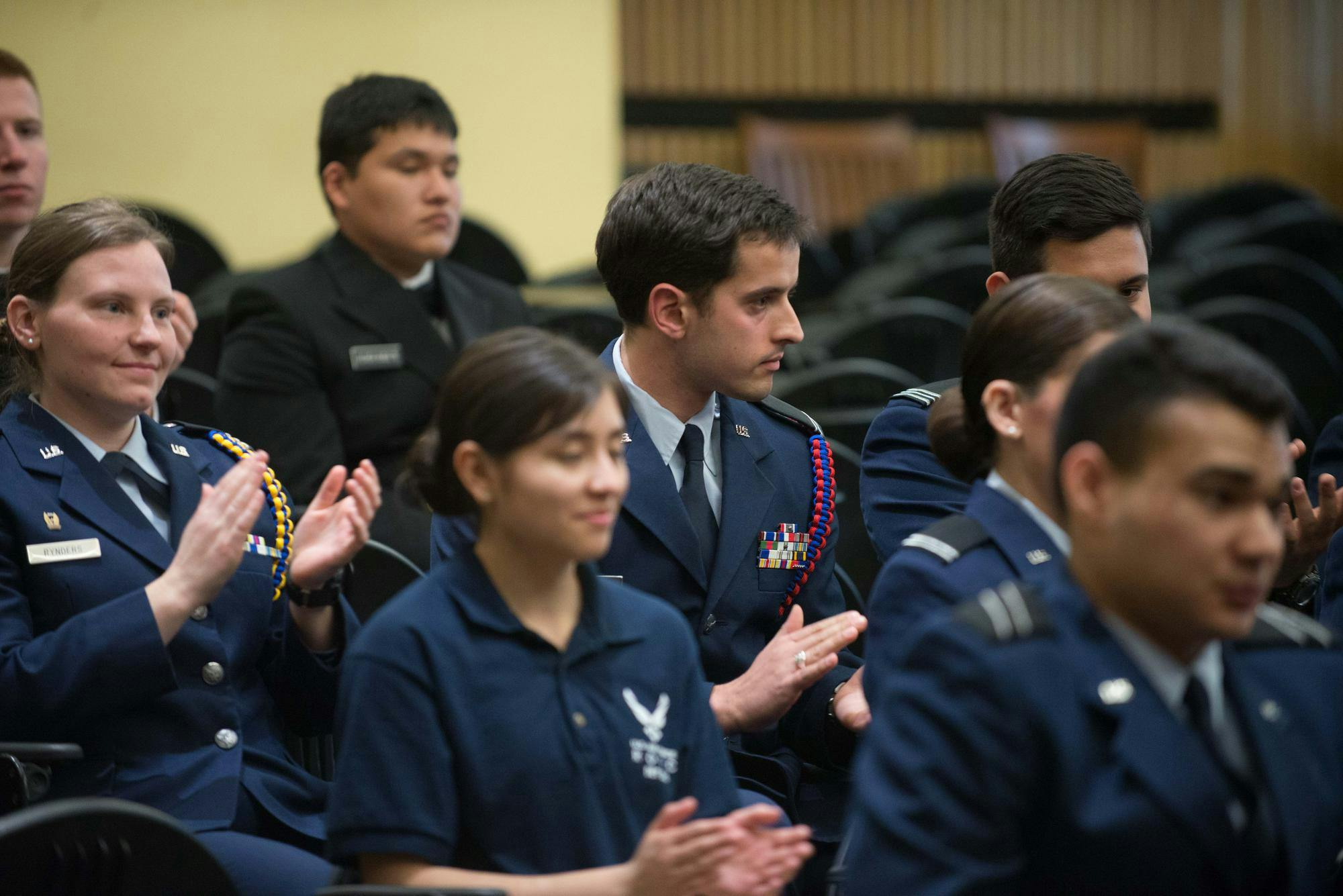
Before dawn broke on Saturday, Nov. 22, each cadence of commands was met with the swift, sharp and synchronized marching of cadets across the Barton Hall track for the 44th iteration of the Cornell University Invitational Drill Competition.
Reserve Officer Training Corps units from across the country gathered at Cornell to compete in team events like Drill and individual events including weightlifting, swimming and running. While the event drew students from across the country, the dedication and talent of Cornell ROTC cadets was evident through Cornell’s Naval ROTC unit earning the third place overall trophy.
ROTC is a national program that prepares and trains college students for service and leadership opportunities in the U.S. Military. At schools with ROTC programs, cadets are able to supplement their college coursework with military, officer and service training opportunities.
Upon graduation, ROTC cadets are authorized to serve as a Second Lieutenant — the entry-level rank for a commissioned officer — and begin their service in the Army, Navy, Marine Corps, Air Force or Space Force branches of the U.S. Military.
When students decide to apply to an ROTC program at Cornell, they must apply to a specific branch based on their interests and post-graduation plans. Cornell hosts three ROTC programs, each representing a different branch of the military: Air Force ROTC, Army ROTC and Naval ROTC.
Christopher Gargan ’29, a Naval ROTC Midshipman, has found being a part of Cornell’s ROTC program to be a unique opportunity to both receive world-class education and work towards a career in the military.
“Cornell is probably the greatest school for ROTC,” Gargan said. “It’s an academic and fantastic school, and the only Ivy school with all three branches.”
According to the University, this school year marks one of the largest classes of incoming cadets to Cornell’s Tri-Service Brigade in recent years, with sixty Cornellians joining one of the three units.
A Military History
Cornell’s support for ROTC and military education programs has been longstanding, ingrained since the University’s founding.
The Morrill Act of 1862 designated Cornell as a New York state land-grant University. Under the terms of this agreement, Cornell was required to provide instruction on military tactics; when Cornell first opened its doors, military science and drill classes were integrated into the curriculum. First president Andrew Dickson White additionally made them mandatory for all male students until 1960.
In 1917, Cornell formally established its first ROTC unit in response to the National Defense Act. Within the same time period, Cornell established Army and Navy training schools and an Army School of Military Aeronautics. This expansion played a large role in Cornell’s commission of “more officers in World War I, and [inducting] more officers and service members in World War II, than any other single institution,” according to the Cornell Air Force ROTC website.
Even though military education became voluntary in 1960, many Cornellians have since chosen to participate in ROTC for the opportunity to serve after graduation.
Finding Purpose
For many students, serving in the U.S. military has been their ultimate goal, and ROTC was one way to get closer. As a student studying mechanical engineering with dreams of working on submarines, Gargan always gravitated towards the Navy.
“I thought that the goals of the Navy and the type of missions that they have were a lot more in line with what I wanted to do as a career,” Gargan said. “I knew that the Navy was something that I wanted to follow.”
Army ROTC cadet Andrew Liu ’29 decided to apply to Cornell’s ROTC program after his parents encouraged him to attend a summer program at the United States Military Academy West Point.
“[The summer program] was very hard and rigorous … but I really liked the culture there, and I realized it was something I wanted to do,” Liu said.
Air Force ROTC cadet Aniket Martins ’27 only considered joining ROTC after being admitted to Cornell.
“At Admitted Students Day, I met the Program Coordinator of ROTC at Cornell,” Martins said. “So, he added me to the list and by freshman fall, I was a totally normal part of the program.”
For Martins, choosing to join the Air Force ROTC was rooted in his passion for aerospace engineering and the opportunity to pursue a commission into the U.S. Space Force, the newest branch of the military.
Martins was especially intrigued by the missions, noting that “the opportunity to work on satellite operation problems and technical issues in space was really inspiring.”
In addition to the career and service opportunities, one of ROTC’s most appealing benefits is its full-tuition and in-college scholarship opportunities.
“It was a way for me to pursue a higher education that was at a level that I could not achieve without the support of the military, because the only other option was state or community college,” Gargan said.
ROTC Training
Each ROTC program consists of weekly physical training, ROTC-related coursework and leadership opportunities. The time commitment for ROTC responsibilities varies by branch and seniority.
Units typically have physical training sessions once or twice a week, in which cadets are expected to arrive at Barton Hall by 6 a.m., ready for an intense workout covering training activities such as circuits, hill sprints and calisthenics.
Martins looks at these sessions as an opportunity to bond with teammates and set a positive tone for the rest of the week.
“The best part is you're doing the workout together, so it’s not as if you’re struggling through it alone,” Martins said.
Martins stresses that the workouts are not meant to deter students, but rather help cadets stay in shape throughout the semester. When deciding whether to join ROTC, Martins was worried that he wasn’t “cut out to join the military” when speaking to an ROTC representative.
“I remember [the ROTC representative’s] exact words were, ‘We’ll get you where you need to be,’” Martins said. “I didn't know whether to interpret that as a threat or a promise, but he was totally right.”
In addition to physical training, cadets are required to take academic classes that correspond with their branch. For example, Naval ROTC cadets are required to take NAVS 1101: Naval Science and Air Force ROTC cadets are required to take MILS 2202: Army Doctrine and Decision Making. These classes, which count as Cornell elective credits and are available to non-ROTC students as well, focus on relevant military science, leadership and strategy concepts.
A Balancing Act
Even with all of these added responsibilities, cadets are still full-time students.
“The view of the military is that you are a college student. You are going to complete your college education,” Gargan said. “[The military wants] you to have a college experience.”
The struggle for many cadets stems from balancing rigorous coursework and extracurriculars on top of the already demanding ROTC commitment.
For Martins, who balances research and project team commitments in addition to ROTC, creating a manageable schedule comes from being organized, communicative and supported.
“I think anyone who wants to do ROTC needs to be pretty cognizant of the fact that it will be a challenge to your schedule. … It’s hard, I can’t lie,” Martins said. “But with good communication and teamwork and camaraderie within your ROTC class, it’s doable.”
As a first year student, Gargan has found the adjustment to both college and ROTC to be smoother than anticipated because of the abundance of resources from Cornell to support cadets.
“[The University tries] to help us with our schedules. They're very cognizant of the challenges that we face,” Gargan said.
Prof. Capt. Michael Mosbruger, naval sciences, who is commanding officer of Cornell’s Naval ROTC unit, assumed command in 2024 and was initially surprised to see the administrative support for ROTC cadets at Cornell.
“When I got here, I expected it to be a liberal northeast United States school where the ROTC was hidden in a corner somewhere, and it couldn't be further from the truth here,” Mosbruger said.
In addition to support from the University, ROTC officers and staff members make sure to prioritize cadet mental health by offering a comprehensive support system.
“Our officers provide excellent counseling and support whenever you need. They have a completely open door policy, so whenever you need, you can walk in, lay down, sit down on the couch and talk,” said Naval ROTC Midshipman Ian Crandall ’28.
“We call it the crying chairs, where the students will come in and close the door and then just vent in a safe place,” Mosbruger said. “Having somebody that's been there done that — it can assure them that what they're going through is normal.”
Regardless of branch, cadets cite that beyond the career development and leadership opportunities, the best part of ROTC is the close-knit and supportive community.
As an upperclassman, Martins confidently says that ROTC has helped him find a “big family” on campus that he can lean on.
“The community, the people you meet, truly define the experience. And I’ve been very lucky to be surrounded by people who, every single day, make my life a lot better,” Martins said.
For many cadets, like Crandall, this sense of camaraderie among the ROTC unit has helped them find their place on campus.
“Without [ROTC], I think I’d probably struggle a little bit more to find my place here,” Crandall said. “I think it’s given me a greater sense of purpose and place at Cornell.”
Martins requested for the following statement to the published by The Sun.
"The views and opinions presented herein are those of Aniket Martins, the interviewee, and do not necessarily represent the views of the U.S. Department of Defense or its components. Appearance of, or reference to, any commercial products or services does not constitute DoD endorsement of those products or services. The appearance of external hyperlinks does not constitute DoD endorsement of the linked websites, or the information, products or services."
Teju Vijay is a member of the Class of 2029 in the College of Arts and Sciences. She is a staff writer for the news department and can be reached at tv95@cornell.edu.


