

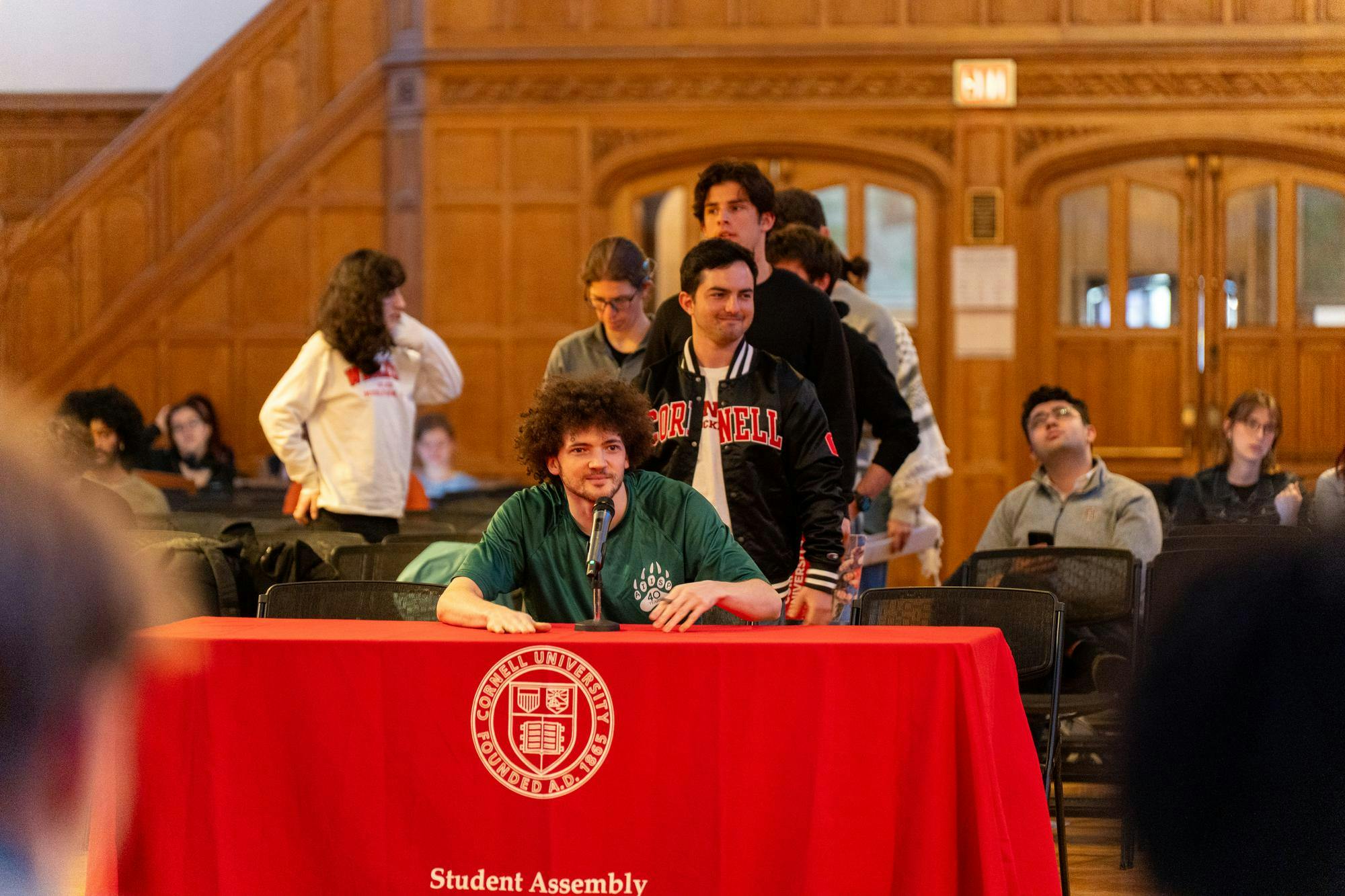
Students packed the Student Assembly’s Thursday meeting to debate two contentious resolutions: Resolutions 61 and 55. The resolutions focus on Cornell Tech’s partnership with the Technion-Israel Institute of Technology and University-sponsored events that feature people accused of war crimes or human rights violations.
Resolution 61: “Calling for the Termination of Cornell University’s Partnership with Technion – Israel Institute of Technology While Preserving Cornell Tech” calls on Cornell Tech to terminate its institutional partnership with Technion, citing ethical and legal concerns related to Technion’s alleged involvement in the development of military technologies connected to human rights violations.
Cornell Tech and the Technion-Israel Institute of Technology jointly established the Joan and Irwin Jacobs Technion-Cornell Institute, an “applied sciences campus” in New York City, according to the American Technion Society’s website. The institute offers dual master’s degree programs, as well as a postdoctoral program, according to its website.
“Partnerships with institutions that contribute to the production of weapons, military technologies, or infrastructure of apartheid are inconsistent with Cornell University’s stated educational mission, ethical commitments, and core values,” the resolution states.
Resolution 61 also calls for divestment from any related joint programs and greater transparency in the University’s ethical review process for international partnerships.
Resolution 55: “Condemning the University Administration’s Use of Programming to Platform Individuals Implicated in War Crimes” condemns the administration for hosting, funding or sponsoring programming for speakers who, according to the resolution’s sponsors, have been “implicated in war crimes and grave human rights violations.”.
The resolution references Tzipi Livni, former vice prime minister and former foreign minister of Israel, who was featured as a panelist during the University’s “Pathways to Peace” event in March 2025, to discuss the Israeli-Palestinian conflict and “potential paths forward for the people of Israel and Palestine.” During this event, 17 pro-Palestinian protesters were arrested or detained.
Livni faced war crime allegations and a warrant for her arrest in the U.K. in 2009 for her decisions made before and during a three-week-long Israeli offensive in Palestine, Operation Cast Lead, while she was Israel’s foreign minister and member of the Israeli war cabinet. The warrant was withdrawn when it was discovered that she was not in the U.K.
Resolution 55 argues that providing such University-sponsored events “endanger[s] student well-being.”
“Students are entitled to an academic environment free from militarization, intimidation, and the glorification or rehabilitation of individuals responsible for large-scale human rights abuses,” the resolution states.
Ahead of the meeting, several student organizations — including Students for Justice in Palestine at Cornell, Cornell Asian Pacific Americans for Action, the Kashmiri Cultural Alliance and the Progressives at Cornell — encouraged students to attend the Student Assembly meeting via a joint Instagram post published on Wednesday. The groups urged students to “pack the Assembly” and use the public comment period to call on representatives to vote in favor of Resolutions 55 and 61.
Public comment revealed divisions within the student community. While community members criticized the proposals, others voiced strong support, and some argued that the Assembly was not the appropriate forum for debating the issue at all.
Graduate student Hannah DeFelice urged the Assembly not to vote on Resolution 61. DeFelice argued that the undergraduate Student Assembly was not the appropriate body to deliberate on the issue.
“The people most impacted are just not here,” DeFelice added. “They’re not members of the voting body. They’re not here on campus to speak to you.”
DeFelice noted that Cornell Tech primarily serves graduate students and does not currently offer undergraduate degree programs. She argued that any changes to partnerships or funding involving the campus would disproportionately affect graduate students who are not represented by the Assembly.
Adriana Vink ’27, who is the president of Progressives at Cornell, co-president of SJP at Cornell and a Sun opinion columnist, spoke in support of both resolutions, and argued that the dissolution of Cornell’s partnership with Technion is essential for the University to uphold its moral responsibilities.
“[It’s a] question of whether you believe the institution that you attend and fund should use its institutional power to prop up more crimes and more criminals, or to prioritize the student experience and its mission to do the greatest good,” Vink said.
Regarding Resolution 55, Francis Burns ’27 argued that Cornell has ethical obligations to consider when deciding which speakers or groups they officially sponsor.
“When this university extends an official invitation to an individual radically implicated in war crimes, it is not engaging in open inquiry,” Burns said. “It is granting legitimacy to these criminals.”
Burns also emphasized that the resolution was not intended to limit debate or prevent student groups from inviting potentially polarizing individuals who could spark a necessary dialogue.
“This is not a call to restrict speech or to avoid controversial figures,” Burns said. “Students, student groups and faculty retain the right to invite, host and engage with a wide range of speakers.”
“This resolution addresses a narrower question — whether the University itself, with its name, its funds and its institutional prestige, should be lending its endorsement to individuals facing credible accusations of war crimes,” Burns added.
Opponents of the resolution, however, raised concerns about its scope and intent.
Levi Schmuel ’27 criticized Resolution 55 specifically for what he described as selective focus and ambiguous language.
“The resolution never mentions a different criteria or system for choosing speakers, nor does it mention other potential problematic speakers,” he said.
Schmuel additionally argued that the measure appeared to target Israeli affiliations specifically, while overlooking potential moral concerns involving other Cornell partners or institutional relationships.
“I have trouble believing that this resolution is actually concerned with human rights or correcting justice, but with silencing speakers with whom the author disagrees,” Schmuel said.
Hasham Khan ’26, closed the public comment period by citing Technion’s use of military technology in the Middle East, then ended with commentary aimed directly at the Assembly.
“Now, fun fact, element systems test their weapons on Kashmir, the region that I'm from,” Khan said. “So why duck around the corner? If you want to support Israel tech, and if you want to support our partnership, kill me now. Kill my people now. What's stopping you?”
The Student Assembly heard more than an hour of public comment before continuing deliberations on the measures.
Resolution 61 was ultimately moved to a third reading. It will be reviewed for a final time at next week’s Assembly meeting before being conveyed to the administration.
Due to time constraints, the Assembly was not able to get through the second reading calendar, so Resolution 55 is still on the third reading calendar for next week.
Vivienne Cierski is a freshman in the College of Agriculture and Life Sciences. She is a Sun Contributor and can be reached at vsc38@cornell.edu


