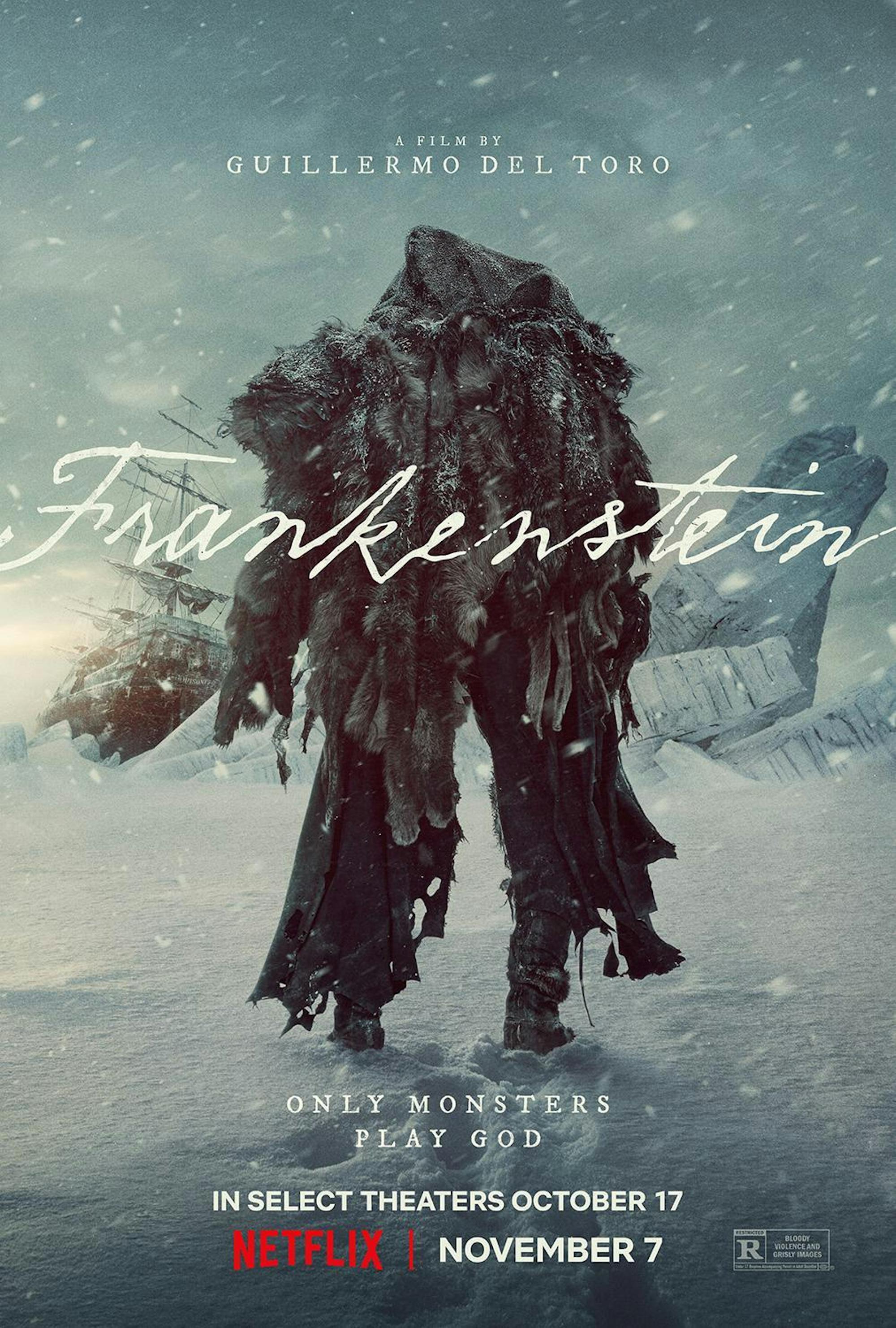
The trend of Gothic adaptations in film this decade has allowed some of cinema’s most interesting filmmakers to finally tell their favorite stories in their own voices. This year, Guillermo del Toro’s Frankenstein feels like a match between director and story as fitting as Robert Eggers and Nosferatu, and the weight of del Toro receiving the budget and freedom to tell a story so important to him is felt throughout the film. Frankenstein is a massive film in both scale and scope, and while some moments feel a little messy, the end result is an impressively beautiful story of pain and forgiveness.
Frankenstein is an adaptation of Mary Shelley’s 1818 novel and follows the same story-within-a-story framing. During a journey to the North Pole, Royal Navy Captain Anderson encounters a wounded man, stranded on the ice, who is being pursued by an inhuman creature. This is Oscar Issac’s Victor Frankenstein, a scientist whose lofty ambition led to his own downfall. Victor tells his tale to the captain in hopes of dissuading Anderson from continuing his own ambitious journey of plotting a new route to the North Pole. Bound together by their dreams of grandeur, Captain Anderson listens as Victor recounts the experiment that led to his doom, and that the creature now standing outside their boat was created by Victor himself.
Frankenstein might disappoint book purists hoping for a completely accurate adaptation. Guillermo del Toro uses the story of Frankenstein to explore his own relationship with parenthood. Victor’s backstory is altered to tell a deeply personal story of generational trauma and the cycle of violence passed down through families. Here, it is not the grotesque nature of the Creature’s existence that disturbs Victor, but the responsibility suddenly thrust upon him to nurture a child when he himself received little love from his father. Victor passes on his anger, grief and desire for vengeance onto the Creature, but is then unable to comprehend his role in making his creation what he is. Victor treats the Creature the same way his father treated him, but is shocked and disturbed when the Creature turns out much like Victor.
While these changes are extremely effective in the overall narrative, they do make the film’s first hour a little slow. Victor’s college life and friendship with Henry Clerval are traded for a relationship with a rich benefactor, Henrich Harlander (Christoph Waltz), who funds Victor’s experiments. The first part of the film, before the Creature is made, drags a little more than it does in the novel. However, the introduction of Harlander also introduces Guillermo del Toro’s version of Elizabeth, the woman that Victor forms an obsessive attachment to. Mia Goth’s Elizabeth is Harlander’s niece and the fiancé of Victor’s brother William, creating an interesting dynamic. In the novel, Elizabeth is taken into Victor’s family at a young age and is promised to him since childhood. There, Victor sees Elizabeth as an object belonging to him, something he will possess once he has finished his experiments. In the film, Elizabeth becomes entirely unattainable. Her engagement to William, as well as her own indifference to Victor, make Victor’s obsession with her all the more delusional.
It’s after this first hour that the film truly finds its footing. Frankenstein becomes truly great when Victor’s experiment ends and the Creature (Jacob Elordi) is born. Jacob Elordi’s performance, despite the layers of prosthetic makeup he wears, is the best of the year. Despite his huge stature, Elordi’s Creature feels incredibly gentle. His eyes do most of the storytelling, at times portraying the wide-eyed innocence of a newborn, at others the sadness and grief of an abandoned child, and, later, the unrelenting rage of a monster. The Creature sends Victor’s life into turmoil, especially when Elizabeth forms an instant connection with him. The relationship between Creature and creator is that of a father and son, yes, but it also grows deeper when Victor begins to feel like the Creature has taken everything from him — especially the love of Elizabeth. The dynamic between Victor and his creation is incredibly fascinating and, while successfully adapting the major themes from the novel, adds another, more familial layer to their relationship. Once the Creature joins the story, Frankenstein becomes exactly the movie I wanted it to be.
While Frankenstein may not be perfect, it’s still cemented itself as my favorite film of the year. Jacob Elordi’s performance as the Creature elevates a film of beautiful, grand visuals into something much more human. Its only setback is its limited theatrical run — Frankenstein is already available to stream on Netflix, but it is certainly made to be seen on the big screen. I encourage viewers to make every effort to see it in theatres before watching it on Netflix.
Nicholas York is a junior in the School of Arts and Sciences. He can be reached at nay22@cornell.edu.
‘Projections’ is a column focused on reviewing recent film releases.
Nicholas York is a member of the Class of 2027 in the College of Arts and Sciences. He is a columnist for the Arts & Culture department and can be reached at nyork@cornellsun.com.