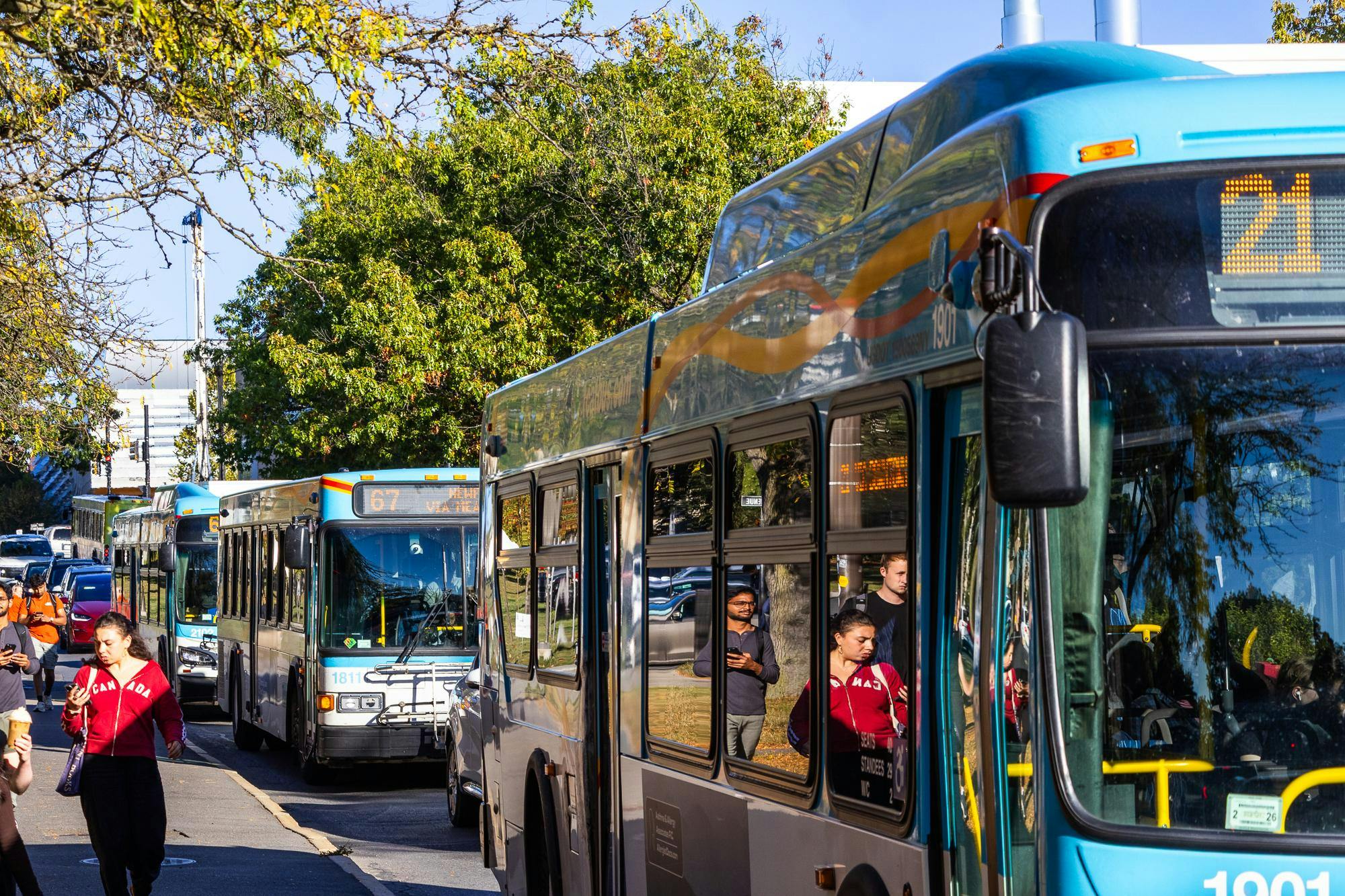
The University has struck a deal with Tompkins Consolidated Area Transit to pay an additional $280,000 to assume the transit service's $1.5 million budget deficit, according to Kyle Kimball, vice president for University Relations, in a Tuesday presentation to the University Assembly.
The funding deal is intended to address TCAT’s funding shortage that could lead to service cuts. The sum agreed upon payment of $280,000 is less than the $500,000 that TCAT originally requested, but higher than the $31,000 that the University agreed to pay TCAT as of Nov. 6. The payment will add to the annual $4.3 million payment to TCAT by the University.
The University currently pays TCAT $1 million annually as part of its underwriter contribution, and a service payment of $3.3 million, according to Kimball. The University is one of three underwriters for TCAT, alongside Tompkins County and the City of Ithaca.
In a Nov. 6 Ithaca Common Council meeting, Alderperson Clyde Lederman passed an amendment where the city set aside $500,000 for the TCAT, but will only pay the lowest amount committed by the other underwriters. Yet, Cornell has agreed to pay 280,000 — which is less than this maximum amount.
“I'm happy to report that today we actually came to a deal and understanding with TCAT to help it get on a path to sustainability,” Kimball said at the Tuesday presentation.
Two “problems” for TCAT’s profitability are that ridership has not rebounded since the end of COVID, and that because the Cornell community constitutes 70-75 percent of the ridership, Kimball said. Overall, he said, “There [are] not enough people to keep it sustained.”
“TCAT does get many state and federal grants, and there’s some concern that in the era of belt-tightening, they may go away,” Kimball said. “Ridership helps grants. The more ridership, the more grants they give. A state grant is tied to ridership and miles, so the key to all this is ridership.”
Kimball said that the University “fought very hard” in the agreement for “sunlight measures” on TCAT’s financial status, such as publicizing TCAT’s financials and ridership numbers — information which he said could have contributed to “people truly understand[ing] what was happening” — which are not currently available on its website.
“Most people I’ve talked to had no idea ... that even with the $1.5 million contribution that they were asking us to provide, TCAT would still lose $2 million next year,” Kimball said.
Graduate student Nicholas Brennan, president of the Graduate and Professional Student Assembly, asked Kimball if the University addressed the “growing number of graduate student[s]” who commute using “underperforming” remote bus lines like the Dryden TCAT 43, due to the “unaffordable housing crisis in the immediate Ithaca region” in the deal.
“That is not something we would dictate,” Kimball said in response to Brennan. “We would certainly advocate through the process, but we wouldn’t necessarily decide which routes we keep and take.”
Correction: November 20, 9:15p.m.: This article has been corrected to include that the $280,000 payment to TCAT is not annual but an additional payment.

Yuhan Huang is a member of the Class of 2028 in the College of Arts and Sciences. Yuhan is a staff writer for the News department and can be reached at yhuang@cornellsun.com.