By Julia Choi
Cornell offers various opportunities for students to get involved on campus, whether through joining clubs or collaborating with faculty. For example, many undergraduate students work as Teaching Assistants, or TAs, where they support professors in numerous tasks.
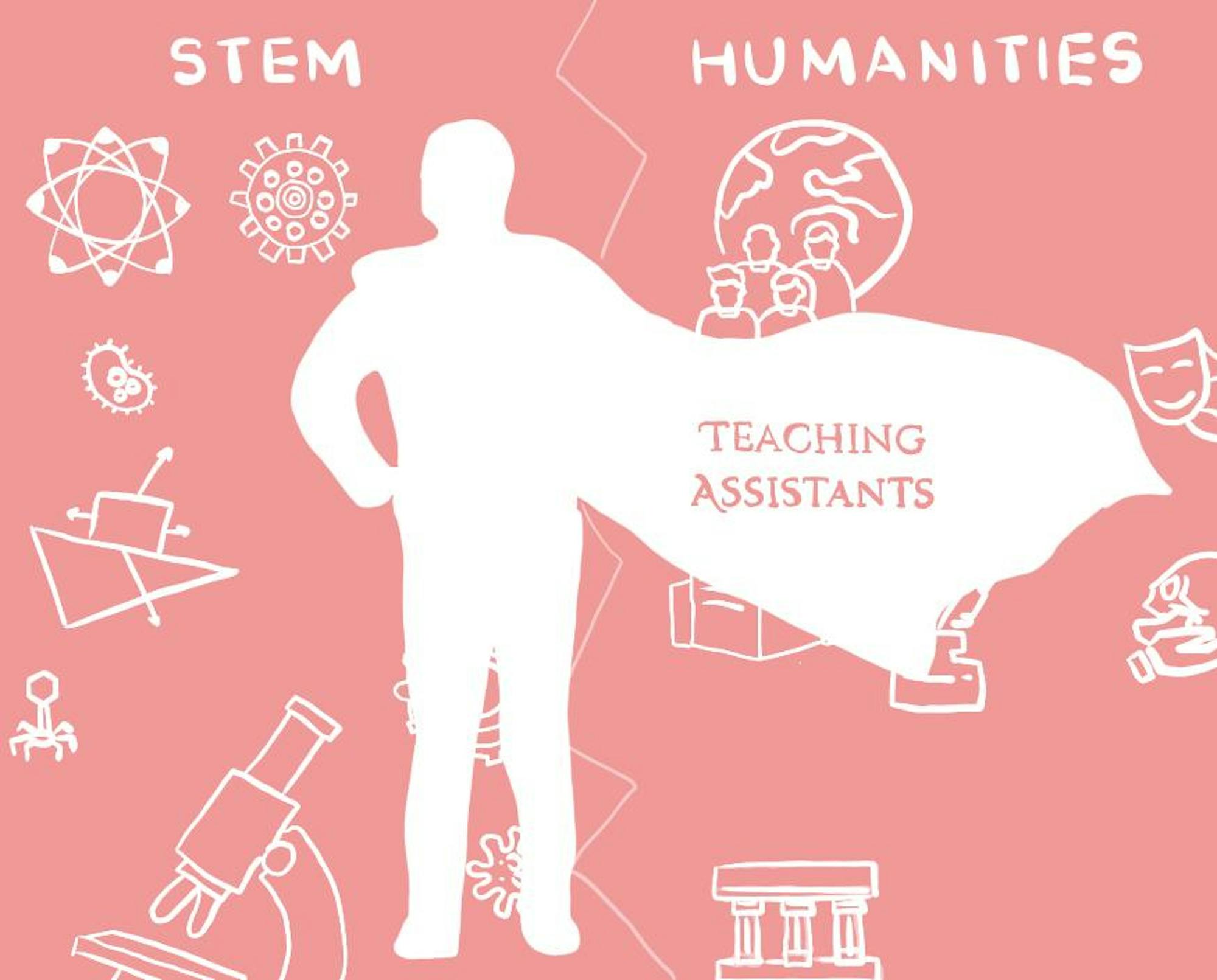
This position interested me, as I wondered if there were any major differences between STEM (which stands for Science, Technology, Engineering and Mathematics) and Humanities (encompassing subjects such as history, philosophy, literature, etc.) TAs, primarily relating to responsibilities or expectations. To determine this, I conducted short interviews with three TAs.
Pre-med student Derek Wang ’26 sought a TA position to build experience and establish a closer relationship with his professors. As a result, he not only filled out TA applications, but also reached out to professors, ultimately landing the roles for General Physics 1 (PHYS 1101), General Physics II (PHYS 1102) and Principles of Biochemistry, Individualized Instruction (BIOMG 3300).
Having enjoyed taking BIOMI 3300, Enya Goonetilleke ’27 found this position to be a great opportunity to help students learn this specific curriculum. Subsequently, she successfully contacted the professor for this role.
And while Joshua Chelliah ’27 was unsure whether PUBPOL 2250 offered undergraduate TA positions, he had fallen in love with the class. This is because not only did it introduce him to new perspectives on how institutions shape society’s structure, but he also had a memorable experience as a student, often having playful interactions in the form of challenging his professor. This love of the classroom environment encouraged him to give TA-ing a shot and email the professor.
However, despite the differences that were highlighted within the conversations, it became clear that the distinct structures of the roles weren’t necessarily tied to the “STEM” or “Humanities” categories, but more so associated with the specific class they assisted in. Moreover, the three roles resembled one another to a great extent, as they all shared the ultimate goal: helping the students.
One of the questions I asked was, “How do you help students when they’re confused or have a question?” While their approaches varied, they were all related in that they were tailored for the student, helping them better grasp a concept or topic.
For example, Wang’s central method was rooted in pushing the students to think for themselves. He begins by first trying to recognize what the student already knows. Specifically with PHYS 1101 and 1102, he often asks about the free body diagram (if it is applicable to the problem) and moves forward step-by-step from there.
On the other hand, Goonetilleke had a somewhat different approach. Considering that BIOMI 3300 was heavily based on memorization, most of the topics did not require a mathematical, sequential explanation. However, when it came to topics, including the process of DNA replication, she would first re-explain the content from the lecture. If the student is still confused, she would delve into the concept, trying to truly figure out what aspect of it they may be confused about. In particular, as there are various ways a virus can replicate its DNA, it is often a challenging topic. Building on her initial explanation, she would ask questions, such as “Are you confused about the proteins involved? Are you confused about which type of replication is used and when?” Based on the student’s answer, she then creates an analogy to make the abstract concept not only easier to graph but also remember.
For Chelliah, he mainly focused on providing real-life examples that would demonstrate how the terms, such as “social imagination,” were applied. While he often used analogies like Goonetilleke to simplify the definitions, he concentrated on presenting case studies that would better exemplify the processes or ideologies.
Essentially, while they all pursued the same objective, each of them differed in their ways, depending on the content and the structure of the class.
Even beyond their teaching approaches, their designated responsibilities varied. For instance, while I assumed that Wang and Goonetilleke would have somewhat the same extent of tasks as they both helped out in STEM classes, they were substantially different.
Wang was assigned a variety of tasks. As both PHYS 1101 and 1102 and BIOMG 3300 did not have formal lectures, he not only proctored unit tests but also conducted oral quizzes. He also floated around the Learning Center to help any students who may have questions, whether that is about the lab or the content itself. In doing so, his general role was to “reinforce knowledge or find gaps in knowledge [so that] students know how to better prepare for their exams.”
On the other hand, Goonetilleke helped host weekly review sessions through a 23 to 25 question Kahoot game to reiterate the materials covered in class or to review for a preliminary exam. Once it was completed, she often went over concepts that the students were confused about or answered separate questions they may have. Additionally, having developed good studying habits that worked well for the class, she would also help students be able to adopt similar strategies.
While Joshua mainly interacted with the students during lectures — typically answering questions during classes — he helped respond to questions posted on EdScope and graded reading reflections and assignments.
However, despite these differences, there is no denying that this position comes with expectations that require the skill of time-management to balance the workload that comes with also being a full-time student. In addition, all found themselves growing and learning while simultaneously teaching other students. Goonetilleke highlighted how as she prompted “them to be kinder to themselves and to give themselves grace as they’re learning and polishing their studying [habits],” she also came to become kinder to herself as she managed her own choices.
So while some minor differences between STEM and Humanities TAs may be perceivable in terms of approaches toward teaching content, they all share the same passion for aiding students as they grow academically.
Julia Choi is a first-year in the Brooks School of Public Policy. She can be reached at jc3767@cornell.edu.