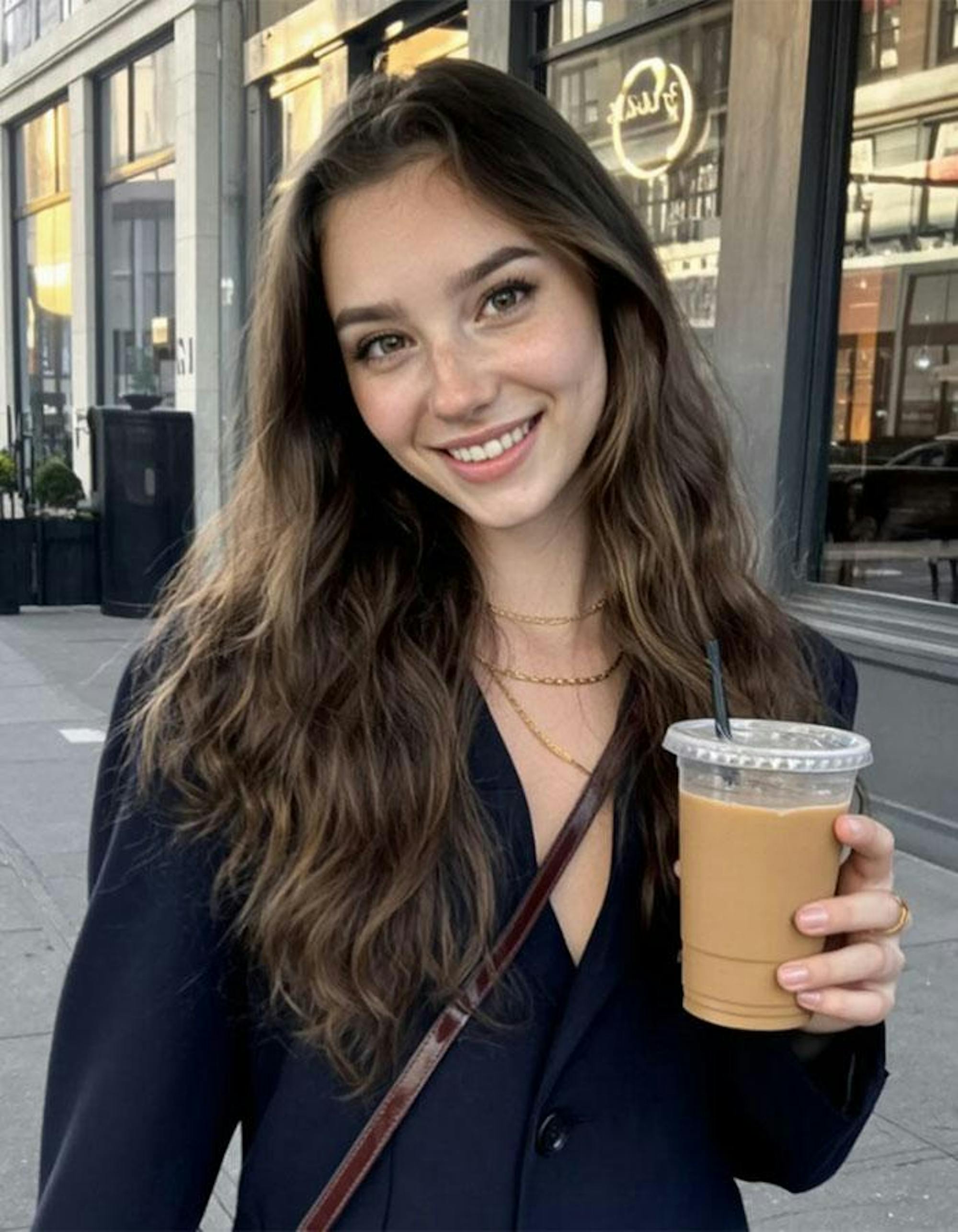
In 2023, the Writers Guild of America and Screen Actors Guild–American Federation of Television and Radio Artists went on strike for better wages and to ensure artificial intelligence would not encroach on their jobs. Yet just over two weeks ago, artificially intelligent actress Tilly Norwood was introduced to the world at the Zurich Film Festival on Sept. 27. She was developed by Eline Van der Velden, the CEO and founder of Particle6, an AI production company which recently ventured to make its own AI talent studio, Xicoia. As its first creation, Norwood and her existence threaten to topple what both the WGA and SAG-AFTRA fought for only a few years ago. As Emily Blunt described, “that is really, really scary.”
While these unions secured protections against AI by preventing it from being able to be credited as a writer on movies or television and requiring employee consent for the use of digital replicas, nothing was determined about preventing the entirely independent creation of synthetic actors. At the industry panel of the same festival at which she formally introduced Norwood, Van der Velden discussed her intention with the AI actress, stating “we’re going to be announcing which agency is going to be representing her in the next few months.”
However, this had led to an uproar from many in Hollywood, decrying the use of a fully synthetic actor, especially given the unnerving nature of combining traits from several different to create a supposedly better composite. Popular young actors such as Melissa Barrera, Lukas Gage and more have taken to social media to address the issue, noting the problem with removing humans from an inherently human industry, as well as the hypocrisy of signing an AI actress, but none of those which her compiled features were ripped from.
Betty Gilpin, a thrice Emmy nominated actress for the Netflix series GLOW, piled on to this sentiment in a strongly written letter she published through The Hollywood Reporter. Discussing her own personal experiences as a growing actress, the letter notes how essential human experience is to the work of an actor with a blend of sarcasm and wry-humor to sweeten the punch. Specifically, Gilpin details her experiences with stage acting growing up: the physicality of a medium which Norwood could never enter, the weight behind an actor who was a composite of emotion rather than faces and the simple fact that technology cannot understand the quintessential vitality of human connection. Moreover, she addresses the objectification of Tilly Norwood, with her agelessness and controllability, maintaining that her artificially constructed beauty only adds to how inhuman she appears. With all this said, it seems Gilpin’s conclusion is that Norwood, or another AI actor like her, would never fully be able to take over Hollywood.
Regardless, her creator Eline Van der Velden stated she “want[s] Tilly to be the next Scarlett Johansson or Natalie Portman” just a few months ago in July, reaffirming the hold AI would take over the industry. Yet due to the expansive public backlash regarding the artificial actress in the past few weeks, Van der Velden has since released a statement on Norwood’s Instagram account, claiming “she is not a replacement for a human being” but rather “as a new tool — a new paintbrush.” Whether this shift is a direct result in the reaction to her announcement in Switzerland or a deeper change in Norwood’s purpose, many of those who work in the industry but would not be directly affected have agreed.
Bryn Mooser, an Emmy-winning and twice-Oscar nominated filmmaker, said that “Tilly Norwood is not coming for anyone’s job anytime soon in a Hollywood movie.” Along similar lines, Rachel Joy Victor and Tricia Biggio, respective founders of their own AI consultancy and animation companies, agree that AI still does not have the faculty nor the representation to even try to compete with real people in the industry. Despite this, fear still lingers as AI improvement continually accelerates and major studios have already been implementing it elsewhere to cut down costs.
For actors, the main issue with using AI likenesses of themselves is copyright and residual pay; with an actor who is not anybody, but the composite of hundreds, that problem is only made worse. While SAG-AFTRA contracts require the union to be notified if studios decide to employ the use of a fully AI actor, the technology is evolving much faster than new regulations can be created or negotiated for.
Ultimately, we will see if new provisions will be made to prevent the encroachment of AI actors like Tilly Norwood into the industry as the DGA, WGA and SAG-AFTRA are due to renegotiate and sign new contracts in mid-2026. As negotiations continue and studios continually employ new practices to cut costs, I hope that they remain true to the heart of their profession rather than prioritizing profit. While it may be easier to have the perfect, human-made woman in Tilly Norwood to tell us stories, a flimsily constructed copy can never put forth the ingenuity, joy, and anguish that defines what it is to be human. As the screenwriter of After the Hunt and former AI analyst for Meta, Nora Garrett, succinctly put it, “AI is sold to us like it's the future, but it's a regurgitation of our collective past, remarketed as the future.”
Aarav Bavishi is a freshman in the Brooks School of Public Policy. He can be reached at arb438@cornell.edu.
Aarav Bavishi is a member of the Class of 2029 in the Brooks School of Public Policy. He is a staff writer for the Arts & Culture department and can be reached at arb438@cornell.edu.