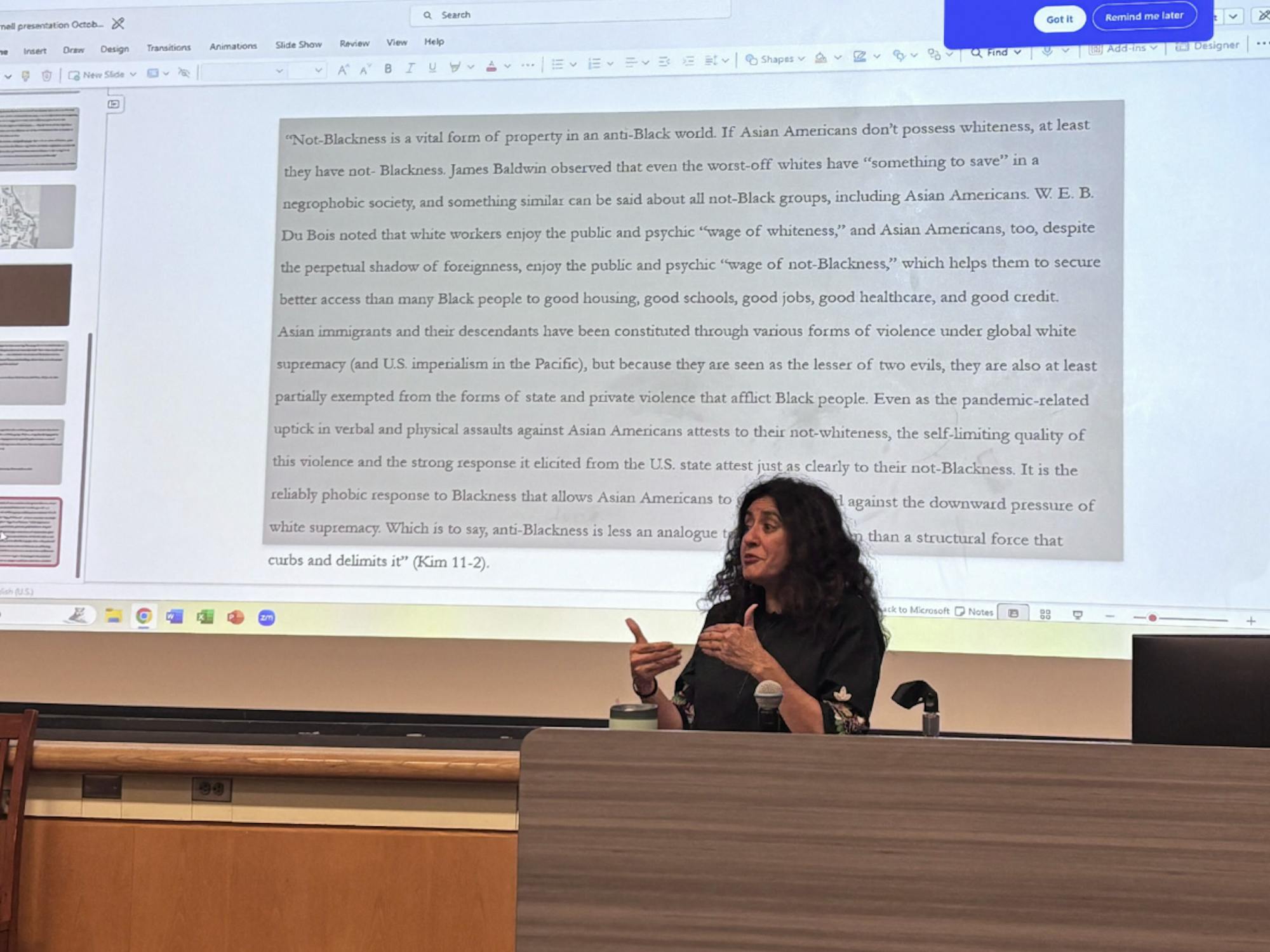
Sandhya Shukla ’88, a professor of English and American Studies at the University of Virginia, presented her ideas of “Cross-Culturalism” on Thursday afternoon in Goldwin Smith Hall.
In the talk, she examined Harlem, New York and other heterogeneous communities to study how different cultures interact.
Shukla shared that she was drawn to pursue this research when she was living on the edge of Harlem, “trying to understand what a response would be to the forces of gentrification.” She continued in explaining that “Harlem is a vital space of movement and mixture, where it was interesting to see how cultures interact."
Throughout her career, Shukla has published several books and articles analyzing how cultures arrive and interact in Western societies, including the United States. Shukla authored “India Abroad: Diasporic Cultures of Postwar America and England,” discussing Indian diasporas in England and the United States after independence from the British in 1947.
Shukla received her Bachelor’s degree in 1988 from Cornell University, as well as her Ph.D. from Yale in 1998. Today, she teaches English and American Studies classes at the University of Virginia.
The event was hosted by the Asian American Studies Program and co-hosted five departments in the College of Arts and Sciences. Shukla presented Harlem as a cultural melting pot, a location that draws people from different places and backgrounds together.
Shukla opened by explaining why cross-culturalism was relevant today.
“Cross-culturalism is a set of ideals,” she said. “It is about grief and hope. We live in a world of borders, turmoil, and misunderstanding, but cross-culturalism promotes the idea that we can have conversations that bring us together.”
Her work examines Black and Asian communities, exploring how Harlem shows that borders can become bridges.
“All of the contrasting identities and communities are connected,” Shukla said, “Our differences are not discrete, and we all live in differences, but the fact that we are all unalike with each other is actually something that we all share. … It both divides and connects us.”
“What I understood she is advocating for is a set of values for the world,” explained Prof. Derek Chang, history, and the director of Asian American Studies. “It is about being open to crossing borders and embracing being different from one another, especially during which this value might be fading, or not within the current dominant political culture.”
Shukla said, “We live in a world of borders, turmoil and misunderstanding, even when the global is brought into locality.”
To understand how differences can actually become similarities, Shukla presented an image on the night African-American civil rights activist Malcolm X was assassinated in the Audubon Ballroom in New York City in 1965.
The image depicts Japanese-American civil rights activist Yuri Kochiyama cradling Malcom X’s head as he lies lifeless on the ballroom floor. Shukla explains how their differences actually brought them together.
“Kochiyama was Japanese and she was a proud resident of the area who was deeply associated with its culture,” Shukla said. "Foreignness made both her and Malcom X targets, and their stories converge.”
Shukla also shared another story about a Bangladeshi comedian in Spanish Harlem, whose stage name is Aladdin. Aladdin’s commentary is inspired by his experiences being surrounded by people unlike himself.
“He is both an outsider and an insider at the same time,” Shukla said. “He dramatizes the anomaly of his family living alongside residents of cultural difference.”
Although Shukla focused on stories unique to Harlem, her messages about breaking down barriers are both timeless and universal.
“Her lecture was originally scheduled for last spring but got cancelled, so I have been anticipating this for a long time,” shared Prof. Adhy Kim, literatures in English, who watched the event. “It serves as a great complement to Asian American studies.”
“The subject of her talk and cross-culturalism resonate in the contemporary moment,” Chang said. “She is advocating for a set of values for us to interact with the world and be open with each other.”
Correction, Nov. 3, 3:45 p.m.: The article has been updated to correct that the event was hosted by Asian American Studies Program and co-hosted five departments in the College of Arts and Sciences, rather than hosted solely by the five departments in Arts and Sciences.
Jonathan McCormack is a member of the Class of 2028 in the College of Arts & Sciences. He is a senior writer for the news department and can be reached at jmccormack@cornellsun.com.