Dr. Jane Goodall, world-renowned ethologist, conservationist and humanitarian died on Wednesday, Oct. 1 at the age of 91, but her legacy will live on through her incredible story. From documentaries like Jane to the 32 books she wrote, including my personal favorite, In the Shadow of Man, Jane Goodall will forever be the larger-than-life figure that has inspired the world for generations. Goodall’s messages famously range from the importance of conservation to ethical treatment of animals. But it is truly her personal story, her refusal to give up no matter what, which granted the world of science, and the world as a whole, irreplaceable discoveries and an irreplaceable inspiration.
I was first introduced to Goodall as a kid by a picture book called Me… Jane. The book depicts a young Goodall exploring her little world with her prized possession: the stuffed chimpanzee, Jubilee. Inspired by Jubilee, Goodall daydreams of a future exploring Africa and living with wild animals. I remember first reaching the conclusion and being shocked that she had actually achieved these dreams despite their fantastical nature. I would take my own stuffed animals by the hand, go on my own backyard expeditions and wonder where my dreams would take me. When I was nine-years-old, Goodall came to Philadelphia, my home town, to speak at the Franklin Institute. I remember sitting there, feeling simple awe that she, Jane, was right in front of me. At that event, I got a copy of In the Shadow of Man, which soon became one of my most beloved books.
Goodall begins In the Shadow of Man similarly to Me… Jane by introducing Jubilee and her childhood dreams. Only a few pages later, she details her arrival in Africa at 26-years-old and getting a job as a secretary at the National Museum of Natural History in Nairobi. The museum’s curator, Dr. Louis Leakey, was the first to tell her about the difficulty of studying chimpanzees, and his belief that they could shine light on early human behavior. He then asked if she would be willing to tackle the job. Why her? Goodall wrote, “He wanted someone with a mind uncluttered and unbiased by theory who would make the study for no other reason than a real desire for knowledge; and … someone with a sympathetic understanding of animals.”
In the Shadow of Man at times reads like a field notebook of Goodall’s observations, both of the chimpanzees and the nature and towns of Africa –– all detailed with stunning imagery. At others she conversationally pens her story, sharing the successes and tribulations of her seemingly impossible task with lots of heart and a strong voice.
The beginning chapters follow the struggles of her early days in Tanzania. For a long time, Goodall was unable to find the chimpanzees or they fled upon approach, crushing any hope of observation. Her translator thought she’d be gone within weeks and her guides abandoned her due to her strenuous searching. She details encountering a leopard while alone in the wilderness, having a six-foot-long cobra swim towards her in a lake and spending the coldest hours of her life during Africa’s rainy season sitting in the mountains pelted by icy winds while desperately trying to watch the chimps. No matter what happened, Goodall persevered and somehow delighted in the experience. Never once does she describe doubting herself.
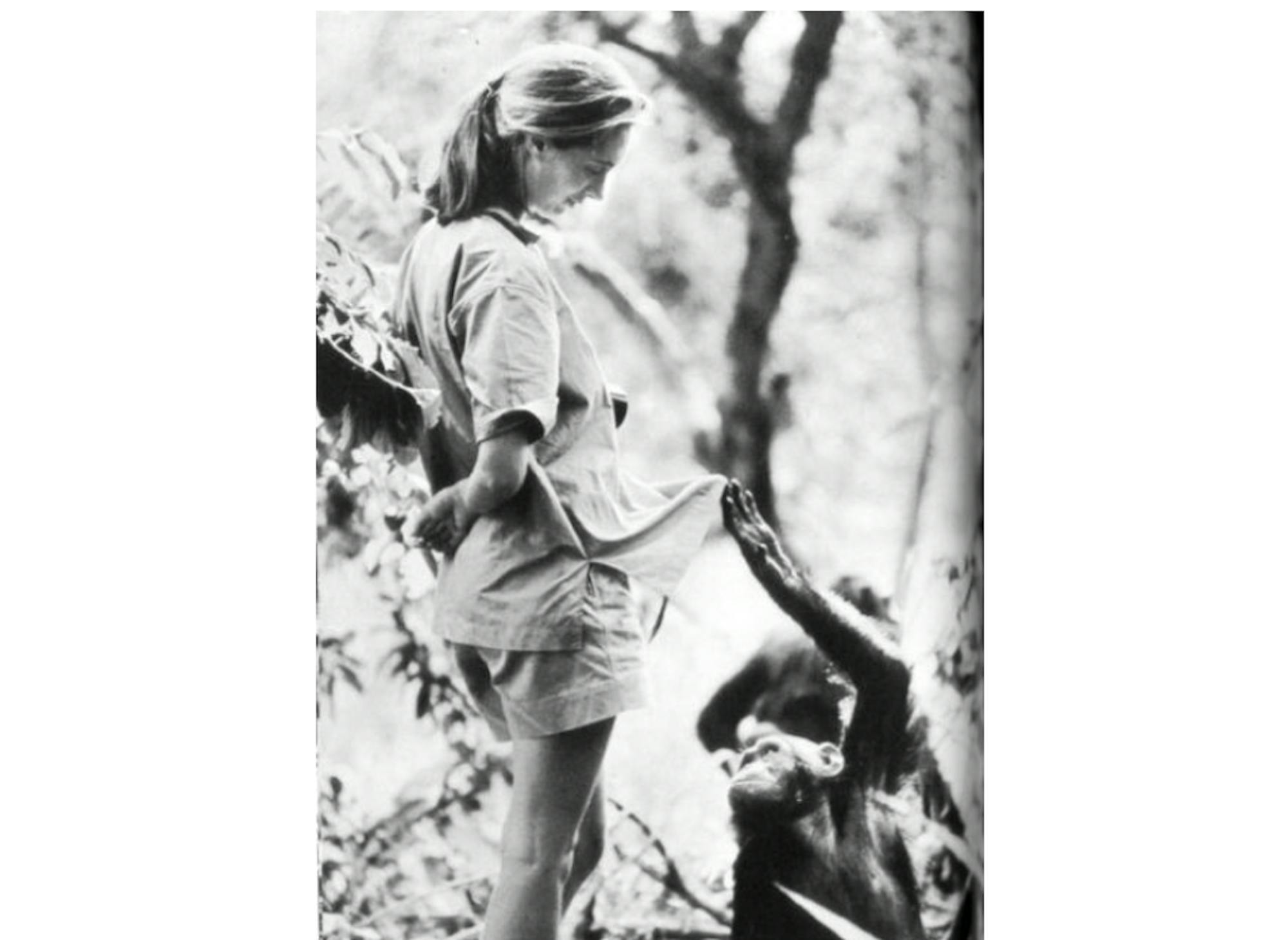
It took a while, but eventually, “the shy chimpanzees began to realize … that after all I was not so horrific and terrifying.” Goodall describes the first moment the chimps did not run from her as, “without any doubt … the proudest moment I had ever known … the chimps had begun to accept me as part of their normal, everyday landscape. A strange white ape, unusual to be sure, but not, after all, terribly alarming.”
For her struggles, Goodall was rewarded with incredible discoveries. She observed that the chimpanzees had fluid social groups with complex hierarchies. She saw human behaviors like hugging in greeting, reassuring contact, games like tug-of-war and social grooming. She also saw meat eating, where beforehand scientists believed chimps to be primarily herbivores. Her most shocking discovery was chimps stripping leaves from twigs and using them to get termites out of the ground. This was the first recorded example of a wild animal not only using a tool but creating a tool. She also saw them create sponges out of leaves to soak up water from trees. Beforehand, tools were part of the definition of man, which had to be revised. This idea has always delighted me: that a woman changed the definition of man.
Goodall’s story makes it clear that her success came from her unorthodox methods, including giving animals names instead of numbers. She describes naming each chimp, from Mr. McGregor, who reminded her of the belligerent gardener from The Tale of Peter Rabbit, to David Greybeard for his silver beard and Goliath, forever following David. In the Shadow of Man is every bit the chimps’ biography as well; they are key characters with distinct personalities and lives. Another important character is Hugo, a photographer sent by National Geographic, in whom Jane finds a kindred spirit and eventually, romance. Goodall writes that following the chimps together, “was like being spectators of life in some village. Endless fascination, endless enjoyment, endless work.”
In the Shadow of Man shows Goodall is not only the impressive figure of school lessons, but a real person: a romantic, tough and personable narrator. Her words transport you to the Gombe Reserve, right into the chimps’ social circles. Along the way, it shows that Goodall took on studying chimpanzees for science, and her own wonder, because she “longed to be able to swing through the branches like the chimps, to sleep in the treetops lulled by the rushing of the leaves in the breeze” and wondered “why on earth our ancestors had ever left the branches.” Her remarkable story gives us all the inspiration to follow our passions, even now that she’s gone.
Jenna Ledley is a junior in the College of Arts and Sciences. She can be reached at jledley@cornellsun.com.

Jenna Ledley is a member of the Class of 2027 in the College of Arts and Sciences. She was an assistant arts & culture editor on the 143rd Editorial Board and can be reached at jledley@cornellsun.com.