


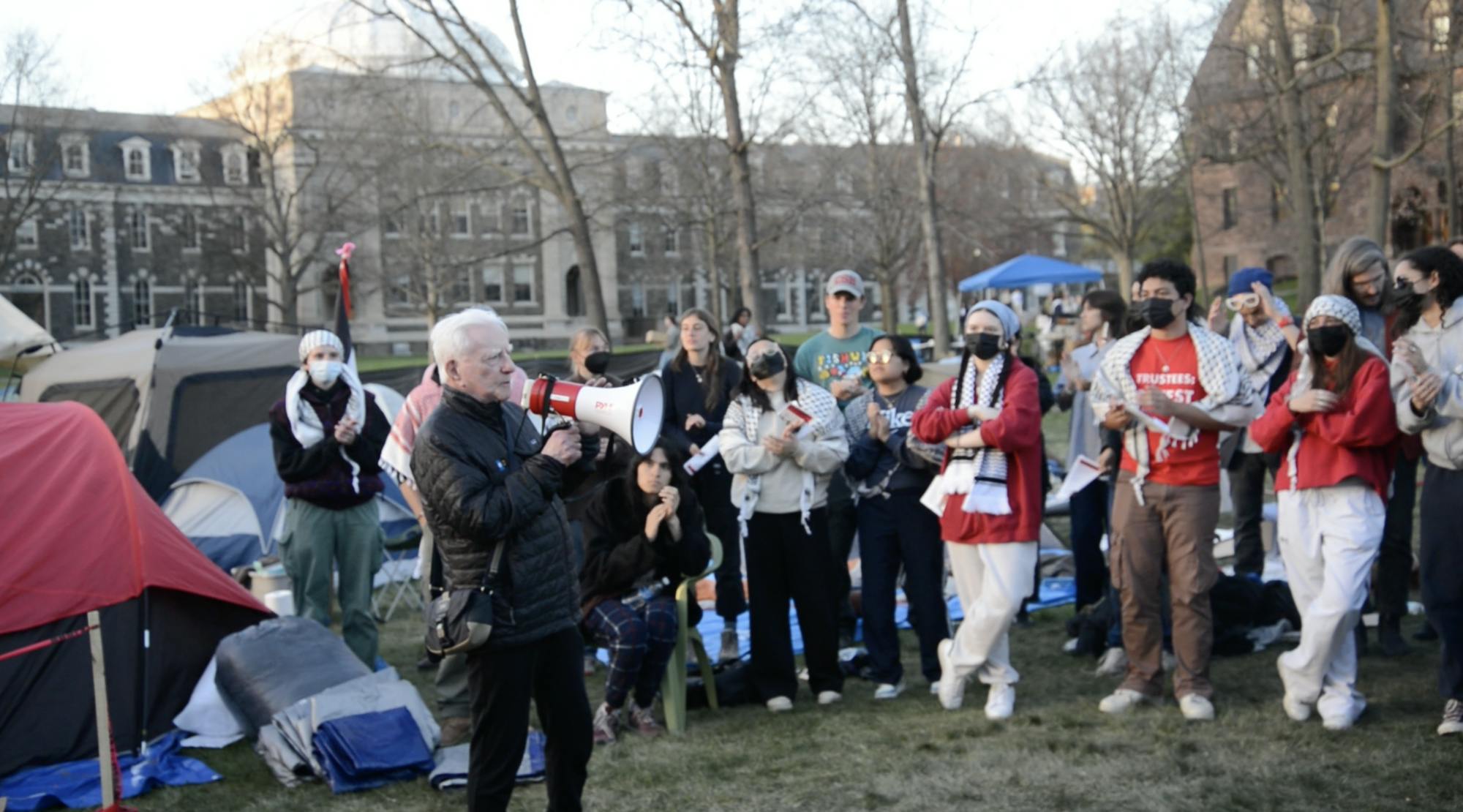
Prof. Eric Cheyfitz, literatures in English, faced a two-semester suspension without pay after an investigation found he violated federal anti-discrimination law when he allegedly asked an Israeli graduate student, whom Cheyfitz claims was “disruptive,” to leave his course on Gaza.
Now, Cheyfitz is set to retire after he and his lawyer negotiated a deal to avoid further deliberation by a University panel and ultimately the president, a Cornell spokesperson told The Sun.
Cheyfitz’s undergraduate spring course AIIS 3500: Gaza, Indigeneity, Resistance, previously drew criticism from President Michael Kotlikoff for what he saw as a biased view of the ongoing Israel-Palestine conflict.
It was during that course, taught last spring, when Israeli graduate student Oren Renard filed a discrimination complaint with Cornell’s Office of Civil Rights. Since then, various University bodies have issued conflicting decisions.
The COCR’s initial conclusion of bias was overturned by a ruling by a Faculty Senate Committee, Cheyfitz said. Despite the committee's ruling, Provost Kavita Bala moved to reopen the case and place it before a new hearing panel and ultimately President Michael Kotlikoff. This was met with backlash from Cheyfitz and the American Association of University Professors over concerns of double jeopardy — the legal principle that prevents being prosecuted twice for the same offense.
Now, the investigation and hearing process launched by the provost has ended with Cheyfitz’s retirement, according to a University spokesperson.
“Professor Cheyfitz has chosen to retire and leave university employment, thus ending Cornell’s disciplinary process,” the statement reads.
Though no further disciplinary process action will be taken, the spokesperson explained that the COCR’s initial “finding of discrimination,” which held that Cheyfitz “violated Cornell policy and federal law,” would remain in place.
However, for Cheyfitz’s lawyer, Luna Droubi, the University’s statement is a “false account of what transpired,” because it fails to acknowledge the findings of the six-person Faculty Senate Committee on Academic Freedom and Professional Status of the Faculty. Droubi claimed that per University Policy 6.4, while the ruling from the Faculty Senate committee should have been binding, Bala chose to reopen the case.
“The Administration now seeks to distract from their failure to follow their own policies by appealing to an earlier [COCR] finding based on less complete information,” Droubi wrote.

Bala said that the Faculty Senate committee made its decision based on less strict rules than are federally required.
Inside the Incident
Immediately after the first class Renard attended, classmates complained to Cheyfitz of his presence as the course’s only graduate student and of his pro-Israel speech during class discussions, according to Cheyfitz. By his third class appearance, he was asked by Cheyfitz to leave.
Renard, the Israeli student in question, is a Ph.D. candidate with a focus in computer theory. He previously served in Israel’s elite military surveillance agency, Unit 8200, according to reporting by The Nation about his LinkedIn profile. Renard’s LinkedIn profile no longer includes his time in Unit 8200, though it includes other cybersecurity work he did with the Israeli Defense Forces.
Cheyfitz claims that he initially welcomed Renard into the class, citing emails the two had exchanged where Renard told him he was Israeli. Cheyfitz, who identifies as Jewish and has a daughter and grandchildren who are Israeli citizens, noted that his personal relationship with Israel is “a very intimate one and not a hostile one.” He added, however, that his critique “is of the government of Israel,” which he labeled as conducting a genocide in Gaza.
The conduct of Renard in those initial classes is the subject of scrutiny for Cheyfitz.
Cheyfitz alleges that Renard recorded fellow students in class and noted that some students raised concerns over being doxxed. When asked by The Sun if he thought Renard purposefully enrolled in the class to surveil students, Cheyfitz answered: “Yes.”
Cheyfitz said he learned during the investigation process that Renard recorded the conversation in which he asked Renard to leave the class. Cheyfitz also said he saw Renard holding his phone during class, but could not otherwise confirm that he was recording during class time.
Sumitra Pandit ’26, a student in the course, also said that she did not notice Renard filming. However, she said, “I don't think I would have noticed if he had.”
Yet for Droubi, after Renard recorded his conversation with the professor, the possibility of doxxing was enough to justify asking Renard to leave the course.
“You look at the fact that he did, in fact, record Professor Cheyfitz. My point is, what else was he recording? ... What else was he surveilling?” Droubi said. “I think it's a fair inference to assume that the students’ concerns [of doxxing] were legitimate.”
Under the Student Code of Conduct, all forms of recording to “appropriate, distribute, share, or use someone’s likeness, identifying personal data, or documents without permission” are prohibited.
Despite concerns over recording, when questioned by The Sun about the reasons for asking Renard to leave the classroom, Cheyfitz primarily focused on the students’ contributions to class discussions. Cheyfitz claimed that Renard was either “simply making contradictory comments” or “not participating in the discussion.” He also stated that he asked Renard to leave the class following peers’ complaints, because Renard was “upsetting my students, and appeared to be not doing the readings.”
Pandit, who is also a pro-Palestinian organizer on campus, shared a similar observation.
In the seminar of 10 to 15 people, she said, “It was pretty obvious that [Renard] was just there to argue with pro-Palestine students.”
Pandit also described how a Palestinian student she knew in the class dropped the course. That student said it was because of Renard’s “‘derailing the conversation’” in class, according to Pandit.
Renard did not respond to a request for comment by The Sun, though he previously told The Nation that he was “very concerned about the risks of having my identity disclosed online.”
Policy Tensions
The months-long investigation process had shown the tensions between academic freedom and the different disciplinary processes at Cornell.
Cheyfitz said that the original COCR investigation found his position “understandable,” and
“that they struggled to come up with the conclusion they came up with.” The Sun could not independently confirm that this was the language of the COCR report, and a University spokesperson stated that the COCR investigation found Cheyfitz was in violation of anti-discrimination law.
Cheyfitz said that the COCR then gave the matter to Dean of the College of Arts and Sciences Peter Lowen, who recommended to the provost that Cheyfitz receive a two-semester sanction without pay.
This sanction was appealed to the Faculty Senate’s Committee on Academic Freedom and Professional Status of the Faculty, Cheyfitz said.
Under the procedures laid out in University Policy 6.4, a faculty respondent can appeal the decision of the dean of their college to the Faculty Senate committee if they argue their conduct arose out of the typical student-teacher relationship.
The Faculty Senate committee unanimously found no violations of University policy, according to Cheyfitz. There was insufficient evidence to back up Renard’s claim that he was discriminated against for his Israeli identity, according to The Nation, which obtained the committee’s report. Cheyfitz claimed that Lowen then “overturned the finding of the constituted committee” and forwarded the charge to Bala, who reopened the investigation in violation of Policy 6.4.
The procedure of Policy 6.4 says that the dean “must accept the Committee's findings,” though it adds that the dean “may modify the Committee's recommended sanctions.”
However, speaking at the Faculty Senate on Wednesday, Bala said the reinvestigation was necessary since the Faculty Senate committee made its decision based on less strict standards than are federally required and used by the Cornell Office of Civil Rights.
“[The Faculty Senate committee] decided, based on its threshold, that there’s insufficient evidence of discrimination, but … we would be violating federal entry discrimination law if we accepted their finding based on that threshold,” Bala said. “This situation led to the actions that the dean and I took.”
Bala’s jurisdiction falls under a separate University policy, Faculty Handbook Section 6.6, which allows for a college’s dean to report the results of an investigation to the provost, who then holds the power to determine if future proceedings are warranted. It is under this policy that Cheyfitz was going to face a second hearing panel.
Concerns Over a Fair Ruling
It is unclear whether or not University Policy 6.4 and Faculty Handbook Section 6.6 run concurrently with each other. However, under Section 6.6, the ultimate decision on the case remained with Kotlikoff.
Kotlikoff previously attacked the course in private emails to a faculty member that were obtained by the Jewish Telegraphic Agency. He wrote in the email that he was “extremely disappointed with the [school] curriculum committee’s decision to offer the course.” Kotlikoff added that it presented “a radical, factually inaccurate, and biased view of the formation of the State of Israel and the ongoing conflict.”
When asked by The Sun if he felt like he was an objective source to decide Cheyfitz’s discrimination case, given his comments about the course, Kotlikoff said, “I don’t really have any bias.”
“These are two separate issues. One is whether a course should be open and objective or essentially dictate a certain definition or a certain interpretation of events, on the one hand,” Kotlikoff told The Sun. “My understanding of the issues you're referring to — they’re really around the Title VI violation.”
Prior to news of his retirement, Cheyfitz was not hopeful that a positive outcome for his case could have been reached with Kotlikoff presiding.
“Why would I? Why would anyone feel [there will be] a positive outcome?” Cheyfitz said. “Would anyone feel safe with someone who had targeted them from the beginning?”
Those immediate concerns have now been averted with Cheyfitz’s negotiated retirement. However, for Droubi, this outcome remains an attack against his course. Cheyfitz said that under the agreement with the University, he began retirement on Tuesday and would receive pay for the spring semester.
“Professor Eric Cheyfitz taught a class entitled ‘Gaza, Indigeneity, and Resistance’ and was punished by the Cornell Administration for doing so.” Droubi wrote. “By choosing to resolve this matter with Professor Cheyfitz, the Administration has essentially conceded that they violated Professor Cheyfitz’s academic freedom.”
Benjamin Leynse is a member of the Class of 2027 in the College of Arts and Sciences. He is a multimedia editor for the 144th Editorial Board and was a news editor for the 143rd Editorial Board. He can be reached at bleynse@cornellsun.com.


