

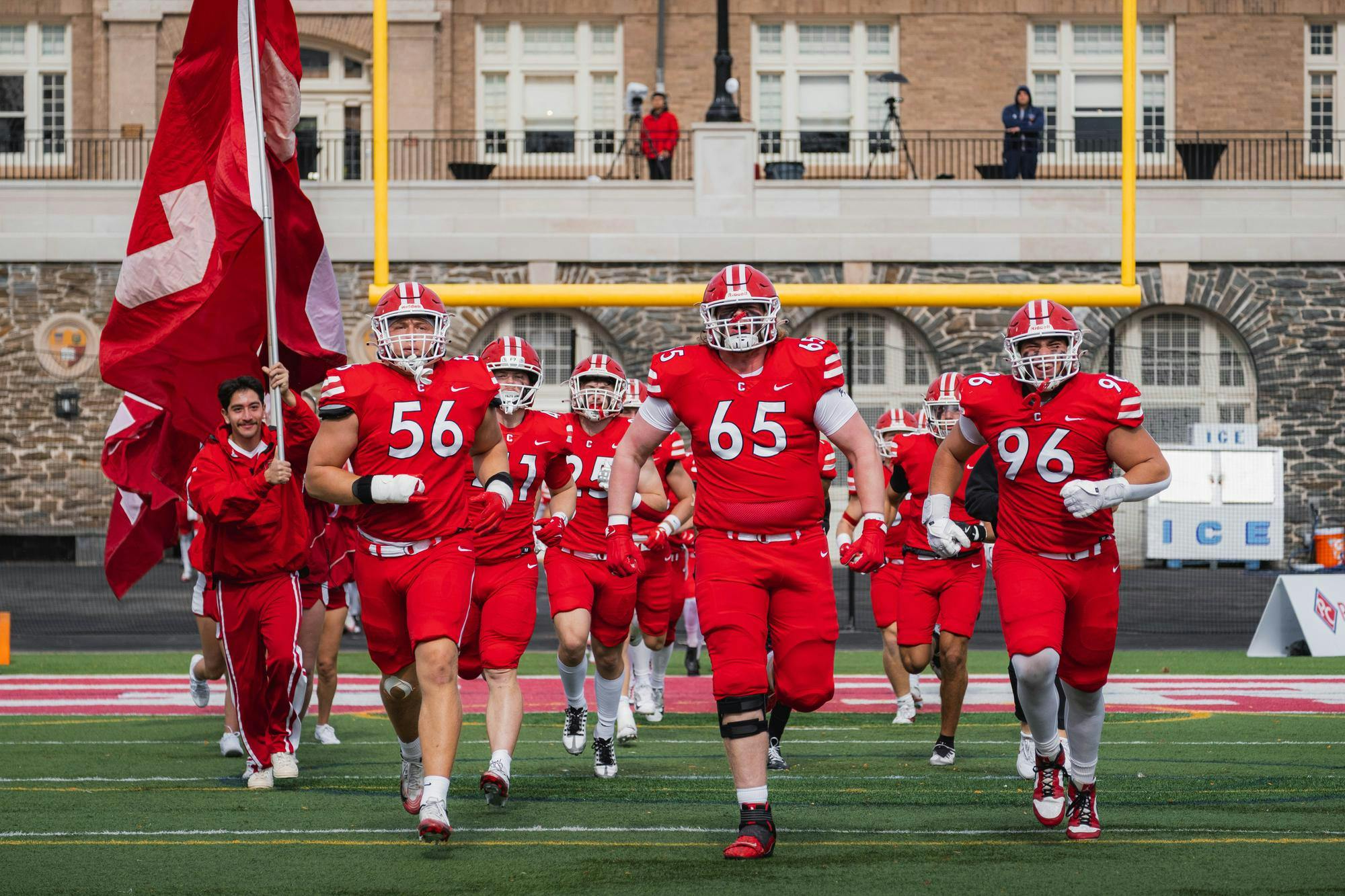
Football’s game this Saturday was shaping up to be characterized by unrealized possibilities.
Four times, a team was within 10 yards of the endzone and failed to earn the touchdown. One missed extra point (by Cornell) and two missed field goals (by Brown) followed the trend of near-misses.
However, a late touchdown got Cornell out of an 11-point hole. With less than two minutes on the clock, the Red was down by a single field goal.
Despite unsuccessful close-calls throughout the game, Cornell proved it could show up when it counted. The team made an improbable run across the field, fueled by junior quarterback Garrett Bass-Sulpizio, and managed to tie the game with seconds remaining.
Two overtimes later, Cornell (2-4, 1-2 Ivy) ultimately pulled ahead of Brown (3-3, 0-3), taking a 30-24 victory for its first conference win of the season. This was the Red’s first overtime game since 2016, and its first overtime win since 2007 — all of which were against Brown.
“It was definitely a battle from start to finish,” Bass-Sulpizio said. “It wasn’t pretty all the way through, but we just fought each and every play. We look at the scoreboard and see if it was good enough, and today it was.”
Cornell made its first move early. On the first play of the Red’s second possession, Brown received a face mask penalty that launched Cornell forward 15 yards. A series of effective rushes inched Cornell closer, and another penalty gave the Red a free jump to the 11-yard line.
Sophomore running back Jordan Triplett made the final carry into the endzone, but freshman kicker Jonathan Roost’s missed extra point dampened the early lead to 6-0. The 75-yard drive was bolstered by 27 yards gained from Brown’s penalties.
Cornell’s momentum appeared to spill over to the following Brown possession, with the Red defense stifling the Bears’ first two plays and a Brown penalty setting them back 10 yards. However, Brown quarterback James Murphy completed a 29-yard pass to Trevor Foley, then a 43-yard pass to Ty Pezza, with little interference from Cornell.
The Bears capitalized on the drive with a 10-yard passing touchdown carried by Pezza, and the successful extra point put them just ahead of Cornell, 7-6.
Uneventful drives induced by error and small gains, the highlight of which was a two-yard fourth down conversion carried by Bass-Sulpizio, ate up the first five minutes of the quarter.
“That group [on offense] has so much more to give me with execution,” said head coach Dan Swanstrom. “We’re playing two freshman receivers. We’re playing a field receiver who’s never played. We’re playing two freshman tailbacks. There’s a lot to manage out there for [Bass-Sulpizio], which you don’t really want in your third start.”
Spurred by effective passing from Murphy — including a 47-yard reception by Pezza — Brown broke the string of short drives. Sophomore lineman Tommy Ducker and senior lineman James Reinbold saved the Red from being down by another seven points, with a third down sack that paired with a Brown penalty to set the Bears back 20 yards on the fourth down.
The Bears opted for the field goal, putting them up 10-6.
Murphy opened the Bears’ next drive with a 50-yard pass to Solomon Miller. With 26 seconds left on the clock, Brown made a successful fourth down conversion to earn a first down eight yards from the endzone.
Again, the Red’s defense showed up in moments of need. Sophomore linebacker Keith Williams Jr. intercepted a pass to stave off Brown and give Cornell possession just before the end of the half.
“[The defense is] developing some competitive endurance, learning how to really compete,” Swanstrom said.
Penalties continued to plague Brown, taking five calls for a total of 58 lost yards in the first half — over double its average for an entire game this season.
“Brown is one of the cleanest teams in the country as far as penalties,” Swanstrom said. “[Their penalties today were] probably close to the national average, but they’re a very well-coached, clean football team. That came down to a play here, a play there.”
Opening the third quarter, which has been Cornell’s most productive quarter this season, the Red was stopped short on its first drive. Freshman kicker Will Buck fumbled with the ball after the snap, leading to a defective punt that gave Brown possession on Cornell’s 40-yard line.
The Bears settled for attempting a 38-yard field goal after being held up by Cornell’s defense, but the kick fell short, keeping the score stable.
On Brown’s next possession, they opted again for the easy three points. The field goal attempt hit the post, but a personal foul for roughing the kicker gave Brown another shot, with a first down three yards from the endzone.
The quarter came to a close with the Bears at the one-yard line on the second down. Following the break, they capitalized on the opportunity, extending their lead to 17-6.
Bass-Sulpizio responded by making his longest pass of the game, a 36-yard completion to freshman wide receiver Ryan Matulevich, to kickstart the Red’s drive. This effort would prove to be fruitless, with a sack and fumble recovery putting Cornell at the fourth down. It opted to attempt to convert, despite being 19 yards from the endzone, and was unsuccessful.
With less than five minutes on the clock, the Red was down by 11 and seeking a redeeming touchdown to narrow the gap. Spurred by a 31-yard completion to junior tight end Ryder Kurtz, Cornell made it back to the 19-yard line. This time, however, a pass and 10-yard rush allowed Bass-Sulpizio into the endzone.
A two-point conversion after the touchdown, caught by freshman running back John McAuliffe, put the Red in a 17-14 deficit with 3:44 left in the final quarter, needing a field goal to tie the score.
“When we needed [Bass-Sulpizio] most was when he was best,” Swanstrom said. “And that’s a good trait to have.”
It looked like Cornell would receive a quick possession, as its defense kept Brown from moving more than two yards in the first three plays of its drive. On the third down, Murphy launched a 45-yard pass to Miller, crushing this potential.
The Red’s defense faced another pivotal moment when Brown faced another third down, this time on the 29-yard line. This time, it was able to prevent the attempted run, and the Bears chose to convert in lieu of a field goal. Brown, unsuccessful, gave up possession on downs.
Cornell used its limited time wisely. Pass after pass, Bass-Sulpizio made four first downs in an unthinkable drive that ended on the eight-yard line, when the Red faced a fourth down with eight yards to go.
This time, Cornell chose the easy way out, and Roost took to the field to make the game-tying kick.
“From the first missed field goal, I thought we’d go for a lot of these [fourth downs],” Swanstrom said. “Of course, when I need the kid the most, he just bangs them out. I’m developing a lot of confidence in [Roost], in his process. He’s getting better every day.”
Brown won the coin toss to begin the extra time with the ball, and Murphy struck quickly. NCAA overtime rules grant each team the opportunity to attempt a score from the 25-yard line, with no time limit. Murphy connected a 25-yard pass to Pezza, and the extra point put the Bears up 24-17.
Bass-Sulpizio’s initial attempts fell short, with an incomplete pass and an unsuccessful rushing attempt making Cornell’s odds look bleak. A 26-yard pass to Kurtz proved the Red’s persistence, and Triplett rushed the remaining yards into the endzone. After the kick, the score was tied at 24-24.
Cornell made the next touchdown to open the second overtime, but its two-point conversion attempt fell short.
The Red’s defense kept the Bears back until it was at a fourth down with two yards to go, and on the ensuing rushing attempt, managed to keep Brown from making any progress. The play went under official review, but the call on the field stood, giving Cornell its first Ivy League win of the season.
“We’d been in this situation many times before in practice,” Bass-Sulpizio said. “The team’s confident, it’s nothing new. We’re ready for the moment and move the ball, get out of bounds, keep the clock going, and get in the end zone.”
Matulevich led the team in receiving yards, logging 100 in his breakout game. Kurtz followed with 81, and Pich earned 78. This was an unusual passing-heavy game for Cornell, which has typically received similar yardage on the ground and in the air. Bass-Sulpizio’s 87 rushing yards topped Cornell’s output, while Triplett was close behind with 64.
Matulevich and Triplett’s contributions as underclassmen didn’t go unnoticed.
“Even the young guys get all their moments in practice to show what they can do,” Bass-Sulpizio said. “Triplett’s done an absolutely fantastic job, so I’ve got my full faith in not only Jordan [Triplett], but all the running backs to do their job, and I know they’ve got my back too.”
The Red managed to hold Matt Childs, Brown’s team leader on the ground, who averages 66 per game, to just 27 rushing yards while allowing Pezza and Miller to receive 172 and 166 yards, respectively.
Cornell ends its three-game homestand next week, as it hosts Princeton University at 1 p.m. on Saturday. Last weekend’s victory over Bucknell marked its last out-of-conference match, and the Red will stay in the Ivy League for the remainder of the season.
Coverage will be available on ESPN+.
Alexis Rogers is a member of the Class of 2028 in the College of Arts & Sciences. She was the sports editor on the 143rd Editorial Board and can be reached at arogers@cornellsun.com.


