


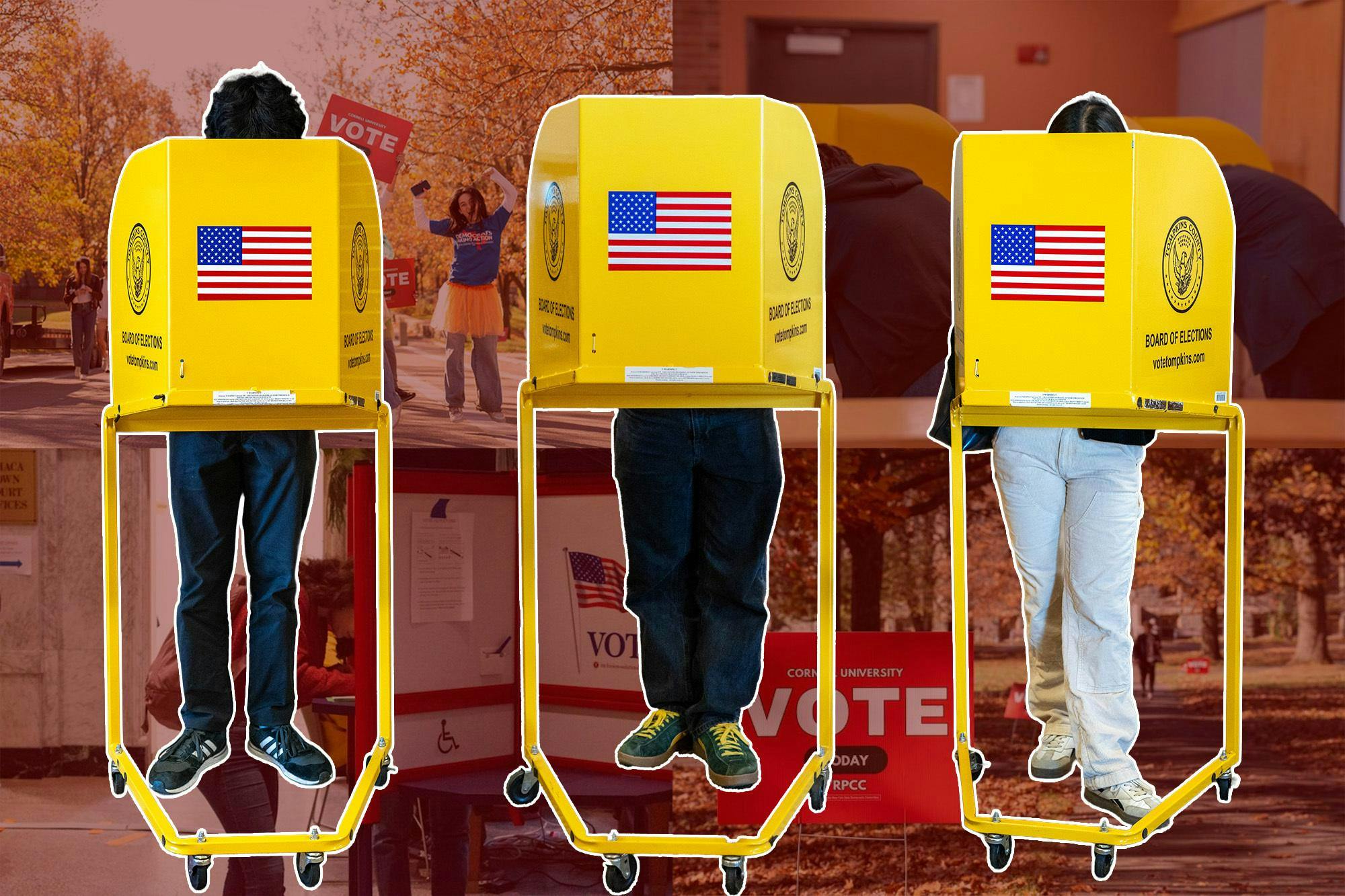
On Nov. 4, students will be bubbling in carefully selected responses to a different kind of answer sheet — their ballots.
Yet, on the most important day of the year for our campus to engage in democracy, Cornellians will balance their civic duties with sitting for prelims, attending lectures and submitting essays.
Last year, at least 86 schools, including Fordham University and George Washington University, cancelled classes for the presidential election.
Meanwhile, Cornell chugged on like any other day, despite sitting in one of the most competitive Congressional districts in the country and holding only one on-campus polling location.
Students told The Sun last year that juggling voting in the presidential election with a full schedule of academic commitments was a nearly impossible balancing act.
“I know some people with prelims tonight, and there certainly would’ve been more student voters if they canceled classes,” one student said.
Sending out annual emails reminding students to vote is not enough. To uphold democracy and free speech, Election Day must be held as a University holiday on both presidential and non-presidential election years.
Fellow New York State and Ivy League school Columbia University will additionally give students off this upcoming Election Day, amid a fiery NYC mayoral election. Yet even students at Cornell Tech on Roosevelt Island in Manhattan must attend classes on Nov. 4.
A university’s decision to conduct classes can be the deciding factor for students opting into voting. Holding classes on Election Day is effectively voter suppression.
Beyond voting, a day off would allow students to engage in educational events, volunteer at the polls and aid others in getting to the polls, empowering them to go beyond the campus bubble and uplift the local community. This is exemplified at Stanford, which will hold its fifth Democracy Day next month, including over 40 events focused on civic engagement and learning.
The statistics speak for themselves. 45 percent of students said that the most helpful action for a university to get them to vote would be cancelling classes on Election Day, according to an Inside Higher Ed/Generation Lab survey conducted in September 2024.
Likewise, the 2016 Survey of the Performance of American Elections found that of people ages 18-29 with college experience who registered but failed to vote in 2016, 47 percent noted they were too busy or had a conflict on Election Day.
New York State is one of five states to officially establish Election Day as a holiday and mandate employers to give employees paid time off. Cornell should align with the state’s emphasis on civic engagement and pioneer the charge to make Election Day a national holiday by starting at the collegiate level.
Moreover, the fight for instituting Election Day as a University holiday is not new.
In 2022, the non-partisan student organization Cornell Votes campaigned to give students the day off for Election Day. In 2023, the Student Assembly adopted a resolution urging the University to make Election Day a holiday.
It is time for the Cornell administration to finally listen to its students.
President Michael Kotlikoff was officially inaugurated on Friday. He pledged to further Cornell’s work as “a university committed to open inquiry, and the values of our democracy” and as “a contributor to our country’s strength and well-being.”
What demonstrates democracy and strengthens a nation more than removing barriers to voting?
President Kotlikoff, the principles of free speech you so frequently speak of are a difficult balancing act to pursue. Yet making Election Day a University holiday is completely nonpartisan and remarkably simple. Put actions behind your words. Your legacy will tell the tale.
For now, professors — provide flexibility for students to vote during class times on Nov. 4.
Students — make your voices heard. Find voting guidelines and deadlines through Cornell Votes' resources and The Sun’s election guide. Whether voting in Ithaca or in your hometown, local races and ballot initiatives determine educational policies, infrastructure, public safety and economic development.
Democracy is worth the inconvenience. Your ballot is the most important assignment you will submit this semester.
And next midterm season, Cornell must not fail its student body on democracy.
The Sun is interested in publishing a broad and diverse set of content from the Cornell and greater Ithaca community. We want to hear what you have to say about this topic or any of our pieces. Here are some guidelines on how to submit. And here’s our email: opinion-editor@cornellsun.com.
The Cornell Daily Sun’s Editorial Board is a collaborative team composed of Editor-in-Chief Sophia Dasser ’28, Associate Editor Sophia Romanov Imber ’28 and Opinion Editors Zara Cheek ’28 and Rayen Zhou '29. The Editorial Board’s opinions are informed by expertise, research and debate to represent The Sun’s long-standing values. The Sun’s editorials are independent of its news coverage, other columnists and advertisers.


