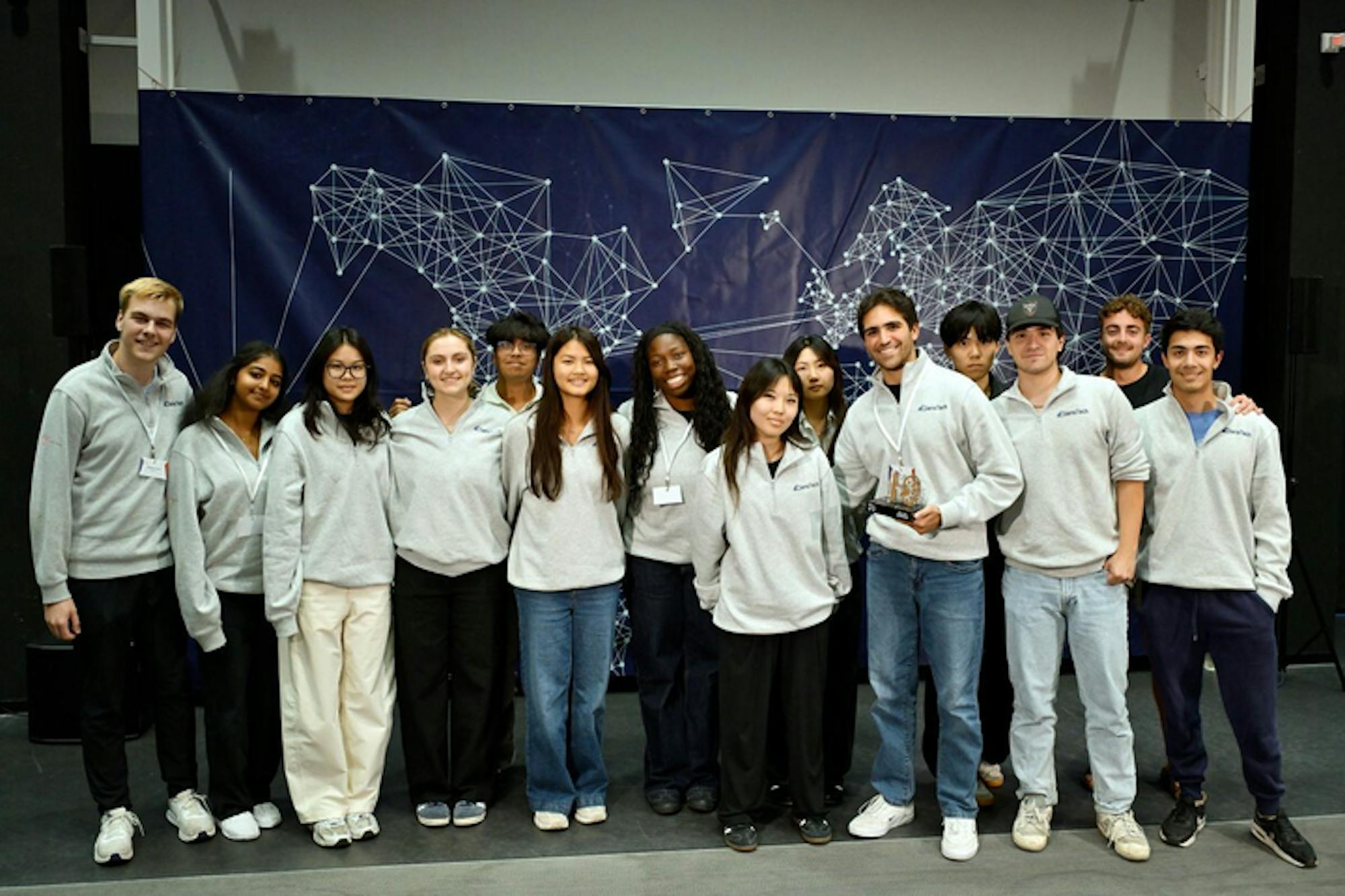
SensTech, one of Cornell’s newest project teams, received a third-place award at the international biosensor competition, SensUs, for its wearable biosensor designed to manage kidney disease this August.
SensTech is a 15-member project team founded in 2024 that develops biosensors to compete in SensUs. Based on the year’s theme, student teams design a biosensor — a small device for rapid, convenient measurement of molecules in body fluids for disease diagnoses or monitoring. The competition gives awards for the research and development of the sensor, as well as a business component in which teams pitch their biosensors to industry experts.
For the 2025 competition, teams were tasked to build a biosensor to monitor creatinine, a waste product of muscle activity that can be a biomarker of kidney disease. SensTech created a wearable biosensor designed for continuous at-home monitoring that would track patients’ creatinine levels and alert them if levels become elevated. The device uses a microneedle patch embedded in the skin to measure creatinine molecules found in the fluid between cells in the bloodstream.
According to Alice Wei ’26, senior advisor and former dry lab team lead for SensTech, “One important aspect that the team focuses on is not only how we read the data but how the data is spread to the patients themselves.”
To help patients easily access the data, the team developed a mobile app to connect to the device. The data collected by the sensor is translated into the app, which informs patients about whether their creatinine levels are healthy without requiring a physician to interpret the data.
To build the sensor, the SensTech team started by researching current techniques and similar products and conducting interviews with stakeholders. The team interviewed physicians, including kidney specialists from Weill Cornell Medicine and patients with chronic kidney disease to better understand patients’ authentic experiences with this type of biosensor.
In conducting these interviews, the team paid particular attention to the perspectives of patients in rural areas.
“We're uniquely positioned in Ithaca, where some people don't have the same access to care that you do around the world or in different parts of the US,” said Alexander Harris ’26, the president of SensTech.
These experiences influenced their design of a continuously monitoring sensor, which may be especially helpful for patients who live several hours away from a physician.
SensTech is divided into three subteams: Wet Lab, which focuses on the biorecognition and chemical aspect of the sensor; Dry Lab, which focuses on the hardware and app development aspect; and Business and Outreach, which focuses on the public-facing, business aspect. Students on separate teams with varying levels of experience are still involved with each step of the biosensor design process, particularly due to SensTech’s small size.
“That's what makes us so unique as we're able to position ourselves as a startup or as a startup environment rather than a project team with very distinguished responsibilities and goals between members,” said Adelin Chan ’26, senior advisor and former wet lab team lead of SensTech.
While building the sensor, the team sought advice from researchers and faculty across Cornell, who provided them with valuable insights to guide their process. Building the sensor itself, however, involved many rounds of trial and error.
“Going through that process over and over again and just going back to the drawing board when we realized that it probably wouldn't work was definitely the biggest challenge for us,” Harris said.
The team traveled to the Netherlands for the SensUs competition this past August, where they received third place in the Analytical Performance category, which highlights the team whose biosensor functions the best in terms of accuracy and speed. The award came as a pleasant surprise to the SensTech team, which is only in its second year.
For Chan, who has been part of the project team since its founding, receiving the award was a meaningful experience.
“Seeing SensTech start as a group of four girls and then grow into this huge project team and winning, and as a senior seeing all the underclassmen really bond together but also develop this really big passion for biosensors and all work towards the same thing, is really rewarding,” she said.
Looking forward, although the team has no current plans to bring the creatinine biosensor to the market, they are excited about designing a new sensor for next year’s SensUs competition.
“It's been amazing seeing how the team grew in the past year,” Wei, who has also been part of SensTech before it was an official project team, said, “I know we have so much potential for even more growth into the coming years, and with not only the projects, but with the people themselves and seeing how they grow with the project team as well.”
Tania Hao can be reached at th696@cornell.edu.
Tania Hao is a member of the Class of 2028. She is a science editor for the 144th Editorial Board and can be reached at thao@cornellsun.com.