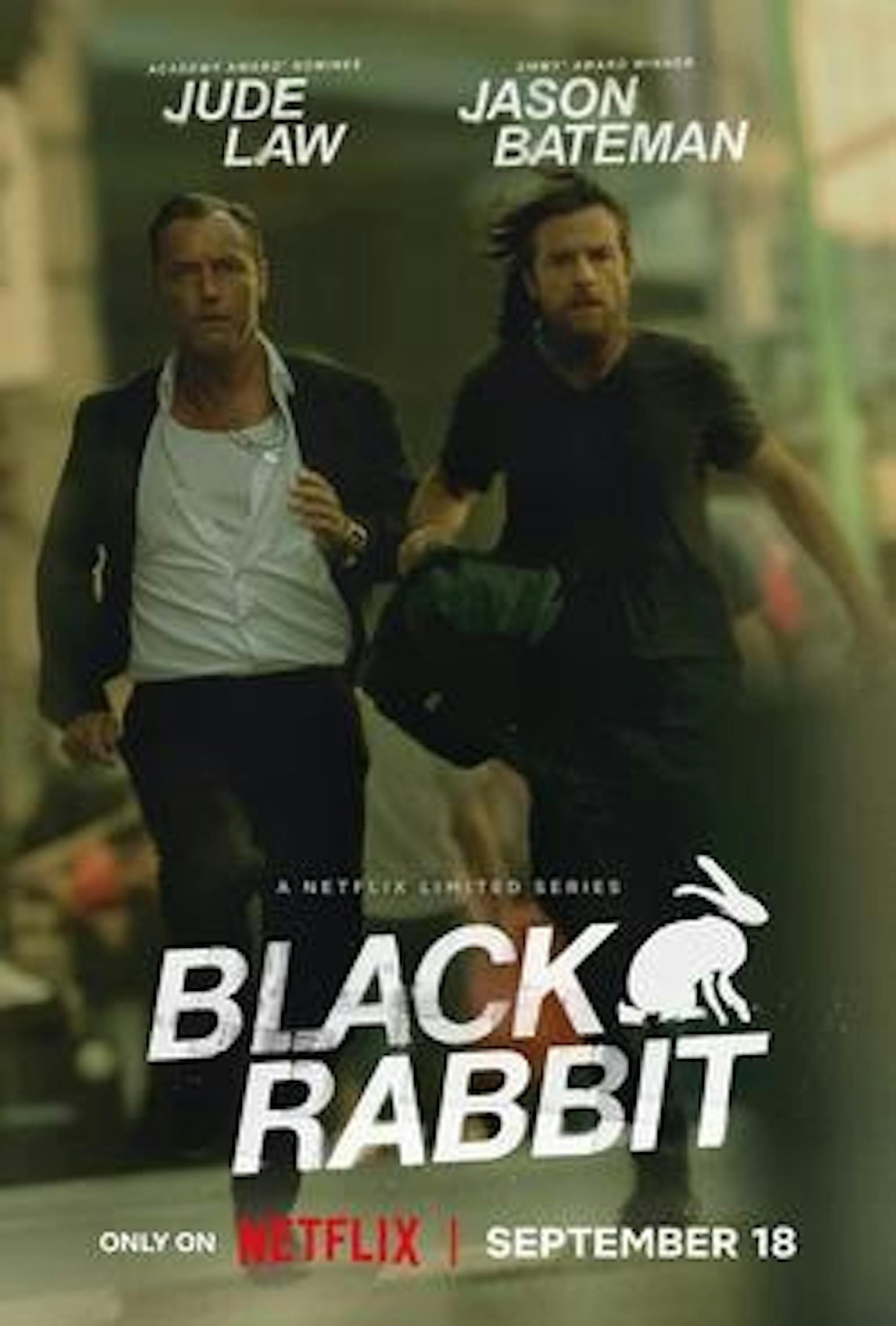
Underwhelmed would be the most appropriate word to describe my feelings upon finishing Black Rabbit, Netflix’s newest crime thriller miniseries. When I first heard that Jude Law and Jason Bateman would be starring in a series together, I was hooked. I’ve been a fan of Bateman’s work for years, admiring the comedic prowess he displayed in Arrested Development (2003-2019), Horrible Bosses (2011) and Game Night (2018), as well as his more serious work in films like Juno (2007). Although I am admittedly less familiar with Law’s filmography as a whole, The Talented Mr. Ripley (1999) owes much of its success to his captivating performance in the film. And, for the most part, Law and Bateman delivered convincing and engaging performances throughout the series. So, then, what was responsible for the series’s disappointments?
First, I’ll highlight the good. Black Rabbit follows Jake and Vince Friedkin as they try to deal with the complications brought on by the enormous debts Vince owes to loan sharks. Their attempts to settle the debts are complicated by difficulties Jake encounters while running his upscale bar and restaurant. As some reviewers have pointed out, Black Rabbit’s story combines the high-stress nature of the restaurant industry as portrayed in The Bear (2022-Present) with an anxiety-inducing debt storyline similar to those featured in Uncut Gems (2019) and Rounders (1998). By blending the culinary and crime worlds, Black Rabbit effectively places the viewer in a state of constant anxiety throughout the course of the show. Each bad decision the characters made left a deeper and deeper pit in my stomach that remained for some time after each episode ended. Law and Bateman effectively executed a portrayal of brotherhood that was addictive to watch, with witty banter and petty arguments perfectly capturing the love and resentment each character holds for the other. The supporting actors (especially Cleopatra Coleman and Troy Kotsur) provided believable performances with the screentime they were given, adding more life and detail to the story’s greater world.
At times, however, the show seems to stretch on for much longer than it has to. Black Rabbit has a runtime of over seven hours, and it seems that the writers felt compelled to add unnecessary twists to the show as a means of keeping the viewer’s attention. However, the show does little to build the groundwork for these twists or fully capitalize on their implications. This becomes most apparent in the miniseries’ last episode, which seems to quickly speed through many of the plot’s storylines with no true feeling of resolution or catharsis for the viewer. Additionally, the sheer amount of noise throughout the show’s plot leaves little room for the side characters to truly be developed or explored in interesting ways. As a result, when these characters appeared in scenes without Law or Bateman, I often felt much less engaged. Many such characters merely seem to be devices for moving the plot forward rather than fleshed-out human beings.
Having focused on the most glaring “bad” aspects of Black Rabbit, we will now move on to the ugly. Though Law’s performance itself proved convincing, his subpar accent work proved extremely distracting at many points. Law, who is from London, struggles to maintain a consistent vocal performance throughout the show: his voice seems to bounce back and forth between a thick New York accent reminiscent of an Italian gangster and a more toned-down, generic American accent. When his voice changed within a single scene, it completely took me out of the action. I also found this failure relatively surprising, given his believable accent work in The Talented Mr. Ripley. Additionally, many of the decisions the characters make throughout the series are ridiculously stupid. While some of these could believably be chalked up to the stress of a situation or a character’s flaws, other decisions have no reasonable explanation. In a manner reminiscent of a James Bond villain, a character about to kill Vince agrees to Vince’s final request to do a line of cocaine together. The man’s complete lack of hesitation regarding the cocaine helps Vince escape the situation, which did not prove believable in the slightest. This, along with several other laughably dumb decisions, was simply too absurd for me to continue suspending my disbelief. Finally, the overall aesthetic of the show seems somewhat derivative of The Bear at many points, with the show’s color scheme and framing often feeling like a cheap knockoff of the unique style crafted in The Bear.
In all, Black Rabbit offers a decently enjoyable watch, especially for fans of Law and Bateman. However, the series does not deliver the rich, carefully crafted viewing experience I had hoped for. If you have an extra seven hours of your life to kill in the near future, Black Rabbit would be a perfectly acceptable way to spend them. If you’re on a more limited schedule, you won’t be missing out on much by skipping the new Netflix miniseries this time around.
Matthew Rentezelas is a sophomore in the College of Arts and Sciences. He can be reached at mmr255@cornell.edu.
Matthew Rentezelas is a member of the Class of 2028 in the College of Arts and Sciences. He is an assistant arts editor for the 144th Editorial Board and can be reached at mrentezelas@cornellsun.com.