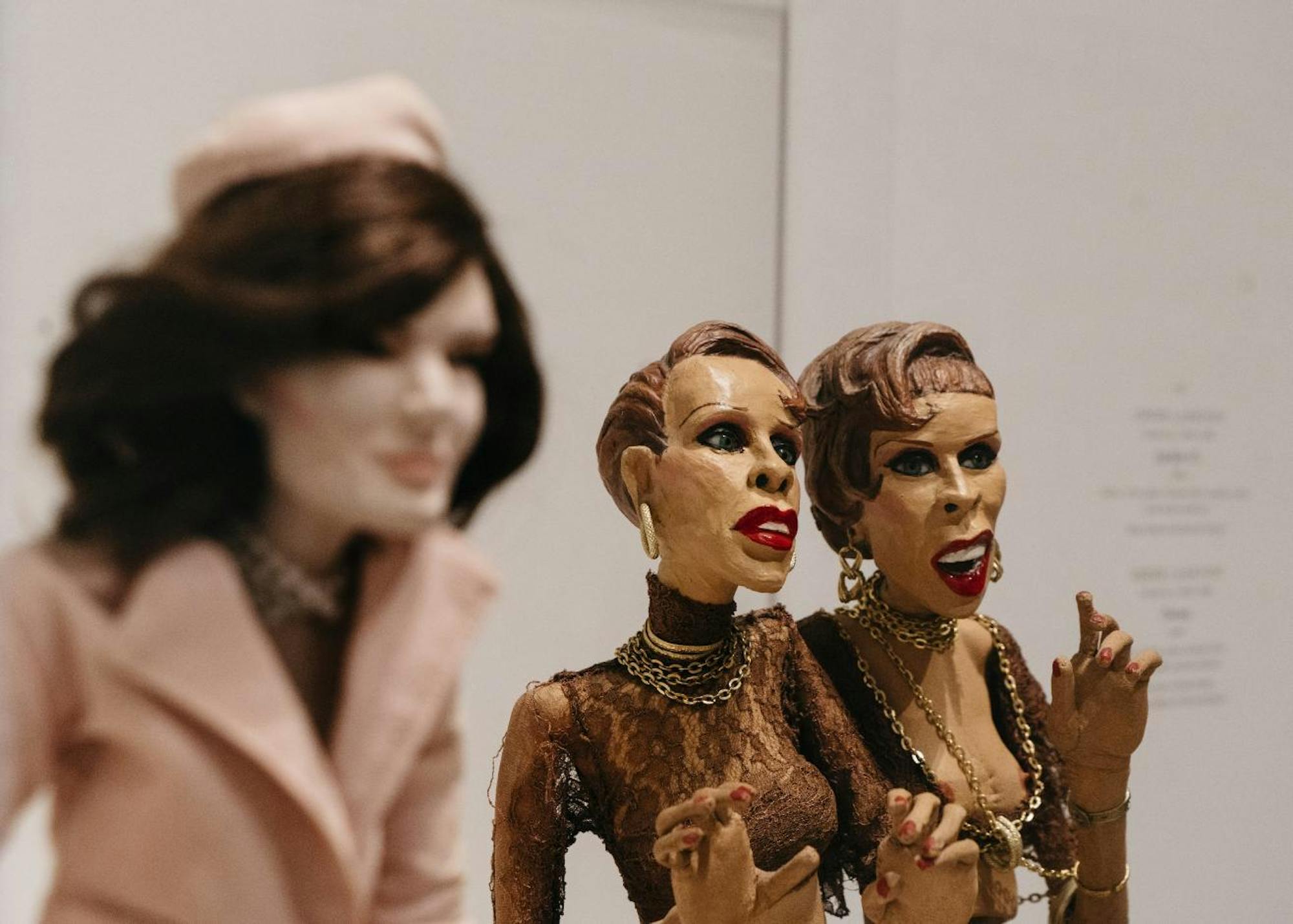
“They're all freaks. Outsiders, untouchables. They’re like biographies, the kind of people you’d like to know about. Really interesting and fucked-up.” Those are the words that artist Greer Lankton ascribed to her extensive collection of doll sculptures. This analysis of her work is perfectly founded when you take more than a quick look at one of her dolls. Lankton breathed a special, unique flavor of life and femininity into them; you can look at one and feel as though it’ll come alive and start speaking with you in a cigarette-rasped, New York drawl. Lankton’s collection of beautiful little freaks are the product of a life lived in celebration of the visceral nature of art and the female figure.
Born in Flint, Michigan in 1958, Lankton dived into the gritty, unforgiving New York art world after attending the Pratt Institute to study sculpture. Lankton medically transitioned when she was 21, and her temperamental opinion on her own body began to inform her characters. To Lankton, a feminine body was an obsessive yet messy composition of moving parts. Finding beauty in yourself didn’t come from the aspects that you were born with, but what you made of yourself. Lankton credited her gender affirming surgery as one of the nexus points for her passion for sculpture, saying it, "made me focus on bodies. I was always thinking about bodies, and if you think you have the wrong body, you're always going to think about it.” Rachel, one of Lankton’s most famous works from 1986, depicts a naked Rachel Rosenthal, a renowned performance artist. Rachel’s body is emaciated, her ribs and waist bones poking from her skin. She evokes an androgyny, with a shaved head and boxy silhouette. Her underweight figure limits the space she can take up, yet she takes it up anyway. Her face contorts in a smug, precocious expression, under a film of bold makeup. Her fingers are frozen in a snap, with her other hand sitting on her waist. Rachel demands to take up the space that her body doesn’t allow, and plays with the arbitrary notion of gender roles by allowing these features to embrace the queerness that is thrust upon them.
Lankton showcased much of her work in the windows of Einstein’s, an East Village boutique she ran with her husband Paul Monroe. She showed her work at the Whitney and Venice Biannales in 1995, and her commissioned dolls of icons such as Diana Vreeland, Candy Darling and Divine were met with much attention. Some considered her work to be disturbing and visceral, but most were able to embrace the idea that her work was truly not for everyone. This nitpicking of body and bodily features served as a double-edged sword in Lankton's disposition, as both her and her husband struggled with an eating disorder throughout their lives. Monroe stated that one of the reasons why celebrities were such a regular medium for his wife was her obsession with celebrity journalism, specifically journalism around their bodies. “She would devour them, chain smoking, laughing, cutting out headlines of Liz Taylor’s weight gain, or Karen Carpenter’s weight loss, crazy animals photos, UFOs. She loved the oddity and the absurdity.” Her depiction of Candy Darling, a famous Warhol-era actress, presents a topless bust of her, with wild hair, bold makeup and a string of pearls around her neck. In her chest opens a hole, revealing her heart on one side, and her beauty parlor on another, a pink drapey table filled with beauty products, jewelry and liquor bottles. The depiction can today serve as a commentary on stardom and celebrity at the time, the values of vanity and obsession becoming so important they sit alongside the heart.
This dollhood that Lankton thrusted onto her women, this new version of life that she gave them, lives on in our collective understanding of what being a woman means. Transfeminine women now refer to themselves as “dolls,” a term that originated from ’80s NYC ballroom culture. We’ve embraced the manufactured yet pure beauty of dollhood in the LGBTQ community, coupling with a sentiment that celebrated glamour is not always natural, but deliberate and time consuming. It is queer art like Lankton’s that has painted this narrative, this depiction of the beauty that queer people have embraced and stood for. While the beauty in her dolls can be exhausting in its obsession, it shows that beauty isn’t what we are given, it’s something we will always have the tools for sitting in our hands.
Caroline Murphy is a sophomore in the College of Arts and Sciences. She can be reached at cqm8@cornell.edu.