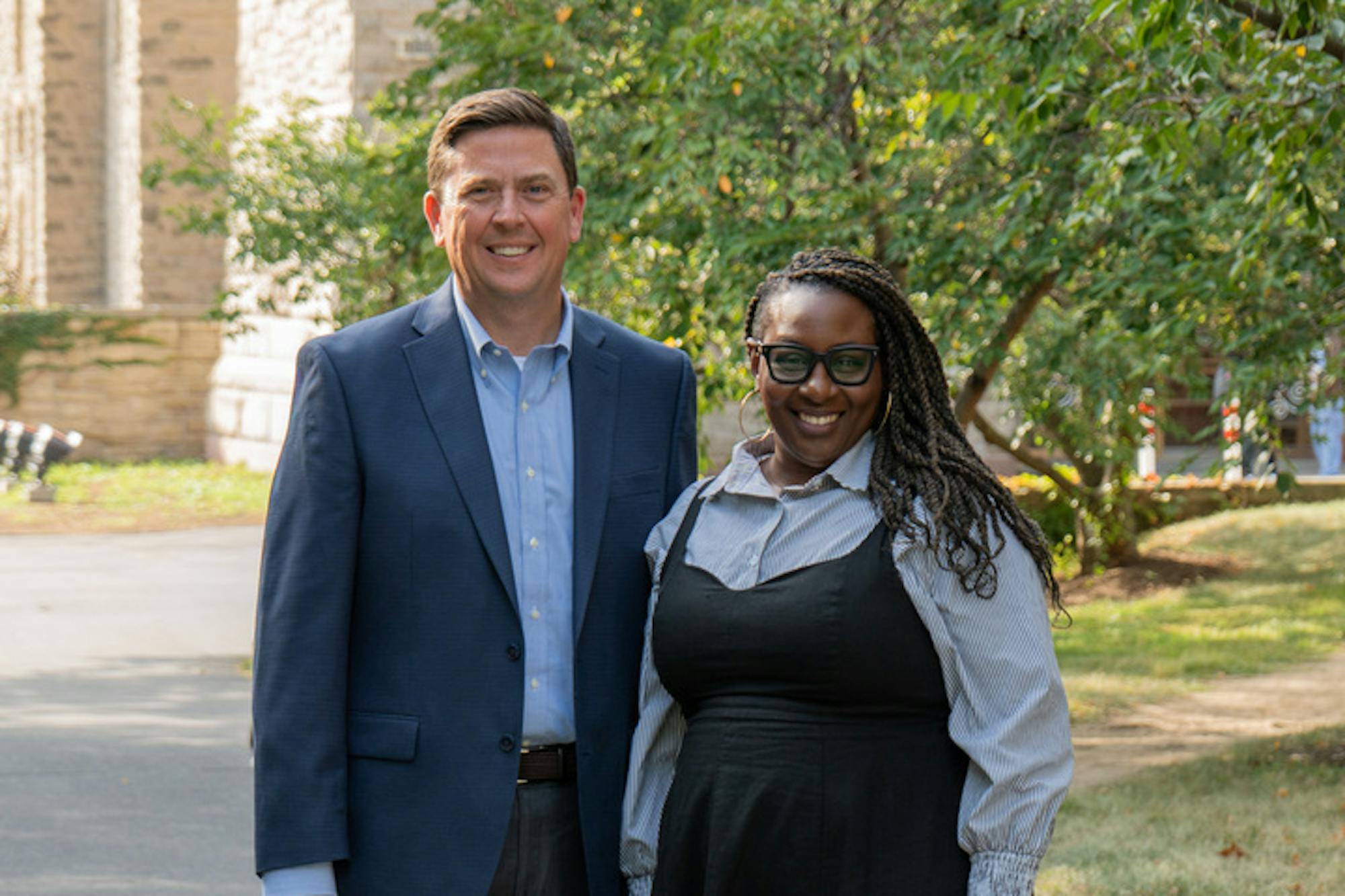
The Sun sat down with Vice President for Student and Campus Life Ryan Lombardi and Dean of Students Marla Love in a 35-minute exclusive interview to discuss the upcoming housing selection process with the Class of 2029 being the largest in University history. The Sun also questioned the administrators on the controversial Student Code of Conduct revision process.
Lombardi is back at Cornell following a one semester sabbatical. He is hoping to continue to “enrich” the student experience throughout Cornellians’ time in Ithaca.
Below is the transcript of The Sun’s wide-ranging, exclusive interview with Lombardi and Love. The transcript has been lightly edited and condensed for clarity.
Reflecting on Loss of Life on Campus
Lombardi: Before I get started, I do want to just say [that] Friday was a really tough day for our campus, and obviously, we know you all are aware of that 一 appreciate your coverage, your thoughtful coverage on that. [It was a] really tough day, and a lot of kudos to Marla and her team for trying to support our community … as that impacted students, families, all those types of things. So I just wanted to acknowledge that before we got started. Marla, I don’t know if you want to say anything, you’ve been very close to this.
Love: Yeah, I would just say … Friday [was] hard for everyone, and we recognize that challenge for students, and while also doing our best to absolutely be in the space to support families who are getting the worst news of their lives. [We] appreciate how you covered both deaths, recognizing that the staff member that passed also had a relationship and worked closely with a student population and the student community as well. So they're reeling from that experience as well. And so I'm just wanting to acknowledge that and to put that out into the space, just recognizing that it's … been a hard weekend for some students.
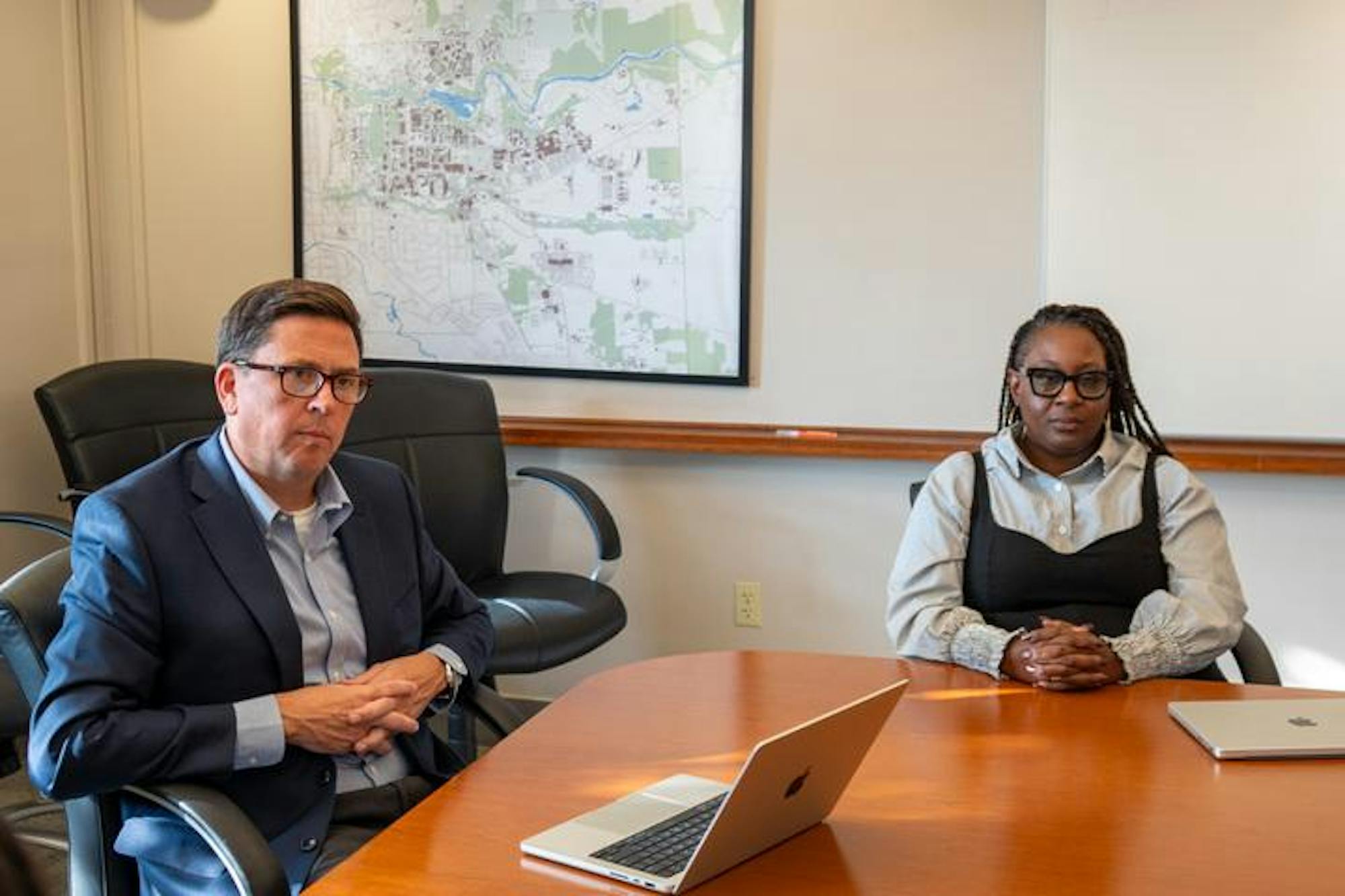
Vice President for Student and Campus Life, Ryan Lombardi, and Dean of Students, Marla Love, answer questions about the housing selection process.
Housing Selection
The Sun: Starting off with housing, [which] is a concern for a lot of students, especially rising juniors and seniors who do not have off-campus offerings so far. What can students expect for the [2025-2026] implementation of [the] housing lottery system? What does that entail for students?
Lombardi: So I don’t know that this system is fundamentally changing. What we're trying to do is, a couple [of] years ago, we started offering the continuing occupancy in the fall semester. That was really intentional, because in the past it had happened in the spring, and if we waited till then, and a student waited until then to go and then they weren't able to get housing, they were way behind the game in terms of trying to get an off campus apartment.
So we moved it [from] the spring so that sophomores, who would be rising juniors a year later. [So] if we don't have enough housing, they aren't able to get a spot, then they still have the whole academic year to go try to find off-campus living. So that was the motivation behind shifting that to the fall from the spring — to try to help students have the information to make a decision.
Now, our commitment is really on first and second year students. So we try to have — we want to — we want to say yes to as many juniors and seniors as possible, but we have to account for how many first years will be rising sophomores who we know. And then we have to work with admissions to try to understand how many folks they plan to admit for the next year. So it's a bit of a science, but it's also a bit of an art, and trying to figure out that right calculation.
The Sun: This relates to the last question. So the Class of 2029 [is] the biggest class in history at this University. How does the administration intend to ensure that there's space for these rising sophomores … as well as for upperclassmen who might want to get housing?
Lombardi: So that is absolutely part of our calculation. We had a really big class that just graduated in spring of ’25, and so the [Class of] ’29 is even bigger, but [the previous graduating class leaving] accommodates a little bit for that. Although that class was [comprised of] seniors, so it had kind of made its way through the housing piece. But that is something we factor. So when we open this process here very soon, the math they do is to say, “Okay, we know the 2029s, they're gonna be rising sophomores. We need to account for all those folks to have housing. We get projections from admissions on what they're expecting for the Class of 2030, … and then whatever is left is then what we would accommodate for juniors and seniors the best we can.”
The Sun: In March, the University announced that they have acquired 301 College Ave as a part of the University housing system. Does the University have a plan to integrate this into the South Campus community?
Lombardi: That will become a part of our housing portfolio for this coming year. So because of when the University engaged in that relationship, it was already, I think, leased, and people already had their spots and all that stuff. So we will be working over the course of this fall to integrate 301 into our housing portfolio. So, making that option. Not exactly sure how that sign-up for that particular facility is going to look yet, but starting next academic year, that will be a part of the housing portfolio.
The Sun: This is the last housing question. At this point in the semester, how many students are in forced triples or forced rooms, and how many students are living in converted lounge spaces. Is it expected that at some point in this semester or in the year, these people are going to be moved into more permanent residences?
Lombardi: So that depends on whether we can get students moved around in spaces, [which] depends on what kind of capacity we have. I know in the spring — I wasn’t here in the spring, you may remember that — I know it was announced that we thought we were going to be very full. We were full, but we didn't have to have any quintuples, or sextuples or anything along those lines. We did have some quads as we started off, and we did have to flex some residential spaces. And I think that was a total of about 30 students who were impacted by that in total. I think many of those students are still in those spaces.
We haven't been able to move a lot yet, but it's certainly as soon as we can, if they want to. We do find that a number of students who land in those spaces end up liking it and being comfortable in there and not wanting to move mid-semester or mid-year, but we'd certainly make that available to them.
We know there's always a change at the semester break, because some students go away in the spring. You're probably familiar with this, and so there's always that, whether it happens before then, we're not sure yet.
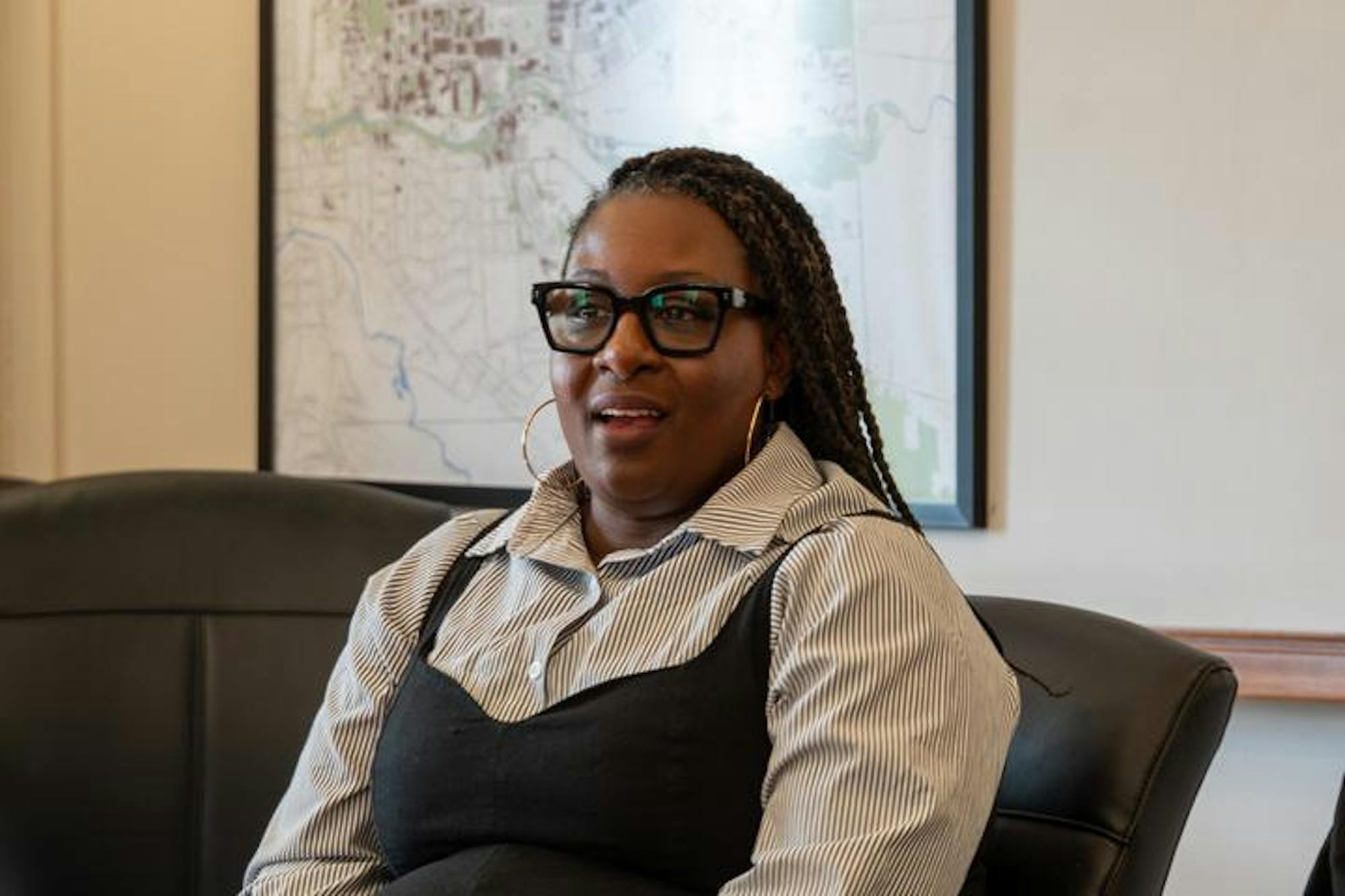
Dean of Students Marla Love answers questions about the revision process for the Student Code of Conduct.
Student Code of Conduct Revision Process
The Sun: I'm going to ask a little bit more about the Student Code of Conduct. Our goal here is to ensure that the students in the broader Cornell community have clarity on the current revision process, since this is the first revision since the 2021 change in the revision policy. So naturally, students have questions on these revisions, how and why they're taking place and how it may affect transparency.
So starting off with the shared governance. Back in 2018, conversations began about shifting responsibility for the Code of Conduct from the University Assembly to more administration-led committees. By 2021, the transition was complete, and the University Assembly was no longer the head of the Student Code of Conduct. Now, for the first time since that change, the Code is being revised again, and the University Assembly is not directly involved in the revision of that Code. So, given its previous and long-standing role in shaping the Code, why was this decision made to shift it into University-led assemblies, and not have the University Assembly involved?
Love: Prior to 2021 … it was the Judicial Administrator's Office, and it actually was a code and procedures for faculty, staff and students. The change in 2021 was for this to be a student-only Code of Conduct. Because it's student-only, that's one of the reasons for the shift from the University Assembly. There still is [the] University Assembly's code committee. … But that group, part of their charge is that their process is that any Code revision that the University Assembly brings forward must go to them first before it goes to a vote, and then they look at that information before taking it to the University Assembly for a vote. That is sort of separate from the Code revision, in that it's not the [Campus Codes Committee], but they can then take what they submitted to the University Assembly and bring that to the revision committee for consideration.
What the Code and the procedures now lay out for the Student Code of Conduct is not an absence of engagement with the assemblies, but rather collaborative consultation, which is absolutely intended and plans to go forward once we get to the public process. But all of the assemblies have the opportunity to submit resolutions with Code revisions, so everyone on this campus community gets the opportunity to participate. Anything that passes resolution through our shared governance systems will come to this review committee. We'll discuss, look at this information and then advise V.P. Lombardi about what's submitted.
So we really look at this as an opportunity for a fuller group of the campus to be involved in the Code process and the Code and, I would say, the procedures review process — the Code and the procedures sit differently. The Code is sort of all of the potential sanctions or violations, [while] procedures is how you then move forward through investigation, alternative resolution, alternative dispute resolution or hearing, and all the pieces that come along with moving something from a complaint to a final resolution. Both of those documents are being reviewed.
Lombardi: I would just maybe underscore one thing that Marla said, which is really inviting folks to become familiar with those two documents, the Code and the procedures, and to make suggestions, if they have them. She talked about the process by which folks can do that, and we would certainly welcome those perspectives.
The Sun: … Is [the revision process] being communicated with the assemblies or is it more the kind of classic situation where any [shared governance] body can come forward to the administration through resolutions?
Love: So for the procedures, there's a process by which revisions are brought to this committee. And it's in the Code, which is outlined for what this revision process should be. And so the other thing that I would articulate is that there are two members that are required to be a part of this Code and procedures review committee, a member from the Student Assembly and a member from the Graduate and Professional Student Assembly. Those two members reflected on our committee are the presidents for this year, [and] they both sit on the University Assembly, and also can represent the University Assembly, and the processes can bring that back to the assemblies to have conversations about how the process is going. The last agenda for the [Student Assembly] had a resolution about the Code, and so I think that there is conversation out [there].
But what we're asking the community, and part of our strategy … [is saying,] “Hey, we're standing up this committee. Here are the members. Here's the link to the Code, and here's the link to the procedures, so that individuals can, one explore those documents and then understand the ways in which they get to participate.” Also in our communication, we talked about the public opportunity to comment and to give feedback on proposed revisions, and so what we hope is that communities will be a part of that. As the person that advises both the Student Assembly and the Graduate and Professional Student Assembly, I've had conversations with both executive groups about their opportunity to have resolutions and the process by which those resolutions get to us, particularly for the undergraduate Student Assembly — 90 plus percent of our cases come to the Office of Student Conduct are undergraduate-focused issues — and we really hope that both assemblies will be involved in the process.
The Sun: The presidents of the GPSA and the Student Assembly are involved in this committee. From my understanding, there are four total students on the committee, [with] two other undergraduates. We were wondering, aside from, obviously, you reached out to the presidents of these two student bodies, how were the other two students chosen? And also, if this is a Code about students, and primarily for students, why are the students the minority in this committee?
Love: [Of the] two students that were chosen, one student is a part of Resident [Advisor Council], and a big portion of our conduct process happens in residential life. And so we wanted that to be reflected, not only from the perspective of where our students live and where policies are enforced, but also their house rules. And so wanting to make sure that the understanding and the connection between those had representation. The second student represents a wide swath of leadership roles and opportunities across campus, athletics, part of the Undergraduate Student Leadership Council. … But wanting to make sure that we also had someone sitting outside of residential life, an off-campus student, but also attached to other parts of campus.
The Sun: [Again,] this committee is focused on students, and there are currently four students on it. Was there a factor in that decision that led to the students being the minority in this committee?
Love: I don't think that there was a design to have the students be the minority. I have to chair it as [V.P. Lombardi’s] designee for this first year. V.P. Lombardi is participating actively so that he can hear and see this process through. We also looked at faculty members that represent the Faculty Assembly, and so we have a representative from that group. [Editor’s note: The 2025-2026 Code and Procedures Review Committee does not include a current senator on the Faculty Senate.] So now we have almost all … of the governance structures covered. The other faculty member has served as a hearing panel chair, and that's a really important part of the Code, and also something that we think is important for us to look into and have that representation. We have a staff member from [the College of Architecture, Art, and Planning] Student Services … So reflecting the ways in which the Code not only sits in the student experience outside of the classroom, but has impact on inside the classroom and folks that work with students in those spaces.
So I think that there was a desire to make sure that — for any committee, there's always going to be that moment where someone says, “Hey, this person should be on the committee and that person should be on the committee.” We're trying to be thoughtful about size, and it's hard to do something. I imagine you're trying to have meetings as The Cornell Daily Sun and you’re trying to get everyone to show up at the same time. But also recognizing that we will have various phases of this process in which we'll be engaging with the campus community. Knowing that this is not where the conversation stops, we actually will have the opportunity, both V.P. Lombardi and I [to] personally go out and have conversations and hear from folks and have them give recommendations and give suggestions.
The Sun: Another question about this committee structure, in addition to students and the administrators, focusing more on the faculty and administrators involved. There are [six] administrators, many of whom are connected within the same reporting hierarchy. … Do you feel like there are any concerns or have concerns been expressed about administrators and their willingness to dissent if their direct supervisors are on the committee?
Lombardi: I don't think we've heard any of those concerns. I mean, well, maybe people, some people, have those concerns. But I think if you, if you were to spend time in, because those people report to me, so I know where this question is going. If you spent time in my organization, I think you'd quickly realize that I, in fact, invite people to disagree with me, invite people to bring their ideas to the table. We're professionals that do this for a living, and this isn't, you know, you can't say anything, you can ask for your opinion. Marla and I don't always agree on everything, and I invite her to bring a different perspective to the table. I do that with everyone who works for me, and so these people that are on the committee happen to know a whole lot or have a lot of experience with the Code and have a deep understanding of whether it's someone like Stephanie Baldwin who, because of her role in Greek life, sees a lot of the Greek-related activity, or Christina Liang, obviously, as the director of the Office [of Student Conduct and Community Standards.] That is going to be invaluable information for this committee. And the message that I would have to them is to bring forward the issues, all of them. Disagree with me, disagree with Marla, put stuff on the table. That is absolutely the message that I would give to them.
The Sun: And then just one more note on the Code of Conduct, kind of getting into the nitty gritty here, looking at standards of evidence. Former President Pollack insisted on a “clear and convincing” evidence standard in previous revisions. However, the current draft … [shifted] some cases involving hate speech and civil harassment … into the Office of Civil Rights … [lowering the standard] to a “preponderance” of evidence. … And while the Title IX office that is also housed in [the Civil Rights Office] used the standard of a “preponderance” of evidence, these new items have also been moved to that category [of using the] “preponderance” of evidence, and it lowers the hate speech and harassment to the evidentiary bar of Title IX. What was the reasoning behind lowering the evidentiary threshold from “clear and convincing” to “preponderance” there?
Love: So I want to go back to one piece, because I think this clarifies and talks about how Cornell has, in the past, historically and now, really looked to the community to give feedback. President Pollack passed the last Code revision, but there was a lot of conversation in the community about the standard … Student and Campus Life use, or the Office of Student Conduct and Community Standards used, right. So there are lots of other institutions across the country that use “preponderance” of evidence. There was a lot of conversation in the community and a desire to see this Code be the standard of “clear and convincing.”
One of the pieces, and what separates it from the Office of Civil Rights, is [that] some of this is legal compliance or governmental compliance. So … the regulations require a preponderance of evidence standard. … We've moved language into looking at bias to … the Office of Civil Rights, and this is the standard that they use, but I think that this is also — there's still language in the Code of Conduct and in which it would follow this standard, which would follow the current standard of the Code. … We have moved a portion to an area that does this work most often, but there still is some work for conduct to do at this moment under our current standard.
The Sun: Got it. Thank you so much.
Student and Campus Life Priorities
Editor’s Note: Lombardi and Love outlined Student and Campus Life priorities prior to The Sun’s questions for the administrators. The administrators’ points have been reordered to the end of this transcript to reduce redundancy.
Lombardi: I'll start, and Marla will have a few things just to hit a couple highlights of things that we're working on within Student and Campus Life. So maybe I'll start, though, by talking about our division just a little bit. You know, I'm the vice president for Student and Campus Life. That really focuses on a lot of the life outside of the classroom. And so we like to think of our work a lot around how we help transform students and really enrich the experience while they're here. But also, of course, we provide a lot of the really foundational health, safety, housing [and] dining, those types of things that support the student experience as well. So Marla and I and all of our teams, I think we wake up every day thinking about how we can make the student experience the best possible that it can be here at Cornell, so that you all can succeed and thrive in the classroom and in life and all the different things.
So, a couple of things that we've been focused on working on most exclusively. … One, I would say the residential experience. The residential experience has probably been one of the hallmarks of the 10 years that I've been serving in this role, really trying to make sure that we can not only have good quality, but enough housing for all of our students that want to live on campus. We really try to grow that. You know, the North Campus residential expansion is fairly new. We just finally got Balch Hall completely done. … It's spectacular. Took a bit longer than we'd hoped, but glad to have that done.
This notion of being a residential campus is really important to Cornell. If you look at the history of Cornell, it's actually pretty interesting. Our founders didn't actually want to be in the business of doing residential … but we are, and so we're really trying to focus on that. I will share with you that we've seen a really strong demand for on-campus housing from now juniors and seniors as well, despite our focus primarily being on first and second year students. … So we think that's good. We want to try to capture and house as many students as we can, because we know that provides some overlay for them.
So that's one area we’ve really been focused on. Now we're really looking interior. How can we build communities? How can we support the communities that are there? Probably won't be doing a lot of renovations for a while, just given some of the financial challenges for the University, [so we’re] really focusing on what happens in the buildings now.
Another area we've been really focused on is health and well-being. This has been something that [we’ve been] very dedicated to, again, for the entirety of my tenure, but certainly recently, we've had some exciting updates in there, [including] a very large gift last year to expand our mental health and well-being offerings. Excited to report that we've got three new embedded therapists that have been hired, and they'll begin working in academic spaces on campus next month, in October. So we're really excited about that. We also have a cadre of 24 well-being coaches ready to help coach our students as they think about navigating life at Cornell and really expanding that well-being program.
So super excited and grateful to the Ceriale family for the very generous gift that's allowing us to expand some more meaningful spaces in the mental health and well-being space. I think most of you know that also we've invested heavily in [Counseling and Psychological Services]. We have a new director of CAPS starting here in just about a week, I think, or so. … A few other priorities, Marla, you want to talk about?
Love: Yeah, I think what's always been important to our work in SCL and sort of some of the things that I love to get up and do every day is just creating a sense of belonging for our students, and thinking about ways in which students get connected, ways that they build community, ways that they find sort of an entry point that then sort of launches them and empowers them to sort of seek other things.
And I think … I do a lot of things within the SCL realm, but there are some areas that particularly sit in my area. Just thinking about our identity centers and and the ways in which they develop programs that are open to all students, that create opportunities for students to engage in community, to learn about community, while also reflecting the nature of diversity within our community. And that that work is really, really important to us, and so we want to continue to build upon the great work of thinking about belonging, of saying that a student is enough, that they belong here, that they'll have moments of challenges and difficulties, but there will be community and areas to support them. To make them feel and to continue to to affirm their sense of belonging as a Cornellian and to continue to affirm that we are connected to that work, that we feel very strongly about that work and that that work and those programs are open to all students, and we hope that all students will avail themselves of learning about others, about engaging across identity groups and thinking about the ways in which our lives are changed when we're engaged in programming and opportunities and community together.
The other thing that I just want to mention, I think you all know that … we've already launched a review of the Student Code of Conduct. In the development of the Code in 2020 and its implementation, it was with the idea that we would ever so often look at the Code and say, “Hey, have things evolved? Have things changed in our community? Have things changed in the way we think about the student experience that would say we need to look at, sort of our processes?”
And so, this is the first year, because the first couple of years, obviously, we have to figure out what's working, what's not working. So this is our first year, launching into what will likely be an annual review of the Student Code of Conduct, and so that the Code and Procedures Review Committee will be meeting to think through presented sort of revisions or suggestions for the Code, then there'll be a public opportunity for folks to give us feedback, roughly about 45 days, to give us feedback about those revisions. During that process, this is where we hope to really be in collaborative consultation with the assemblies and also with our community members.
As the chair of this review committee, I'm starting to think through, are there certain populations of students, of stakeholders that we really should be in one-on-one conversation with or not really one-on-one, but us going to a group and asking questions and getting their feedback. We hope to do that also during the public review process. This is really an opportunity for us to again think about what does it mean for a student to develop in this environment, to not be their last mistake, and to think thoughtfully about our process and addressing accountability. It's going to be a really thoughtful and intentional process, and I'm happy to be guiding us as we give recommendations to V.P. Lombardi about those revisions towards the end of the spring semester.
Lombardi: … I would be remiss if I didn't talk about a few of the big construction projects we have with athletics right now, the new field house … up by my Meinig [School of Biomedical Engineering]. So that'll be wrapping up at the end of this year. So we're really excited about that. It'll support not only varsity sports, but hopefully a lot of clubs and intramurals too. So I just want to make sure that you all are tracking on that. It's hard, hard to miss it, physically. But just want to make sure that you're aware of that.
And then the last thing I would say, … a few of the other areas were really focused that I'm super proud of this fall, the Einhorn Center. … You may know we have the goal of hitting 100 percent of undergraduate students participating in a community-engaged learning experience, and we're at about 75 percent now, so we're super excited about that — making good progress. One of the things we've been doing is substantially expanding the Summer Experience Grant. Over the last 10 years, we've gone from distributing about $40,000 10 years ago to this past year, [distributing] over a million dollars and [supporting] about 359 students with Summer Experience Grants. We're super excited about that.
The last thing I'll say is we're about to publicly launch the new Office of National Fellowships. So I don't know if any of you have or have considered applying for a Rhodes or a Truman or a Marshall [Scholarship] or something like that. We've completely reconfigured the way we think about supporting students. We actually started this quietly about a year ago, and we saw almost a 200 percent increase in students using services. So we've kind of expanded the staff — redeployed existing staff. It's not growth, per se, but redeployment, and [we’re] really excited to publicly launch that soon. So, I hope that more students will have support to pursue these nationally competitive awards. And of course, we want more students to receive them and be recognized for their outstandingness.

Dorothy France-Miller is a member of the Class of 2027 in the College of Agriculture and Life Sciences. She was the managing editor of the 143rd Editorial Board and was a news editor for the 142nd Editorial Board. She can be reached at dfrancemiller@cornellsun.com.

Matthew Kiviat is a member of the Class of 2027 in the College of Arts and Sciences. He is a senior editor for the 144th Editorial Board. He was the assistant managing editor for the 143rd Editorial Board and a news editor for the 142nd Editorial Board. He can be reached at mkiviat@cornellsun.com.