Two Cornell offices, the Cornell Office of Civil Rights and the Office of Academic Discovery Initiatives, which oversee diversity initiatives, education rights and access, had name changes this past summer. And yet, after a review of their programming and policies, it appears their missions and operations have remained largely unchanged.
OADI, formerly the Office of Academic Diversity Initiatives, has removed mention of “diversity” from its title — as revealed in an August announcement. The Office of Institutional Equity and Title XI was also renamed, changing to the Cornell Office of Civil Rights in June. The move broadened COCR’s scope to account for discrimination beyond sexual misconduct, updated staff member titles and removed mention of “equity” in the office’s name.
These changes come amid the Trump Administration’s continued campaign against DEI initiatives in higher education. In February, the U.S. Department of Education threatened to investigate federally funded institutions, including Cornell, if they did not end race-based decisions in areas including admissions, hiring and institutional programming. This stance was later relaxed, however, the ED maintained that assessments of school policies and programs would occur on a case-by-case basis.
In April, the Trump administration froze $1 billion dollars in federal funding for Cornell amid Title VI investigations into alleged antisemitism and racial exclusivity in programs. President Michael Kotlikoff later clarified in an interview with The Sun that it was “hundreds of millions” of dollars in stop-work orders that had been frozen thus far. In August, Bloomberg reported that Cornell was eyeing a settlement worth up to $100 million, following similar agreements with Columbia and Brown.
Office of Academic Discovery and Impact
According to an email sent to Pre Professional Programs scholars this summer by OADI Director Kristin Dade, the new name highlights OADI’s emphasis on “discovery” for scholars as they approach and proceed through their academic journey” and the “impact” each student has on Cornell’s campus.
OADI’s mission statement has remained unchanged except for wording when a snapshot of the webpage from 2024 was compared with the most recent version at the time of publication.
Signature programs housed under OADI such as the McNair Research Scholars Program, OADI Research Scholars Program, Pre-Professional Programs, Educational Opportunity Program, Higher Education Program and the Peer Mentor Program remain unchanged.
Adam Sharifi ’24 is the Graduate Program Coordinator for the McNair Research Scholars Program and a graduate committee member for the CALS Committee on Diversity and Inclusion. As an undergraduate at Cornell, he participated in three of OADI’s signature programs: EOP, ORSP and McNair.
In an email to The Sun, he emphasized that the office’s goals have not shifted despite its rebranding.
“My responsibilities have not changed. Our mission remains the exact same,” Sharifi said.
Sharifi said he has not been given any information on how his position would change post-name change, but he is confident that he and his colleagues “believe in the values that these committees stand for.”
However, Sharifi told The Sun that the McNair Scholars Program, a program dedicated to preparing underrepresented participants for doctoral studies, is one of eight other Federal TRIO Programs at risk of termination in upcoming 2026 budget cuts. TRIO, a set of US Education Department initiatives designed to support students from disadvantaged backgrounds, recently saw hundreds of millions of dollars frozen by the Trump Administration.
The McNair Scholars Program prepares first-generation, low-income and underrepresented students for Ph.D. programs through mentorship, programming, and funding during their undergraduate careers. Only about two dozen students are accepted into this prestigious program each year.
Sharifi has continued to advocate for the Cornell McNair chapter alongside programs nationwide, saying, “We believe that the values of McNair are worth fighting for.”
Despite the office’s continuity in mission and responsibilities, Sharifi expressed concern that its broader goals could be stifled under the current political climate.
“It is a bit daunting that the current administration is fighting to destroy notions of diversity, equity, and inclusion,” Sharifi wrote. “Because, think about it, what is the opposite of diversity? Uniformity. What about equity? Inequity. How about inclusion? It is exclusion. Do we want a diverse, equitable, and inclusive education system or a uniform, inequitable, and exclusionary system?”
While OADI’s programs remain intact for now, Sharifi argues their future could depend on how higher education institutions respond to federal efforts to limit diversity initiatives.
“We now face the true test as individuals, organizations and institutions,” Sharifi wrote. “The[se] values, morals, and beliefs we claim to uphold…are we willing to defend them, or will we support them only when it is easy?”
Office of Civil Rights
COCR oversees three University policies: Policy 6.3, “Consensual Relationships,” Policy 6.4, “Prohibited Bias, Discrimination, Harassment, and Sexual and Related Misconduct” and Policy 6.13, “Accommodations For Faculty And Staff.” These policies were each updated after the COCR name change.
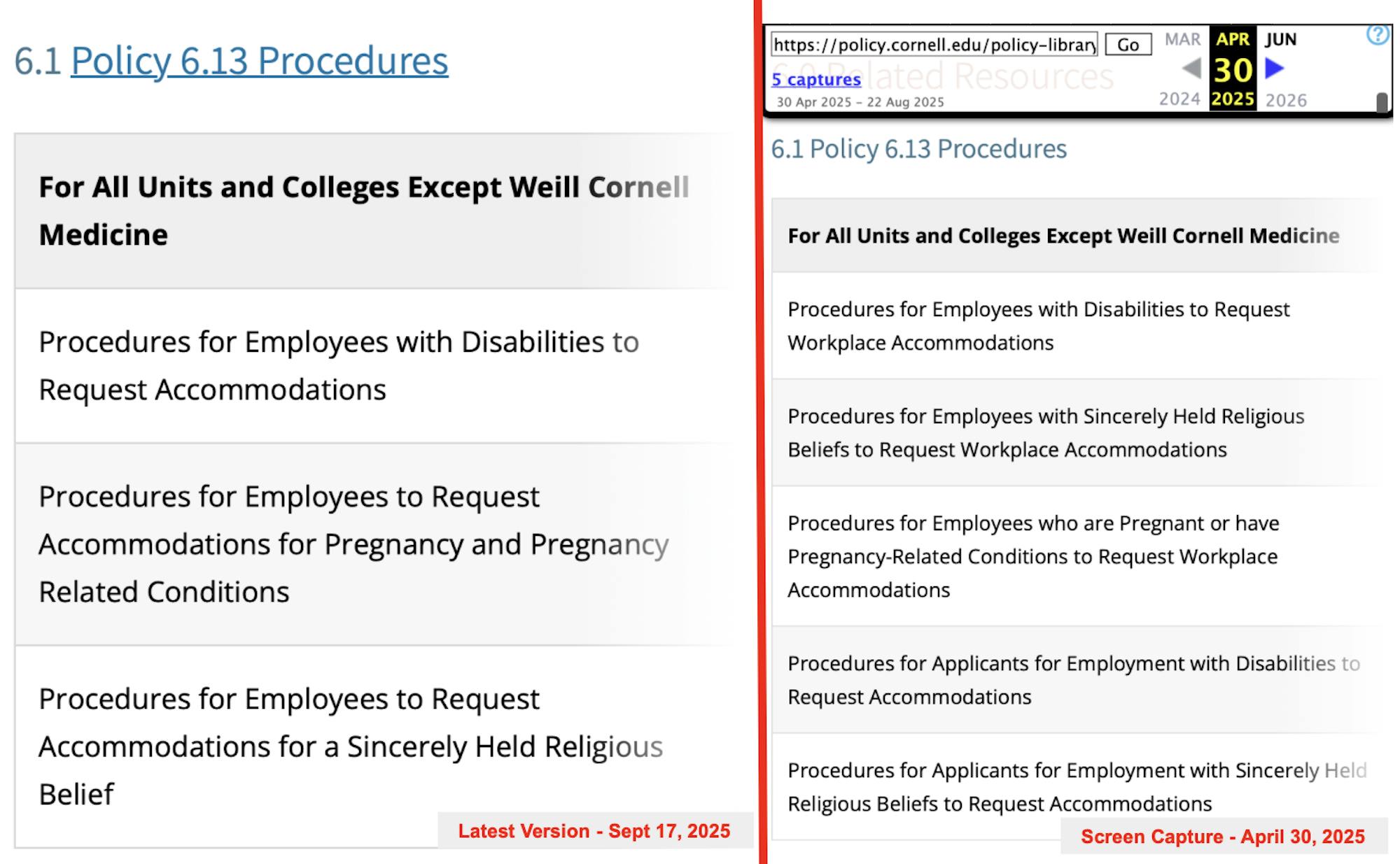
An analysis by The Sun found that the updated Policy 6.13 removed two policy procedures that described the ability for job applicants to request accommodation for disability or religious beliefs.
A subheading in Policy 6.13 titled “To Whom This Policy Applies” still includes a note that the policy applies to all applicants. However, nowhere else in the policy or its procedures are “applicants for employment” mentioned or given accommodations.
The updated Policy 6.4 added a policy procedure for reports of non-sexual misconduct-related discrimination or harassment conducted by a student. A similar procedure, but for cases specifically related to Title IX sexual misconduct, continues to stay in place.
According to the policy procedure, if an initial COCR assessment finds that investigation is required, a process of taking interim actions, gathering evidence and conducting a Formal or Informal resolution will take place concurrently to any Cornell University Police Department or Office of Student Conduct and Community Standards investigations. Policy 6.3 saw no fundamental changes except to update the title of the COCR. .
Following a broader trend, staff titles within the COCR office have changed. Terms such as “affirmative action,” “equal opportunity” and “equity” were replaced with language emphasizing compliance and civil rights, moving away from terminology that has been targeted in federal debates over diversity initiatives.
The updated staff titles include several alterations from their previous versions. The “Affirmative Action Program Consultant” is now “Compliance Consultant,” the “Equal Opportunity Program Director” is now “Director of Civil Rights Compliance,” the “Equity and Disability Specialist” became “Employee Accommodations Specialist” and the “Institutional Equity Investigator” role is now titled “Civil Rights Investigator.”
In a statement announcing the name change of COCR, administrators clarified that the office’s renaming will not affect students’ “rights and responsibilities” in the Student Code of Conduct. Instead, the office is now meant to be a central hub for all civil rights issues on campus.
“By centralizing all civil rights compliance work in one office, we hope to provide clarity to the Cornell community about where and how to report any incident of bias, discrimination or harassment,” said Katie King, Associate Vice President of COCR, to the Cornell Chronicle.

Sofia Principe is a member of the Class of 2026 in the College of Arts and Sciences. She is a senior writer for the News department and can be reached at sprincipe@cornellsun.com.

Sofia Loayza is in the College of Agriculture and Life Sciences. She is a senior writer for the News department and can be reached at sloayza@cornellsun.com.