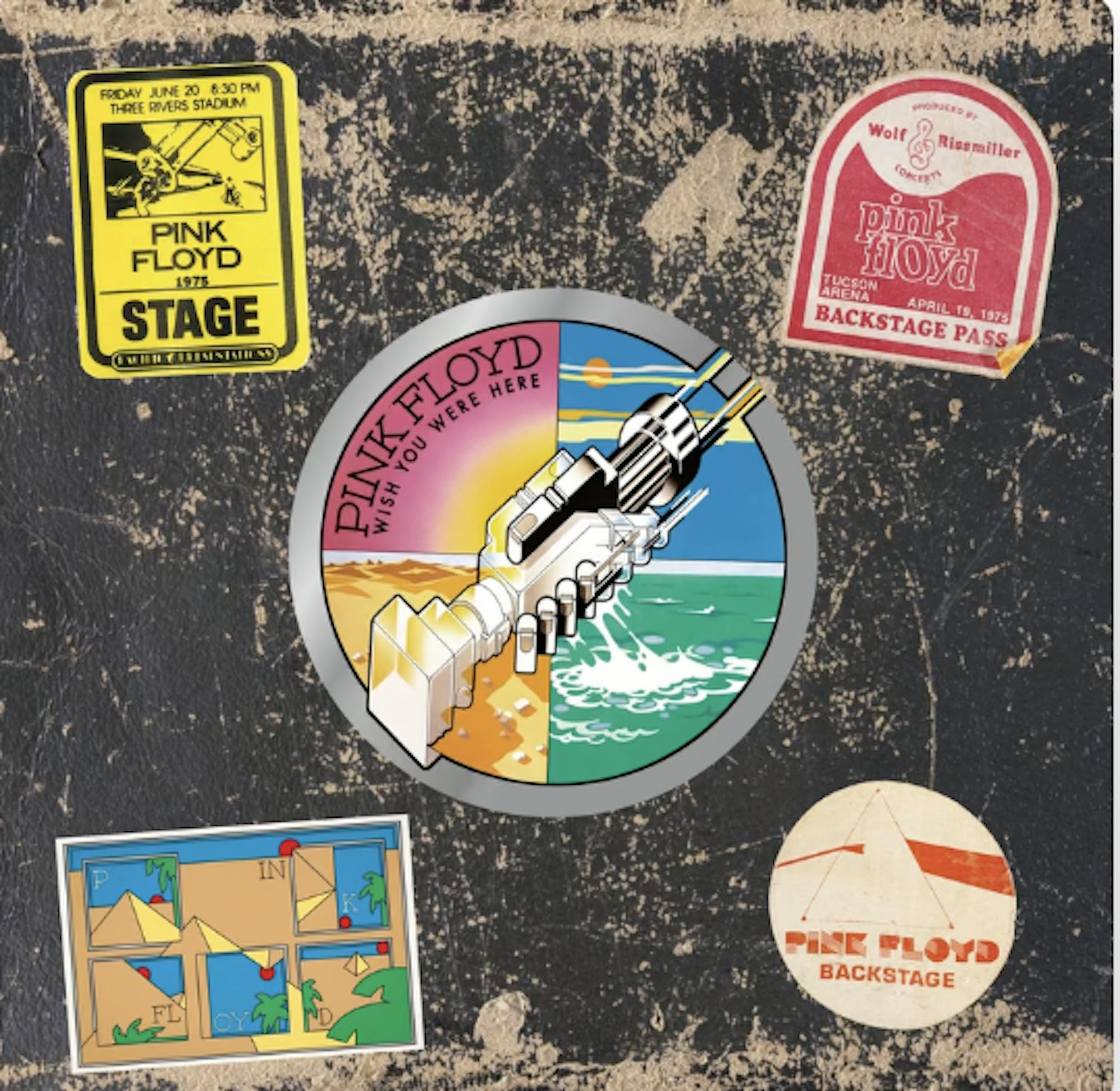
Think about your all-time favorite album. Maybe it's the one that calms you after a long day or the one that gets you up and dancing each time without fail. Maybe it's the album that you lip-sync to in the library as if it's a concert; you’ve memorized every lyric, tempo change, ad-lib and drum solo. Surely, you could picture the cover of this album instantly — it greets you on Spotify or Apple Music (or whichever other streaming service you frequent) with the comfort and reliability of an old friend. Now, imagine searching for this album and its cover is nowhere to be found. Instead, you are greeted by a stranger, a minimalistic replacement cover with a white text describing the original art atop a black shrink wrapped background. The familiar album cover you once knew and loved — that had supplemented your favorite listening experience — all of a sudden stripped away.
This horror became a reality that Pink Floyd fans, myself included, lived this past Tuesday, when the ’70s psychedelic rock band’s discography was abbreviated into uniformly dull album covers that compress their certifiably iconic cover art into mere descriptions. For example, their The Dark Side of the Moon art was reduced to text reading “A prism refracts light into the spectrum.” The publicity stunt was performed on various streaming platforms, their official website and their Instagram, with unified elements of black shrink wrap and ambiguity. Despite their initial dismay and my personal outrage, fans were certain this change was linked to a surprise celebrating a big occasion on the horizon — the 50th anniversary of the band's Wish You Were Here album on Friday, Sept. 12. Theories circulating on Reddit, discussion forums and Pink Floyd’s comment sections recalled the black shrink wrap that the original 1975 WYWH vinyl arrived in. It had obscured the album’s famous art of “Two men in suits shaking hands one man is on fire” (per the recent description) until after purchase of the record. The “hidden” cover was a trademark of the release of the album, reflecting WYWH’s themes of isolation and the fear of losing artistic integrity in the face of the money-hungry music industry.

Courtesy of Pink Floyd Music Limited, marketed and distributed by Sony Music Entertainment
By Friday, Pink Floyd had announced the impending release of Wish You Were Here 50, a new multi-disc anniversary album featuring the original album, unreleased alternate versions, demos and live recordings set to release in three months on Dec. 12. Regarded as one of the greatest albums of all time, Wish You Were Here explores both the absence of founding member Syd Barrett — who had left the band seven years earlier due to his deteriorating mental health and drug use — as well as Pink Floyd’s negative experience with their newfound fame post The Dark Side of the Moon (1973) stardom. With only five tracks spanning a total of 44 minutes (including two songs over 10 minutes each), the album does what many albums today can’t — it creates a cohesion in themes that make the songs melt together into a story. As a true concept album that invites listeners into the personal world of the band, their troubles losing a core member and their worries for the future of their music, it is a vulnerable and eerily beautiful story of absence, both personal and musical.
The album opens and closes with “Shine On You Crazy Diamond,” a nine-part tribute to former guitarist and vocalist Syd Barrett. Structurally, it is a masterpiece; it’s the type of song that consumes you with its textural variation including breathtaking guitar solos alongside synthesizers and drums. In parts 1-5 (the first 13 minutes of the album), more than eight minutes of pure instrumental genius pass before poetic lyrics regarding Barrett, the “crazy diamond,” begin. The lyrics demonstrate the tension the band faced when making the final decision to let go of Barrett due to his wearing substance abuse. They remember Barrett in a positive light, that, at the band's conception, he “shone like the Sun.” Parts 6-9 which close out the album continue their reverence for Barrett’s creative skills that had fueled the band: "yesterday's triumph.” Situated alongside a weeping guitar, the whole of “Shine on You Crazy Diamond” reflects the band’s interpersonal pressures that coincide with their professional and artistic struggles that are explored throughout the three middle tracks.
Track 2, “Welcome to the Machine,” transitions the album into contemplations on musical exploitation and creative captivity that confined the band as they grew in fame. The song likens the music industry and its ensuing consumerism to a machine, one which turns innocent aspiring musicians into professional cogs. Loaded with impactful lyrics characteristic of Pink Floyd’s style, the song is emphatically explicit in the lyrics: “What did you dream? It’s all right we told you what to dream.” “Have a Cigar” — which is my personal favorite — tells a similar satire of corporate greed from the perspective of a businessman. It’s famous lyric “Oh, by the way, which one’s Pink?” caricatures a record executive whose selfish ignorance illustrates how many business-people see the band not as artists, but a monetary product. While the song is comparatively more alive in its musical aspects, it has a concept cohesive to “Welcome to the Machine.” Namely, Pink Floyd’s sprawl into fame forced them to experience first-hand the money lust of the recording industry.
The eponymous track, “Wish You Were Here” links both the personal and professional aspects of the album, acting as an elegy for Barrett as well as the band member’s younger selves that were unaware of the crippling rapacity their fame would invoke. The lyrics question what the band had to leave behind — willingly or not — as they grew into their stardom.
Fifty years later, the poignant story presented throughout Wish You Were Here is more relevant than ever, as profiteers continue to see music not for its creativity but for its possibility as a money-making scheme. When will this time-old tale of musical exploitation end? Will it be the same in another 50 years — or worse?
Hazel Tjaden is a sophomore in the College of Arts and Sciences. She can be reached at hlt43@cornell.edu.

Hazel Tjaden is a member of the Class of 2028 in the College of Arts and Sciences. She is an assistant arts editor for the 144th Editorial Board and can be reached at htjaden@cornellsun.com.