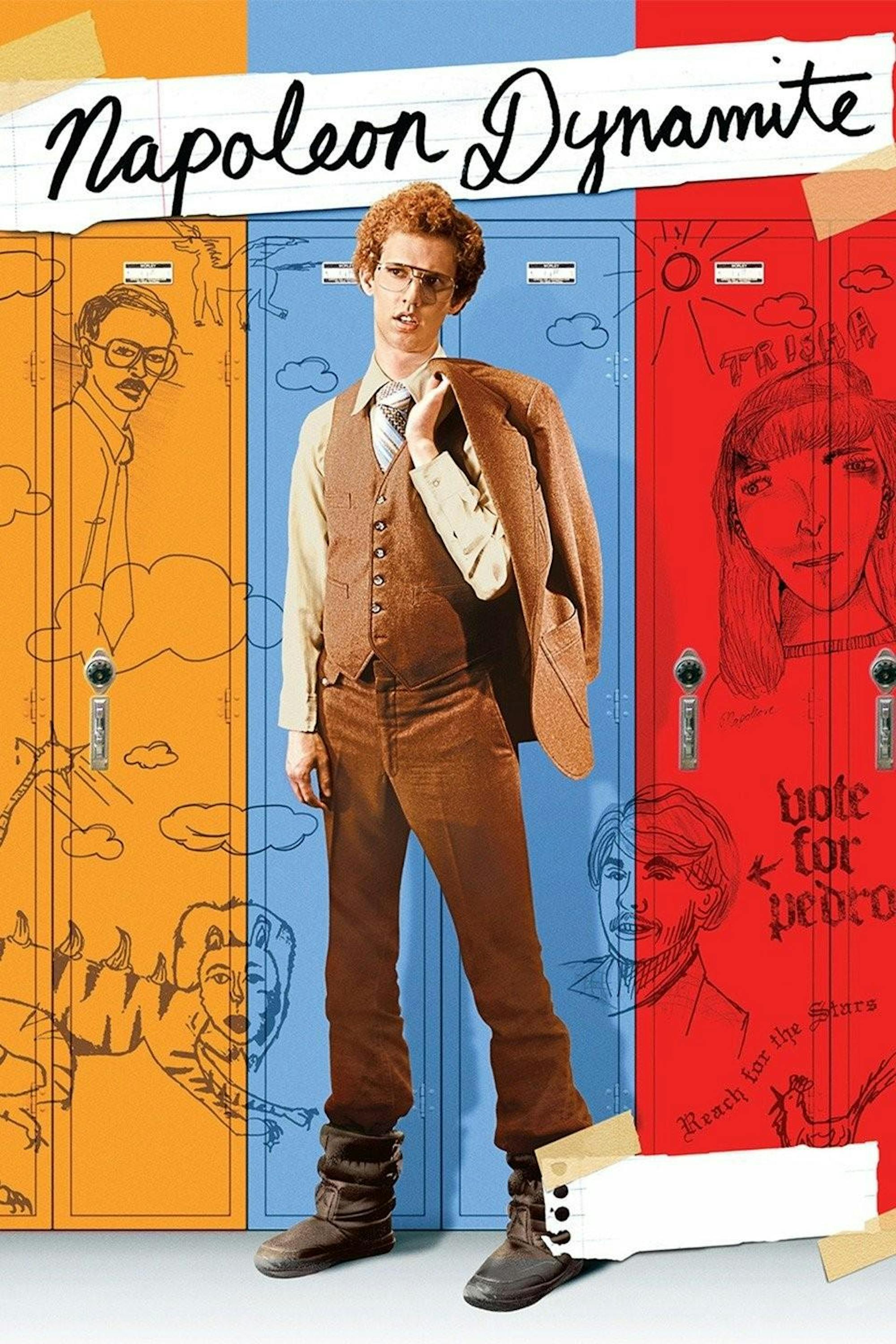
A lot has gone on in 2025. It’s been a while since we took a breath and enjoyed ourselves — since the headlines haven’t been flooded with words we don't really want to read. In the midst of the noise, it seems harder and harder to keep account of the positives. If this reality leaves you in dire need of a smile, I have just the excuse for celebration. This year, Napoleon Dynamite turns 21! A cult classic of the early 2000s “Indiewood” era, the 2004 independent film follows an awkward small-town Idaho teen, Napoleon, as he nurtures new friendships despite bullying and alienation at Preston High. Yet, the storyline is hardly the popular appeal of Napoleon Dynamite; the film’s deadpan humor and absurd scenes have ensured that now, even two decades later, the movie’s references are still iconic. They resurface every Halloween alongside a surge of unruly ginger curls, moonboots and “Vote for Pedro” tees.
Early on in my tween years, I was indoctrinated into the film’s mythology of ligers, nunchucks, Tina the Llama and pocket-tots; Napoleon Dynamite was an iron-clad reference in my household. This summer, I revisited the film for a second time because I yearned for its stupid comedy, which I thought it delivered best. Almost a decade since my first encounter, I found the indie-comedy much denser than before. What I remembered as a ridiculous, random watch with hilariously senseless characters was now an endearing, slow-moving glimpse at the beauty of authenticity — despite how loser-ish its package may appear. The film, when seen with older eyes, became one that invites audiences to dwell in quirks — be those in the characters or the odd out-of-the-blue scenarios they find themselves in — and let the weirdness sit. Despite being an overall comedic blast and worthy of its reputation as an absurdly hilarious movie, Napoleon Dynamite also has a more intimate, endearing and almost sentimental side that lies in its plotlessness and oddball characters, causing it to more closely resemble a slice of life, quirky as it may be.
In preparing a synopsis for this movie, I was initially confident in my ability to summarize. Quickly, I was dumbfounded. The film, though replete in iconic and quotable scenes, doesn’t have much of an interesting or clear plot. At a basic level, the film is about a nerdy, friendless high school boy (Napoleon) finding a friend (Pedro) and sticking by his side, ultimately helping defeat the school bullies. In practice, however, a majority of the 82-minute watch is curious scenes that do not lead to this storytelling end. Sometimes they are loosely attached vignettes of Napoleon’s family members, and other times they are Napoleon doing something — to put it bluntly — weird and unrelated.
One of my favorite of these moments is when he angrily feeds his llama, Tina, some casserole, stating in his characteristic flat, yet also constantly perturbed, voice “Tina, you fat lard. Come get some dinner.” It’s like the audience is a fly on the wall, watching every incidental event that takes place in Preston, Idaho. If the film wasn’t so situationally funny, it could easily feel boring; it would be no different from placing a camera in front of someone and letting it roll as they completed their monotonous, daily tasks.
This absence of a traceable storyline is a direct contradiction to the notion that each scene of a movie must meaningfully correspond to the overarching theme or plot. Instead, the unrootedness in plot reflects a cinematized scheme that is more similar to real life, where not everything can be part of our romanticized “plot.” The randomness that is displayed throughout these scenes in Napoleon Dynamite are disorienting at first, but point to the idea that the film, like life, isn’t purely plot-driven. These disorganized vignettes also reflect the strangeness of the titular character, one whom we as audience members are made to resonate with when we become confused watching him draw mystical creatures or pull leftover tater tots straight out of his cargo-pant pockets during class. We, like Napoleon, start to feel out of place. Yet, we also feel right at home as we watch his slice of life oddly unfold.
Characters like Napoleon and the rest of his eccentric group feel familiar and dear in spite of their idiosyncrasies. They are portrayed as oddball characters that are ostracized by their peers, however, simultaneously, their weirdness is what makes them seem more real; everyone is or has known someone like Napoleon Dynamite. The Napoleon Dynamites of the world have their quirks and own them authentically. Napoleon knows he is not like everyone else, but in very few instances does he ever try to change and be what he is not. In the climactic scene of the movie, he dances like nobody’s watching in front of the whole school to help his friend Pedro win class presidency. Though this may appear like a shy nerd’s courageous leap over a perilous confidence hurdle, Napoleon seems so flippantly indifferent in all his pursuits that it is completely in-character for him to perform in this manner at any point in the movie. I mean, a guy who comfortably plays tetherball by himself during gym class probably won’t even sweat dancing in front of the school. This unchanging honor to who he is allows us to assume that Napoleon has an incredibly strong self-image. Maybe Napoleon Dynamite is not a movie about some weird underdog gaining friendship and confidence, but a celebration of the bluntness of being yourself, despite how strangely others may perceive you.
An amalgamation of abnormal yet lifelike scenes and characters, Napoleon Dynamite is an honest film with an underlying comfort to it. It inspires us to free our inner Napoleons and throw away any self-destructive strive for conventionality. After all, isn’t there a little Napoleon Dynamite in all of us itching to yell “Gosh!” and break into a killer dance routine?
Hazel Tjaden is a sophomore in the College of Arts and Sciences. She can be reached at hlt43@cornell.edu.

Hazel Tjaden is a member of the Class of 2028 in the College of Arts and Sciences. She is an assistant arts editor for the 144th Editorial Board and can be reached at htjaden@cornellsun.com.